 By Tsuky
Apple has finally put a date on the arrival of Apple Intelligence in mainland China. The company confirmed the plan in an October 31 announcement, and its first iOS 27.3 developer beta was distributed on November 3 ahead of the November 4 testing window for Chinese users.
The public release is scheduled for December, although Apple has not specified a day. The initial rollout focuses on supported iPhones, leaving iPads and Macs outside the launch until additional approvals are obtained.
The arrangement is especially interesting because Apple's AI features in China are not an exact reproduction of the services offered elsewhere. The company is retaining its own generative models for Apple Intelligence while integrating Alibaba's Qwen into selected experiences that require additional knowledge, understanding or content generation.
That distinction is critical. Apple is not announcing that Alibaba will process every Apple Intelligence interaction. Qwen is an optional external assistant within particular workflows, and the boundaries of that integration will matter as the service moves from developer testing to widespread use.
Where Qwen fits into the Apple experience
Siri is the most obvious entry point. Chinese users will be able to send certain requests to Qwen for more detailed answers, including questions involving photographs, PDF files and presentations. Apple says Qwen can be accessed through an existing account or through Sign in with Apple.
Writing Tools will offer familiar rewriting, proofreading and summarization capabilities. With Qwen integration, users can also ask the system to generate original content from a prompt. This extends the writing interface beyond editing existing material.
Visual Intelligence is another part of the partnership. Users can identify objects and locations with their iPhone camera, then ask additional questions involving visual content or documents.
The result is an AI arrangement that combines Apple's own system-level tools with a Chinese model provider. It resembles the broader approach Apple has taken to third-party assistants in other regions, but the local partner and regulatory conditions are different.
What Chinese iPhone users will actually receive
Live Translation is part of the initial feature set. Apple plans to support translation in Messages, FaceTime and Phone, as well as face-to-face translation using supported AirPods paired with a compatible iPhone.
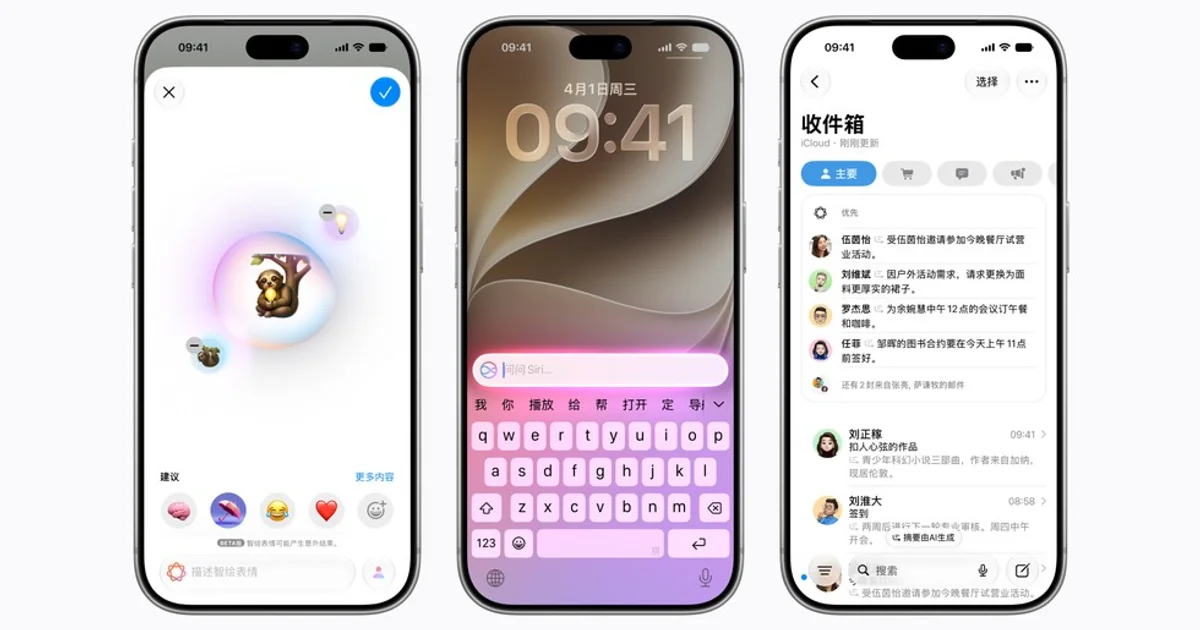
Photos is gaining Clean Up for removing unwanted objects, natural-language searches and the ability to create memory movies from descriptions. Genmoji is also included, allowing users to generate personalized emoji.
Mail gains message summaries, priority sorting and suggested replies. The notification system will highlight priority alerts, summarize longer messages and provide Reduce Interruptions Focus to filter less urgent notifications.
Audio handling receives its own additions. Notes will offer summaries of recorded audio transcriptions, while the Phone app will support summaries of transcribed calls.
These capabilities are not entirely new to the wider Apple ecosystem. Their significance comes from their regional availability. Chinese iPhone owners have had to wait while similar features became part of the standard Apple software experience in other supported markets.
For Apple, the release is also an opportunity to strengthen the software offering around its newer iPhone hardware in a competitive smartphone market. That business implication is clear, although Apple has not presented a measurable sales forecast attributable to this AI launch.
The Siri AI limitation is substantial
Apple has explicitly excluded Siri AI and other next-generation Apple Intelligence features announced at WWDC 2026 from this Chinese release.
The Siri experience included with iOS 27.3 is still improving. Users can type to Siri, make less rigidly structured requests and benefit from more natural conversational continuity. Qwen will provide additional responses for selected prompts.
However, this should not be confused with the separate Siri AI assistant introduced on supported markets. Integrating a chatbot into Siri does not automatically bring the broader next-generation assistant and its more extensive capabilities to China.
Image Playground is also absent from the initial regional rollout. Genmoji and Qwen-assisted content creation are included, but users will not receive the full collection of Apple's generative image tools.
No confirmed Chinese release date exists for these missing capabilities. December is the target for the initial public Apple Intelligence deployment, not an announced deadline for Siri AI.
Compatibility and language requirements
Apple says the first release supports the iPhone 15 Pro and Pro Max, the iPhone 16 family and later generations, alongside the iPhone Air and iPhone Duo. Individual features may depend on device capabilities and their own compatibility restrictions.
Users must configure both the iPhone and Siri languages to English or Simplified Chinese for this rollout. This is a specific requirement of the Chinese implementation rather than evidence of unrestricted multilingual availability.
The initial release is limited to iPhones. Macs, iPads and other Apple platforms must wait until the company receives the necessary approvals for their respective deployments.
Developer beta access should not be mistaken for a finished consumer release. Apple is using the November testing period ahead of a planned December rollout, and the final availability remains subject to the company's release process.
A regional AI partnership with wider implications
The Alibaba agreement illustrates how difficult it can be to maintain a consistent global AI product when local regulations affect which services and model providers can operate.
Apple has chosen to preserve the familiar iOS experience while introducing Qwen through existing Siri, Writing Tools and Visual Intelligence interfaces. Users should not have to switch to a separate application to access every capability offered by the partnership.
Alibaba has stated that users can decide whether to enable Qwen integration and control what information they share. It also says user requests and generated responses will not be used for model training. Those are provider commitments, rather than independently established findings about every part of the processing pipeline.
There are still meaningful questions about how information is routed between Apple services, on-device processing and Alibaba's systems. The companies have announced the principal integration points, but that is not the same as providing an exhaustive public technical audit of the implementation.
The staged launch also prevents Apple from delivering every AI feature at once. Chinese iPhone users are scheduled to gain Apple's earlier intelligence tools and selected Qwen capabilities first. Siri AI, Image Playground and the remaining newer functions have no announced regional launch dates.
The next confirmed milestone is the public release planned for December 2026 with iOS 27.3. Beyond the iPhone, expansion remains dependent on further regulatory approvals.