
 By Adri
A cloud service can store data in Europe while remaining dependent on foreign infrastructure providers, software platforms and hardware suppliers. That distinction has become increasingly important as AI workloads require large computing clusters and specialized accelerators.
Bull and Schwarz Digits want to address part of this dependency by combining capabilities that usually belong to different layers of the technology industry.
Bull designs and manufactures high-performance computing systems, including supercomputers and AI servers. Schwarz Digits operates STACKIT, a European cloud platform serving businesses and public-sector organizations.
Their November 3 memorandum establishes a framework for developing a common AI and cloud infrastructure ecosystem. It is an agreement to pursue cooperation, not a completed product launch or a confirmed purchase order covering a specified amount of computing equipment.
French manufacturing forms the physical foundation
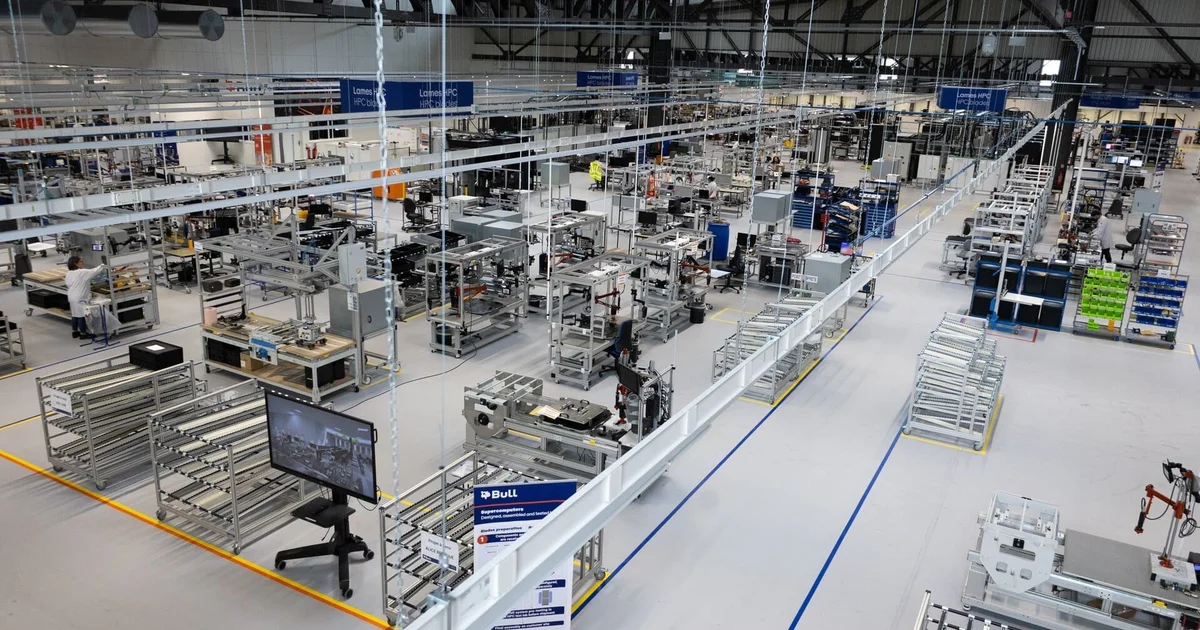
Bull's manufacturing facility in Angers is central to the proposed partnership. The French company intends to use its European production capacity to manufacture AI computing systems designed for deployment at rack scale.
The facility was expanded in October 2026, doubling its supercomputer production capacity. Bull has been investing in manufacturing infrastructure as demand increases for AI systems that require substantial amounts of processing power, cooling and networking.
The collaboration would draw on Bull's experience in large-scale high-performance computing projects and direct liquid cooling.
Liquid cooling is particularly relevant to modern AI systems because densely packed accelerators can dissipate considerable amounts of heat. Delivering coolant directly to hot components can help manage those thermal loads more effectively than relying exclusively on air circulation.
Bull and Schwarz Digits describe energy efficiency as one of their design priorities. However, they have not published performance measurements for the future joint platform.
The announcement also leaves important hardware questions unanswered. No particular processor, GPU architecture or accelerator supplier has been confirmed for the common systems.
European manufacturing does not necessarily imply that every semiconductor, memory module or network component will originate in Europe.
The initial agreement makes no claim that the partnership has established an entirely European semiconductor supply chain.
STACKIT provides the cloud environment
Schwarz Digits is the IT and digital division of Germany's Schwarz Group, which operates major retail businesses including Lidl and Kaufland.
Its STACKIT business already provides cloud computing and storage services to organizations seeking infrastructure operated under European jurisdiction.
Under the new partnership, STACKIT would provide access to computing infrastructure developed with Bull, making advanced resources available to companies and public authorities without requiring them to build equivalent systems themselves.
The partners emphasize European governance over data, infrastructure and operations. That positioning is especially relevant for regulated sectors, where customers must understand who operates their systems and which legal requirements apply.
Yet data residency and full technological independence are not interchangeable concepts.
A European cloud provider can still depend on international hardware, proprietary software and global supply chains. Physical server location alone does not establish complete sovereignty over an entire computing environment.
The distinction matters for organizations evaluating long-term risks, particularly those involving privileged access, software maintenance and the availability of replacement components.
STACKIT is an existing commercial cloud platform. The new infrastructure planned with Bull is not being presented as a fully deployed service already available to every customer.
BullSequana AI could become part of the STACKIT Marketplace
The agreement extends beyond hardware. Bull and Schwarz Digits intend to make the BullSequana AI platform available through the STACKIT Marketplace.
This would give customers access to AI software capabilities alongside the underlying cloud resources.
The companies describe the intended environment as open and modular, allowing organizations to develop, deploy and operate AI applications while retaining more control over their infrastructure choices.
Such integration could reduce the operational complexity associated with combining high-performance computing hardware, AI software and managed cloud services.
However, specific model compatibility, supported development frameworks and deployment options have not been detailed.
The announcement also does not provide pricing, guaranteed GPU availability or service-level agreements for the proposed common offering.
Until those details are published, customers cannot independently compare the commercial and technical capabilities of the future service against established cloud alternatives.
Open Compute Project standards enter the roadmap
Bull and Schwarz Digits plan to co-design server systems based on Open Compute Project standards.
OCP promotes openly developed hardware specifications for data centers, including approaches to servers, racks and supporting infrastructure.
The intention is to combine Bull's engineering and manufacturing experience with Schwarz Digits' operational knowledge of cloud environments.
Open specifications can improve interoperability and reduce dependence on certain proprietary hardware designs. They do not automatically eliminate dependence on individual processor vendors, accelerator ecosystems or software platforms.
The companies have not specified which OCP standards will form the basis of their initial server designs.
Their broader roadmap also identifies potential cooperation on large-scale HPC projects, SAP-related integration and quantum computing.
Those areas remain prospective. They should not be confused with completed joint products or services already launched under the agreement.
Why sovereignty is becoming an infrastructure requirement
European organizations increasingly need to assess where their data is processed, which entities control their computing infrastructure and how critical digital services can be maintained during geopolitical or commercial disruptions.
These considerations are especially important for government agencies, healthcare organizations, financial institutions and companies operating in strategic sectors.
Bull and Schwarz Digits are positioning their partnership around those concerns rather than competing solely on raw computing performance.
The market they hope to address is already served by global cloud providers, including Amazon Web Services, Microsoft Azure and Google Cloud.
Those companies operate extensive ecosystems of managed services and AI development tools. Matching their breadth requires far more than installing comparable computing hardware in European facilities.
The proposed Bull–STACKIT combination could offer customers an additional option, particularly when jurisdiction and operational control are central procurement requirements.
Its ultimate competitiveness will depend on software maturity, accelerator availability, performance, operating costs and support capabilities.
None of those factors can yet be assessed through independent benchmarks of the proposed joint infrastructure.
The agreement follows major investments by both partners
Bull's expansion in Angers reflects a wider increase in European demand for supercomputing and AI infrastructure.
The company was acquired by the French state in March 2026, reinforcing its strategic position within France's computing industry.
Schwarz Digits has been expanding its cloud and AI activities through infrastructure development and partnerships.
Reuters reports that Schwarz Group is leading a C$7 billion funding round for Canadian AI developer Cohere. The company is also expanding its European presence through announced transactions involving Aleph Alpha in Germany and Aisle in the Czech Republic.
These developments provide commercial context for the new partnership, but they should not be interpreted as direct funding commitments to the Bull–Schwarz Digits project.
Neither partner has disclosed a dedicated investment amount for the cooperation announced in Berlin.
There is also no confirmed schedule for commercial service availability, no number of servers committed to production and no specified electrical capacity for the joint infrastructure.
A credible industrial combination, with major details still missing
The partnership has a clear technical logic. Bull brings high-performance computing design, industrial production and cooling expertise. Schwarz Digits contributes an existing cloud service and experience operating infrastructure for European organizations.
Together, they could provide a more integrated route to AI computing resources under European jurisdiction.
The key challenge will be turning that proposed architecture into an operational service with competitive performance, predictable pricing and reliable software support.
Enterprises will also need details about hardware configurations, access controls, data handling, deployment locations and service commitments before evaluating the offering for production workloads.
The memorandum does not establish that those capabilities have already been delivered.
Bull and Schwarz Digits have announced a direction for industrial cooperation. The next milestones will be concrete server specifications, platform integration, commercial agreements and deployment schedules.
As of November 3, 2026, the financial terms of the agreement have not been disclosed.