
 By Camille
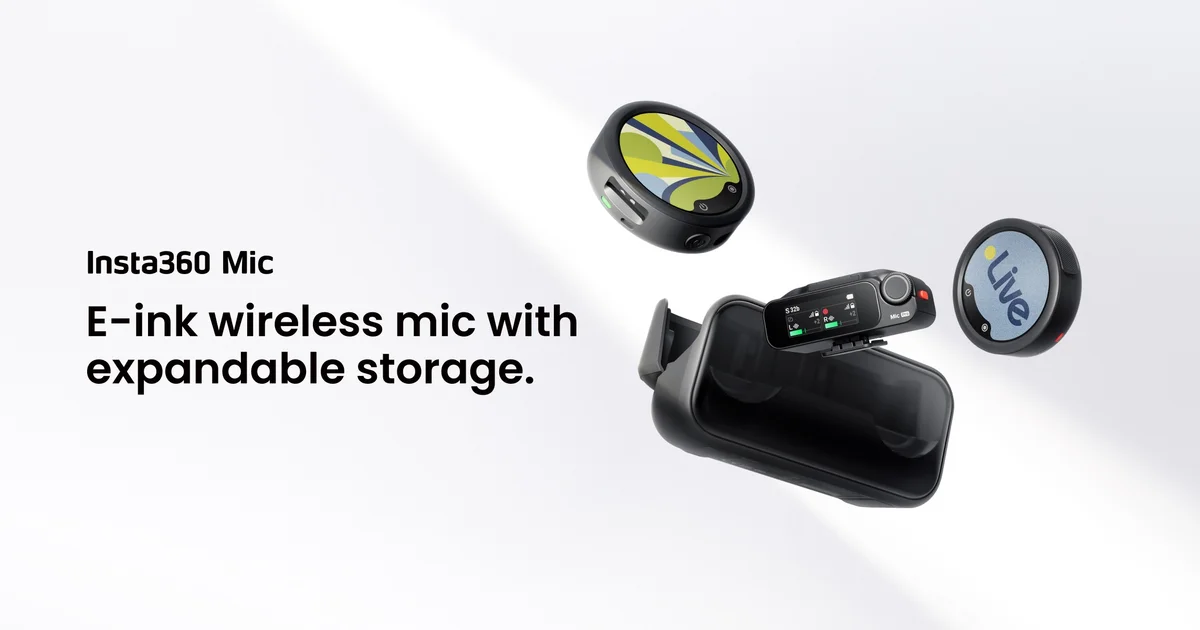
Compact wireless microphones have made video production considerably easier.
A small transmitter clipped to someone's clothing can capture speech without running an audio cable back to a camera or smartphone.
However, affordable systems often come with limitations involving audio levels, backup recording, multiple speakers and battery life.
With the new Mic, Insta360 aims to offer several advanced features at a lower price than its flagship system.
The product has been available since October 22, 2026, and sits between the entry-level Mic Air and the more capable Mic Pro.
The company has not simply removed accessories to make it cheaper.
It has changed both the storage architecture and the physical microphone configuration, creating trade-offs that matter during real shoots.
A customizable E-Ink display on every transmitter
The most immediately recognizable feature of Insta360 Mic is its circular display.
Each transmitter includes a 1.22-inch color E-Ink screen with a reported resolution of 240 × 208 pixels.
Users can replace the displayed graphic through the Insta360 application.
It can show a personal logo, a channel name, an illustration or an emoji.
The feature can also help identify speakers during filmed interviews or podcasts.
When a microphone remains visible on someone's clothing, it becomes part of the shot.
A customizable display turns that technical accessory into a form of visual identification.
E-Ink differs from conventional LCD and OLED technologies in its ability to retain a static image with limited power consumption.
That characteristic makes sense for displaying logos that rarely change.
However, the more expensive Mic Pro already offers a similar customizable screen.
The new Mic makes the feature available in a lower-priced product.
microSD replaces the Mic Pro's fixed internal storage
The most consequential practical difference concerns recording storage.
The Mic Pro includes 32GB of built-in memory.
The standard Mic replaces that fixed storage with a microSD card slot.
Users must therefore provide their own card if they want to record audio directly on the transmitter.
This offers flexibility because storage capacity can be selected and the card can be removed.
It also introduces an extra requirement.
A suitable card must be purchased, inserted and checked before recording begins.
Without a card, the microphone can still transmit audio through its receiver or a compatible Bluetooth connection.
However, it cannot provide the same independent local backup recording.
That distinction matters for videographers who want a safety copy of every take.
Why local recording can save an interview
Wireless audio depends on a radio connection between a transmitter and a receiver.
In crowded environments, interference, obstacles and connection problems can disrupt the received signal.
If a camera records only that signal, transmission problems may damage an otherwise usable take.
Local recording provides an additional copy.
Even when the wireless link briefly drops, the audio saved on the transmitter may remain intact.
That does not guarantee every recording can be recovered.
A defective memory card, poor microphone placement or acoustic overload can still ruin a take.
However, maintaining separate recording paths reduces dependence on one wireless connection.
For an interview that cannot easily be repeated, this may be more valuable than the device's visual customization.
32-bit float recording makes postproduction more flexible
With a microSD card inserted, Insta360 Mic can record internally using 32-bit floating-point audio.
This format provides a particularly wide range for representing digital audio levels.
It makes certain gain adjustments easier during editing.
Audio recorded at a low digital level can often be raised without encountering the same representation limits as some fixed-point formats.
Large level changes can also be easier to handle when the recording hardware properly supports the format.
However, 32-bit float does not make the microphone physically impossible to overload.
If the capsule or an analog stage distorts before conversion, the recording format cannot reconstruct the original undamaged signal.
Microphone placement and recording technique therefore remain important.
Insta360 also specifies that 32-bit float applies to internal recording.
It should not be assumed that every Bluetooth connection or receiver output delivers 32-bit float audio.
One microphone capsule instead of the Mic Pro's three
The lower price comes with an acoustic compromise.
The Mic Pro uses three microphone capsules and provides multiple pickup configurations.
The standard Mic relies on a single omnidirectional microphone.
An omnidirectional capsule picks up sound arriving from several directions around it.
That makes it convenient for recording speech when the transmitter is clipped to clothing.
However, it can also pick up more surrounding noise than a properly positioned directional setup.
Digital noise reduction may suppress selected sounds, but it does not physically change the capsule's pickup pattern.
The Mic Pro therefore retains a potential advantage for users who need different recording patterns.
The standard Mic appears more closely focused on situations where the transmitter remains near the speaker's mouth.
Dedicated AI processing for noise reduction
Insta360 includes a specialized audio-processing chip for noise reduction.
The company says its AI model is designed to separate speech from background noise more effectively.
This could be useful for recordings on busy streets, at events or during travel.
However, noise-reduction algorithms must balance several competing goals.
Aggressive processing can change vocal tone, introduce artifacts or make some syllables sound unnatural.
Insta360 claims to have reduced these unwanted effects.
The available sources do not provide independent comparative recordings establishing the improvement.
The microphone also offers Auto and Dynamic automatic gain modes.
One focuses on controlling levels, while the other aims to smooth changes in loudness.
Three voice tone presets are available: Regular, Rich and Bright.
These options allow users to adjust the perceived sound, but cannot replace good recording technique.
Up to four speakers through one receiver
Insta360 Mic supports up to four transmitters connected to one compatible receiver.
This expands its potential use beyond conventional two-person interviews.
It can support group discussions, collaborative videos and certain podcast setups.
The manufacturer also provides cross-generation compatibility.
Mic and Mic Pro transmitters can be combined using a suitable receiver.
That is useful for creators who already own Insta360 equipment.
They may be able to add microphones without replacing their entire system.
However, the number of connected transmitters should not be confused with the number of independent output channels.
In some configurations, multiple microphones are mixed into shared channels.
The official documentation states that four-channel output requires selected Sony cameras and an optional official adapter.
Creators who need a completely isolated track for each participant should confirm their equipment's capabilities before recording.
Sending synchronized audio to multiple cameras
Insta360 also provides a feature aimed at multi-camera production.
Two transmitters can distribute synchronized audio to multiple compatible receivers.
The company advertises support for up to four receivers in this arrangement.
This can be useful when one scene is recorded from several angles.
Each camera can receive a common audio reference, simplifying some editing and synchronization tasks.
The workflow can reduce manual preparation of audio files from multiple cameras.
However, it does not automatically eliminate every synchronization problem.
Actual behavior depends on the connected devices and recording configuration.
Local backup recording remains a valuable additional safeguard.
Direct Connect can remove the need for a receiver
The new microphone supports Insta360 Direct Connect.
This lets transmitters pair directly with selected Insta360 cameras through Bluetooth.
The announced compatibility list includes X6, X5, Luna Ultra, Luna Pro, GO Ultra and Ace Pro 2.
Compatible X6 and Luna models can use two transmitters simultaneously without an external receiver.
Insta360 advertises 48kHz audio in this mode.
The practical appeal is straightforward: fewer accessories need to be attached to the camera.
For action-camera users, avoiding an additional receiver can also simplify a compact filming setup.
However, Direct Connect is limited to explicitly supported devices.
It does not mean that every Bluetooth camera can receive audio with the same functionality.
Smartphone compatibility has an important limitation
The Mic can also work with smartphones and conventional cameras.
The receiver supports compatible devices through connections including USB-C and a 3.5mm audio cable.
Receiver-free operation depends more heavily on software compatibility.
Insta360 explains that direct Bluetooth pairing with a phone does not necessarily work with its native camera application.
Compatible third-party applications may be required.
This is worth checking before purchasing.
A microphone can be successfully paired with a smartphone without being selectable as an audio source in every video application.
Bluetooth availability alone does not establish universal support.
13 hours per transmitter and 34 hours with the charging case
Battery life is another selling point.
Insta360 advertises up to 13 hours from a transmitter on one charge.
The charging case extends the claimed combined runtime to 34 hours.
Those values exceed the 10 hours per transmitter advertised for the Mic Pro.
However, they are manufacturer specifications rather than independent measurements under identical conditions.
Actual endurance will depend on local recording, audio processing, wireless connections and other enabled features.
The difference may still appeal to creators who record for long periods without reliable access to charging.
The case also provides storage and charging for the system's components.
That can make it easier to keep transmitters and accessories together while traveling.
The complete $249.99 kit costs $80 less than Mic Pro
The product's pricing makes its positioning relatively clear.
In the United States, a single Mic transmitter costs $79.99.
A kit containing one transmitter and one receiver costs $139.99.
The two-transmitter kit, including a receiver and charging case, costs $249.99.
The comparable Mic Pro kit is listed at $329.99.
The difference is therefore $80.
Choosing between them depends on the features a particular creator needs.
For face-to-camera videos, interviews and social media production, the standard Mic already offers several useful tools.
For productions requiring adjustable pickup patterns and fixed built-in storage, Mic Pro retains advantages.
These are US prices.
Exact French retail prices should be checked with local distributors.
The most important improvements are practical rather than visual
The E-Ink display immediately attracts attention.
It allows users to customize the microphone's appearance, which can be valuable when the transmitter remains visible on camera.
However, the more consequential features concern recording reliability.
microSD backup, 32-bit float recording, multi-camera support and compatibility across Insta360 microphone generations can directly affect how a shoot is organized.
The compromises are equally important, especially the single omnidirectional capsule and the absence of fixed internal storage.
Moving to microSD offers expandable capacity but adds another item that must be prepared and managed.
AI-powered noise reduction will also need to prove itself through real recordings rather than promotional demonstrations.
Insta360 Mic is not a direct replacement for Mic Pro. It offers a different allocation of features for creators who want recording safeguards and a lower equipment cost.
At $249.99 for the two-transmitter kit, its lasting value will depend less on the customizable display than on reliable recordings, stable connections and battery performance during actual production.