
 By Adri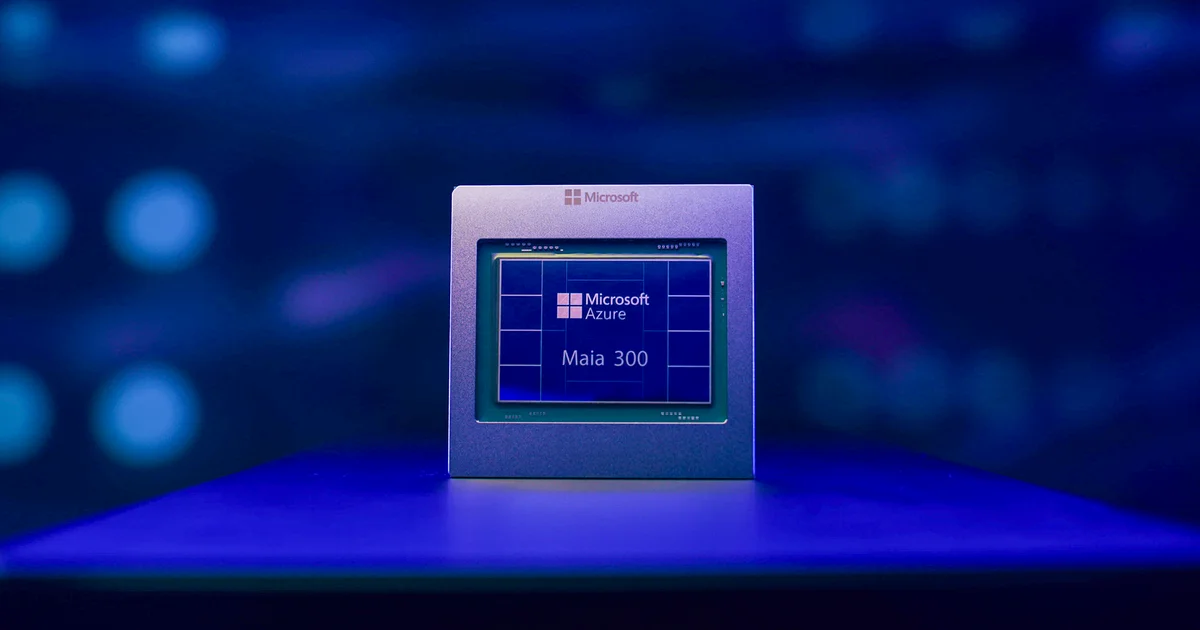
A company selling AI services has two ways to improve its margins. It can charge more for those services, or it can reduce what each interaction costs to deliver. Microsoft is pursuing the second option in silicon.
Azure Maia 300, introduced on October 12, 2026, is the newest generation of Microsoft's custom AI acceleration program. Its intended role is to become a primary inference platform across the company's services. Production deployments are scheduled to begin in 2027, alongside a planned expansion of Maia infrastructure to a multi-gigawatt scale.
That distinction matters. Microsoft has announced the design and deployment strategy, but Maia 300 is not yet running the promised fleet of production workloads. Today's operational experience comes from Maia 200, its predecessor. The new system still has to demonstrate its advantages under real deployment conditions.
Why Microsoft is optimizing for inference
The most revealing feature of Maia 300 is not its manufacturing node. It is the workload Microsoft chose to prioritize.
Inference covers the work an AI system performs when it responds to requests. It includes generating answers, handling extended conversations, interpreting large contexts and executing the sequence of operations required by software agents. For a company running Copilot and other large-scale AI services, those activities generate recurring costs that continue long after a model has been trained.
The hardware requirements can be different from the demands of training. Sustained token generation needs high memory bandwidth, efficient data movement and infrastructure capable of handling many concurrent sessions. More theoretical compute does not necessarily translate into proportionally more useful answers.
Microsoft has designed Maia 300 around that reality. The company describes an inference-first system that coordinates processing, memory and networking, rather than concentrating exclusively on the headline speed of a standalone accelerator.
Inside the Maia 300 architecture
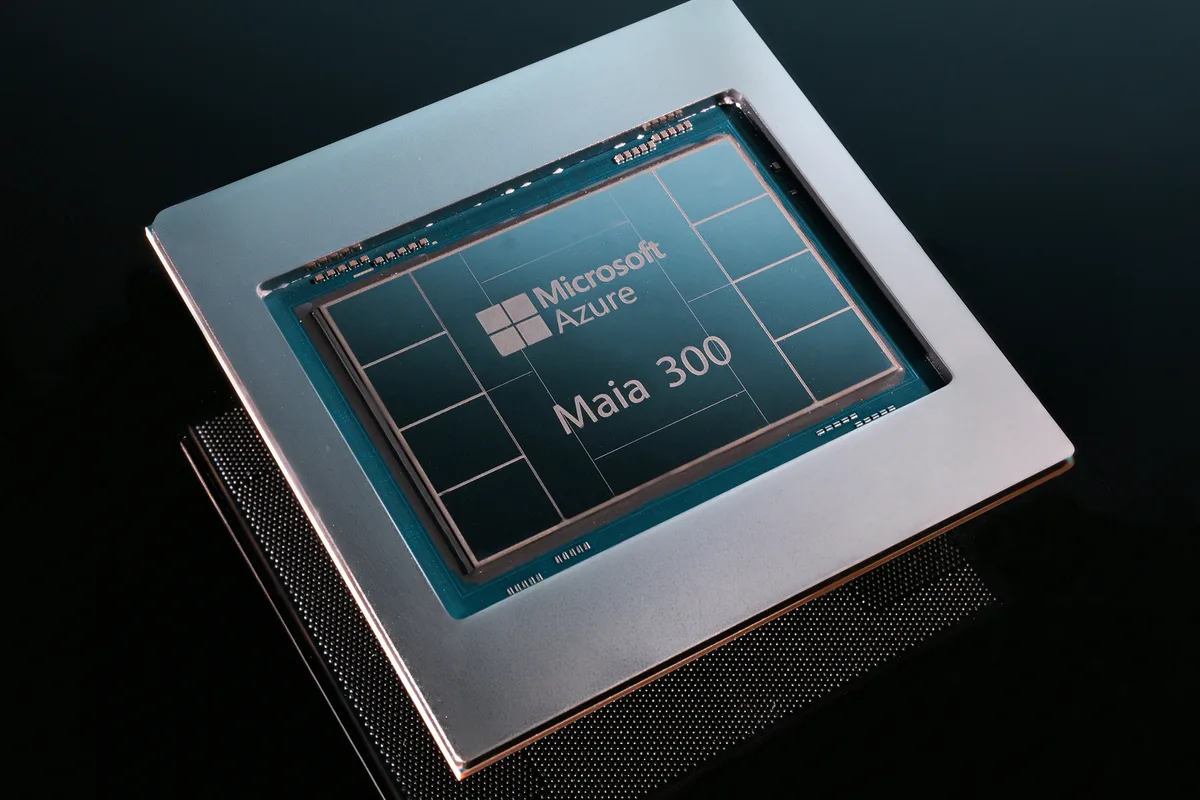
The processor uses a chiplet-based design. Its compute chiplets are manufactured using TSMC's N2P process, part of the company's 2-nanometer-class manufacturing technology. Other elements handle functions such as memory control and communication.
Separating those responsibilities creates opportunities to select suitable silicon technologies for different parts of the system and to optimize the way data moves between them. It does not remove the complexity of packaging, validation or software development; in several respects, it increases the importance of getting those layers to work together.
Microsoft says its software-defined dataflow architecture is designed to reduce unnecessary movement of information. Specialized kernel optimizations and software-managed memory resources are intended to keep useful computation flowing rather than leaving expensive hardware waiting for inputs.
This focus reflects a broader constraint in large AI deployments. A processing unit may be capable of immense arithmetic throughput, but if its data cannot arrive quickly enough, a substantial fraction of that capability can remain idle.
HBM4 is central to the design
Maia 300 uses eight HBM4 memory stacks, with Microsoft claiming a peak bandwidth of 18 TB/s. The accelerator has a specified thermal design power of 950 watts.
High-bandwidth memory is particularly important for inference workloads that repeatedly access model parameters and context-related data. As context windows expand and agentic tasks grow more involved, the balance between computation and data access becomes more difficult to manage.
The architecture also supports reduced-precision formats, including enhanced MXFP4. These formats can improve efficiency by reducing memory requirements and data-transfer volume where the workload tolerates lower numerical precision. They are useful engineering tools, although their effect on output quality must be evaluated for the models being served.
Taken together, the design suggests a system built to remove practical bottlenecks rather than win a contest for the largest raw compute specification. Whether that approach produces better economics depends on the software and production workloads running on top of it.
The rack is becoming the real unit of competition
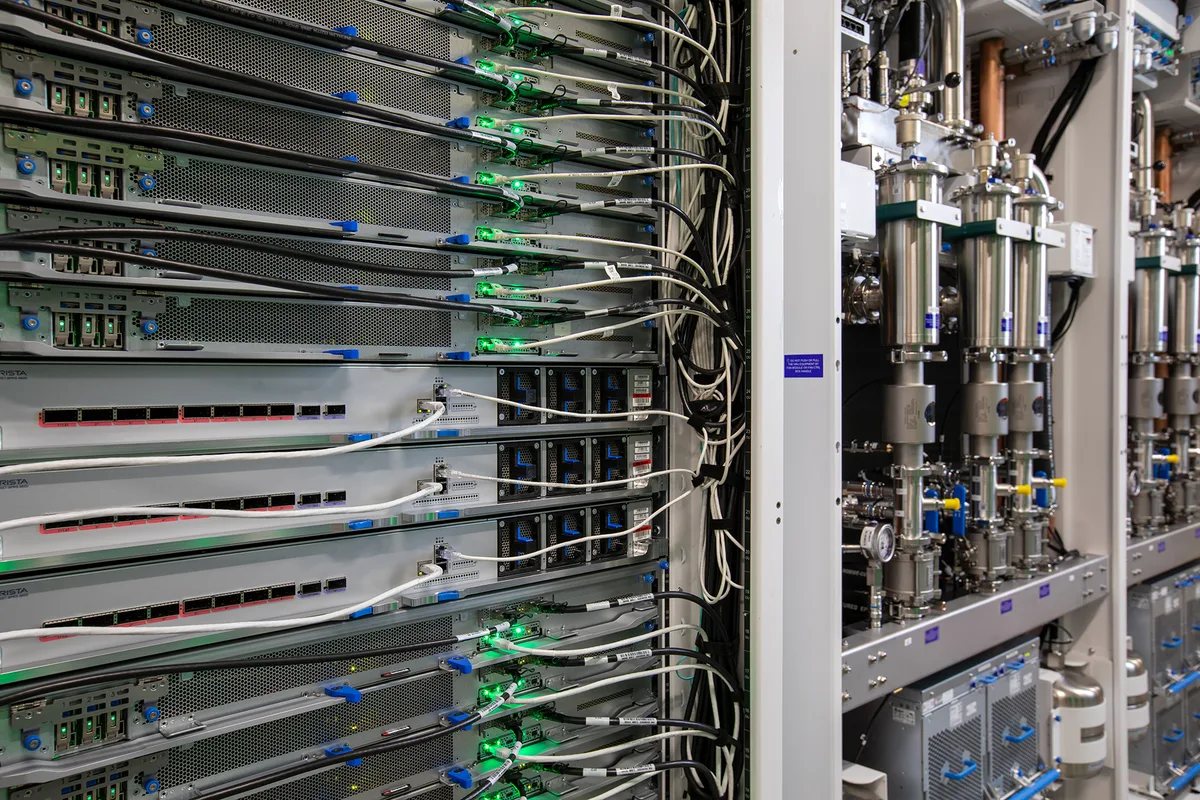
Microsoft's full Maia 300 rack contains 96 accelerators within an approximately 167-kilowatt power envelope. The configuration offers 27.6 TB of aggregate HBM capacity and a stated 1.7 PB/s of aggregate memory bandwidth.
Those numbers underline how misleading comparisons between individual chips can become. Cloud operators deploy complete systems, not isolated benchmark boards. Networking overhead, cooling, power delivery and scheduler efficiency all affect the amount of useful work a data center can deliver.
Maia 300 uses custom AI networking built around Ethernet-based infrastructure and high-bandwidth accelerator connections. Microsoft says the system can distribute operations across hardware resources without treating every communication step as an expensive, separate process.
There is also a physical cost to this density. A rack drawing 167 kW creates significant power-delivery and cooling requirements. Better energy efficiency per generated token may help control operating costs, but it does not guarantee lower total electricity demand if Microsoft dramatically expands its installed capacity.
How to read Microsoft's performance claims
Microsoft expects Maia 300 to deliver 40 percent more tokens per megawatt than leading GPU-based systems. It also reports up to seven times the rack-scale token throughput of Maia 200 in a full configuration and more than 2.5 times its predecessor's performance per watt.
These are substantial claims, but they need context. Microsoft has not provided a sufficiently detailed public identification of the competing GPU configurations used in its headline efficiency comparison. The choice of model, batch size, latency target and context length can materially influence tokens-per-watt measurements.
The comparison with Maia 200 requires care as well. A full Maia 300 rack contains more accelerators than its predecessor's rack configuration. A large rack-level throughput increase is not equivalent to saying that each individual accelerator has become seven times faster.
The figures are therefore best understood as Microsoft-reported system results and expectations, not independent cross-vendor benchmark rankings. An external assessment using comparable workloads and transparent measurement conditions would provide a stronger basis for judging Maia 300 against Nvidia and AMD systems.
What is already running, and what comes next
Maia 200 is already serving Microsoft production workloads, including Copilot and work associated with the company's AI model development efforts. According to Microsoft, its existing platform runs models from OpenAI, Microsoft's MAI family and open-source ecosystems.
That operational experience feeds directly into Maia 300 development. By observing the bottlenecks in services it runs itself, Microsoft can make coordinated changes to hardware and software rather than designing an accelerator for an abstract benchmark.
The company expects the broader Maia platform to support work across GitHub, Microsoft Foundry, Copilot and other services. These applications have different priorities, ranging from code generation to conversational responsiveness and multi-step agent execution.
Yet the 2027 production schedule remains a meaningful boundary. The new hardware has been announced; its promised large-scale operation is still ahead. Nor does the announcement mean that Azure customers will universally move away from third-party GPUs. Microsoft's cloud must continue supporting diverse computing needs, including those that benefit from existing Nvidia infrastructure.
A direct challenge to Nvidia's business model, with limits
The strategic consequence is straightforward. If Microsoft can run a meaningful portion of its own inference workloads on purpose-built accelerators, it can reduce its exposure to the pricing and availability of general-purpose AI GPUs.
It can also tune its entire stack around familiar applications. Hardware development may take years, but Microsoft has access to real usage patterns from the services it operates. That creates a different optimization opportunity from selling hardware intended to satisfy as many customers and workloads as possible.
Reuters reports that Microsoft is considering deployment volumes potentially exceeding one million Maia 300 chips in 2027. The figure describes a plan, not confirmed deliveries. At that scale, supply chains, manufacturing yields, advanced memory availability and data-center construction become just as important as the underlying processor architecture.
Nvidia's position is not suddenly obsolete. Its software ecosystem, broad accelerator portfolio and installed infrastructure remain significant strengths. Microsoft is also reliant on external manufacturing partners, including TSMC, so producing a proprietary design is not the same thing as controlling every part of its supply chain.
The more realistic outcome is a diversified market in which major cloud providers reserve custom silicon for workloads they understand and continue buying third-party accelerators where flexibility, tooling or performance makes those products attractive.
The test arrives in 2027
Maia 300 illustrates how the economics of AI infrastructure are changing. The competition is moving beyond impressive specifications toward maximizing useful output from constrained electricity, cooling and capital budgets.
Microsoft has presented a credible technical direction supported by detailed architectural disclosures and the production experience of Maia 200. What it has not yet provided is independent proof that Maia 300 will consistently outperform the best alternative systems across comparable production conditions.
The first deployments next year will be more instructive than the launch figures. They will show whether Microsoft's tightly integrated approach produces measurable savings at the scale required by its AI services.
For Nvidia, the announcement is another sign that its largest customers increasingly want choices. For Microsoft, it is a costly wager that the future of AI will reward control over the entire infrastructure stack, not simply access to the fastest accelerator available.