
 By Tsuky
A conventional chatbot can recommend a product. An agent can research alternatives, compare prices, prepare a checkout and ask the user to approve a purchase.
That distinction explains why Meta is placing so much importance on Muse, the personal AI agent it launched on September 8.
During the company's third-quarter earnings call on October 21, CEO Mark Zuckerberg said more than 10 million people in the United States and Canada had set up Muse during its first six weeks.
He also indicated that approximately 25% of those users were returning daily.
The figures are meaningful for a young product, but their definitions matter.
A sign-up measures initial adoption. It does not guarantee that a person will continue using a product after the novelty has faded.
Muse remains in its early launch period and has benefited from substantial promotional activity.
The challenge is now to convert that initial interest into sustained usage.
Sign-ups, downloads and active users are different measures
Several numbers describing Muse's growth are circulating.
Meta reports more than 10 million people setting up the service across the US and Canada.
Sensor Tower estimates approximately 10.9 million cumulative app downloads, including 10.2 million in the US.
The analytics company also estimates that Muse reached 2.5 million daily active users on October 16, representing an increase of around 15% from the previous week.
These figures should not be treated as interchangeable.
Downloads are not necessarily unique users. People may install the app on multiple devices or never become regular users.
An account can remain registered even when its owner stops using the product.
Daily active users provide a different measure of engagement, although the methodology and measurement period must be considered.
Sensor Tower also estimates seven-day retention of 30% and fourteen-day retention of 23%.
Its comparisons place ChatGPT, Claude and Grok at average reference rates of 19% and 16% over comparable intervals.
Those estimates suggest encouraging early engagement, but they do not prove a lasting advantage. Different launch conditions, audiences and promotional strategies can influence retention.
Muse is designed to perform tasks, not simply answer questions
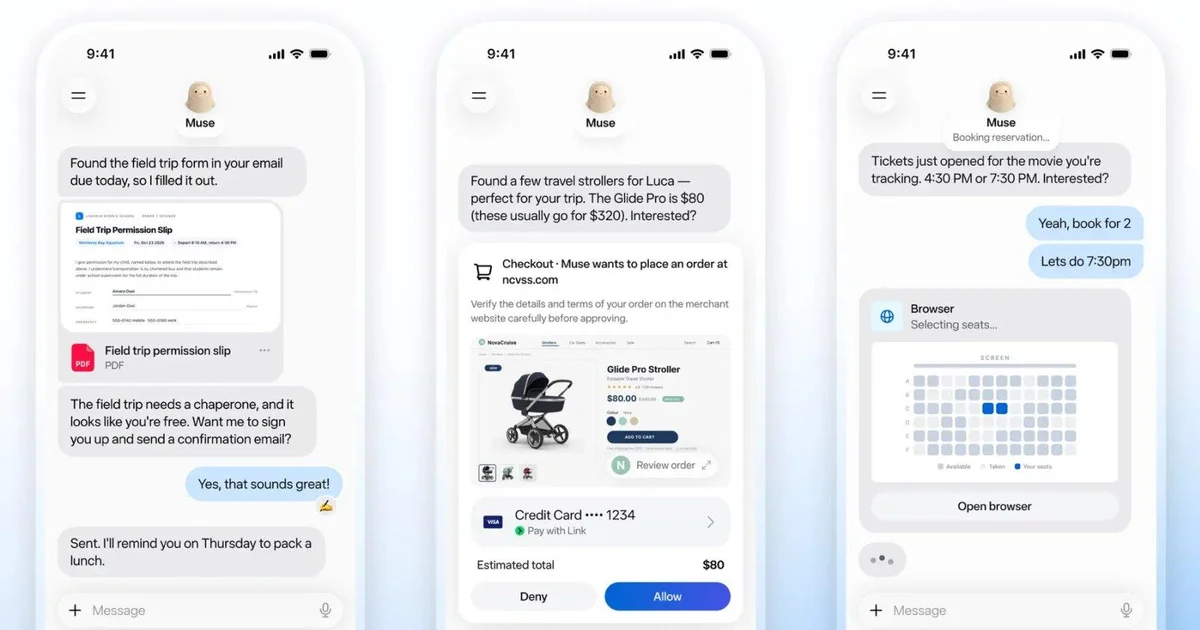
Meta describes Muse as a personal AI agent capable of carrying out multi-step work across connected applications.
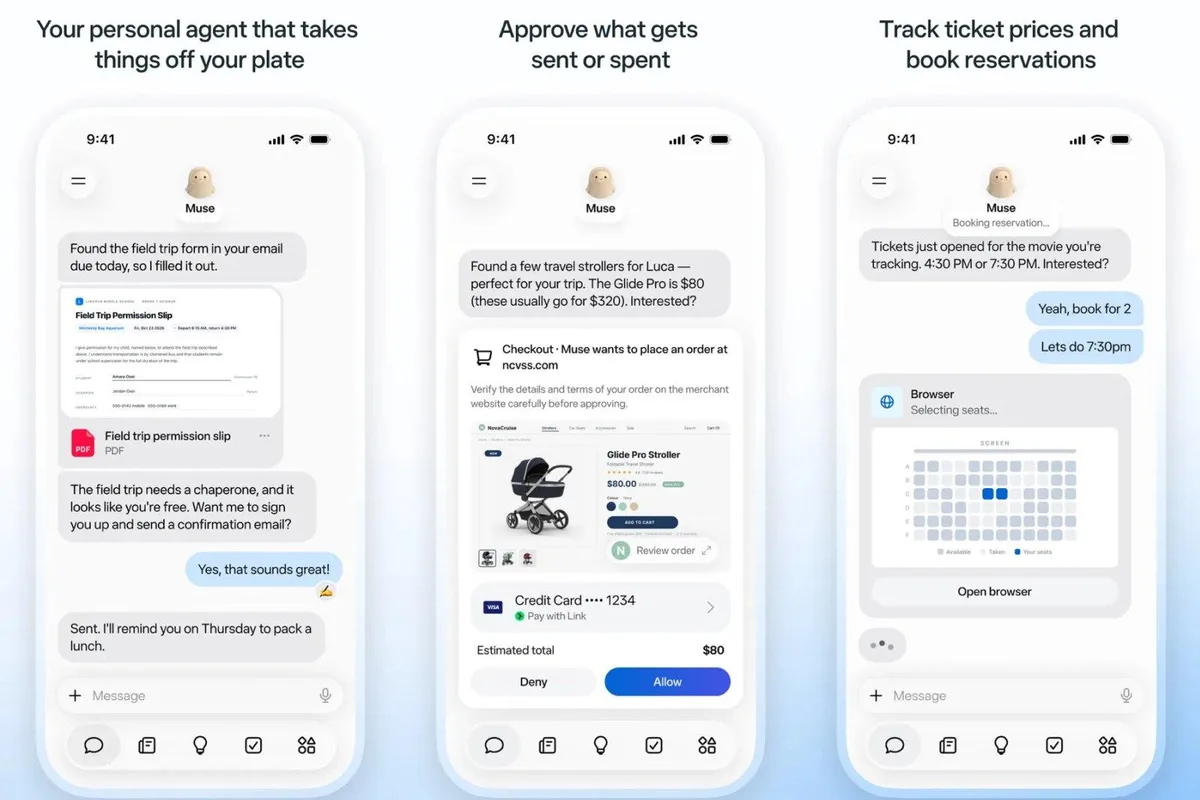
Users can ask it to research information, manage schedules, draft emails, organize trips, fill out forms or work toward longer-term objectives.
The product runs inside Muse Secure VM, a dedicated cloud computing environment associated with the individual user.
That environment includes a browser and the resources needed to interact with supported services.
Muse can continue certain tasks after a person closes the app, returning when new information becomes available or approval is required.
A travel planning task, for example, may involve comparing transport, considering accommodations and keeping track of preferences across multiple steps.
The agent can prepare proposed actions rather than requiring the user to perform every search manually.
The system's capabilities still depend on available connectors, user permissions and the services it can access.
It is not a guarantee that Muse can complete every requested task without intervention.
Shopping is already an important part of the product
Meta's comments about early usage reveal a possible business model.
CFO Susan Li said more than a quarter of Muse's weekly active users engage in shopping-related tasks.
That does not mean one in four users completes a purchase each week.
Shopping activity may include researching products, comparing prices, checking availability or preparing an order.
Even so, the figure matters because commerce could provide a source of revenue beyond traditional subscriptions.
Meta already operates one of the world's largest digital advertising businesses through Facebook and Instagram.
A personal agent could become another point where consumers discover products and interact with merchants.
Instead of only displaying advertising, the agent may help a customer evaluate options and take action on a purchase.
That creates new commercial questions.
How will merchants be selected? Will some transactions generate fees? How will businesses compete for visibility when an AI agent is doing the comparison?
Meta is exploring transaction-based and business-oriented revenue opportunities, but it has not announced a universal payment model for every purchase arranged through Muse.
The economics remain at an early stage.
Payments are designed to require user approval
Meta has already announced integrations intended to support commerce.
Muse works with Link by Stripe for eligible transactions. The integration can generate a single-use card, limiting the need to expose a customer's standard card details to merchants.
The company has also discussed future support for additional payment and credential-management tools, including Shop Pay.
Meta says sensitive actions such as sending an email or making a purchase require user approval.
This creates a distinction between an agent preparing a transaction and being authorized to complete it.
A user may allow Muse to research products and prepare an order without granting it unrestricted purchasing authority.
In practice, protection mechanisms depend on the payment provider, merchant and relevant integration.
Users still need to verify prices, recipients and transaction conditions before approval.
Dedicated cloud computers introduce new security responsibilities
A personal agent operating across connected services requires access to potentially sensitive information.
Meta says Muse Secure VM provides an isolated computing environment for each user.
The company has also described Sentinel, a separate monitoring agent intended to review certain Muse operations before they reach the internet.
According to Meta, sensitive credentials and payment information are stored in protected systems rather than being directly exposed to the agent.
Users can choose which services to connect, grant different levels of access and revoke those permissions.
Meta also states that Muse conversations and data within its virtual environment are not shared with the company's advertising systems.
These are product architecture and privacy claims made by Meta.
They should not be interpreted as independent proof that the system cannot contain security vulnerabilities.
Agents with web browsing capabilities face risks including prompt injection, where malicious content attempts to influence an agent's behavior.
Security depends on the separation between untrusted content, agent permissions and sensitive actions.
User approval, audit records and the ability to disconnect services remain important safeguards.
Compute costs are limiting Muse's international expansion
Despite its early adoption figures, Muse has not launched globally.
Availability is primarily focused on the United States and Canada.
Meta has not confirmed a definitive global release date.
Zuckerberg says the computing resources needed to operate the service are a major constraint.
An agent performing a long task may invoke AI models repeatedly while using browsers and other tools.
Serving that workload is more expensive than generating a single short text response.
At millions of users, these costs become a central part of the business model.
Meta is therefore working to improve the computing efficiency of Muse before expanding its availability.
Zuckerberg has described a target of more than a tenfold improvement in compute efficiency over the following year.
He also discussed infrastructure capable of potentially supporting more than one billion people over the next several years.
Those figures are ambitions, not achieved capabilities.
Delivering them will depend on software improvements, data-center capacity and the cost of operating increasingly capable models.
Why monetization may arrive earlier than usual
Meta has historically launched some consumer services with a strong emphasis on adoption before developing mature monetization.
That strategy becomes more difficult when every active user can generate substantial computing expenses.
Muse needs enough financial value per user to support the cost of completing tasks.
Commerce presents an opportunity because an agent may contribute directly to a purchase decision.
Subscriptions and specialized business services could also contribute to future revenue, depending on the products Meta chooses to offer.
The company has suggested that revenue from its newer AI businesses could begin contributing to growth in 2027.
That remains a forecast.
The current user figures do not establish Muse's average cost per task, profitability per user or future transaction revenue.
Those measures will be essential for determining whether the product can scale economically.
Muse Wonder models are intended to improve agent capabilities
Meta introduced Muse Wonder and Muse Wonder Full on October 12.
The models are designed for demanding agent tasks, including multi-step reasoning, tool use and software development.
Muse Wonder is available through selected developer products, including the Meta Model API and Muse Code.
Muse Wonder Full is offered to eligible Muse Code subscribers.
Meta intends to incorporate Muse Wonder capabilities into the consumer Muse experience, initially for selected subscribers.
It would be inaccurate to describe every feature of these newly announced models as already available to all Muse users.
Model improvements could increase the range of tasks Muse can complete, but end-to-end reliability depends on much more than benchmark performance.
Agent workflows need functioning integrations, appropriate permissions and the ability to detect and recover from errors.
The next challenge is trust, not just growth
Muse's early performance demonstrates Meta's ability to attract an audience to a new AI product.
Its established platforms provide distribution advantages that smaller competitors cannot easily reproduce.
However, converting curiosity into sustained personal-agent usage requires reliability.
Users need confidence that the agent will execute tasks correctly, ask for approval at appropriate moments and avoid mistakes involving personal information or money.
Meta also needs to make the underlying infrastructure substantially more efficient if it wants to expand beyond its initial markets.
As of October 22, 2026, the confirmed company figure is more than 10 million Muse setups in six weeks. Independent estimates suggest strong download growth and encouraging early engagement.
Neither figure proves that Muse has become a permanent daily habit for tens of millions of people, or that its commercial model is already profitable.
The next phase of competition among personal AI agents will be measured by repeat usage, task reliability, consumer trust and the economic cost of getting work done.