
 By Adri
The GPU is no longer the only processor that determines how quickly an AI application finishes its work. As agents move between model inference, code execution, data retrieval and external tools, substantial portions of their workloads can depend on conventional processors and networking.
Oracle's latest NVIDIA infrastructure announcement is built around that distinction. Vera Rubin NVL72 systems and Vera CPUs have entered general availability on Oracle Cloud Infrastructure, bringing a new generation of accelerated computing and dedicated CPU resources to the platform.
The announcement also describes a significantly larger future deployment strategy. Oracle and NVIDIA intend to grow their Superclusters to multi-gigawatt scale, while a separate eight-GPU Rubin server configuration is planned for later introduction.
Those are different availability states. General availability has been announced for NVL72 and Vera CPUs, whereas the multi-gigawatt expansion and HGX Rubin NVL8 remain plans rather than completed rollouts.
NVL72 brings 72 Rubin GPUs into a single connected system
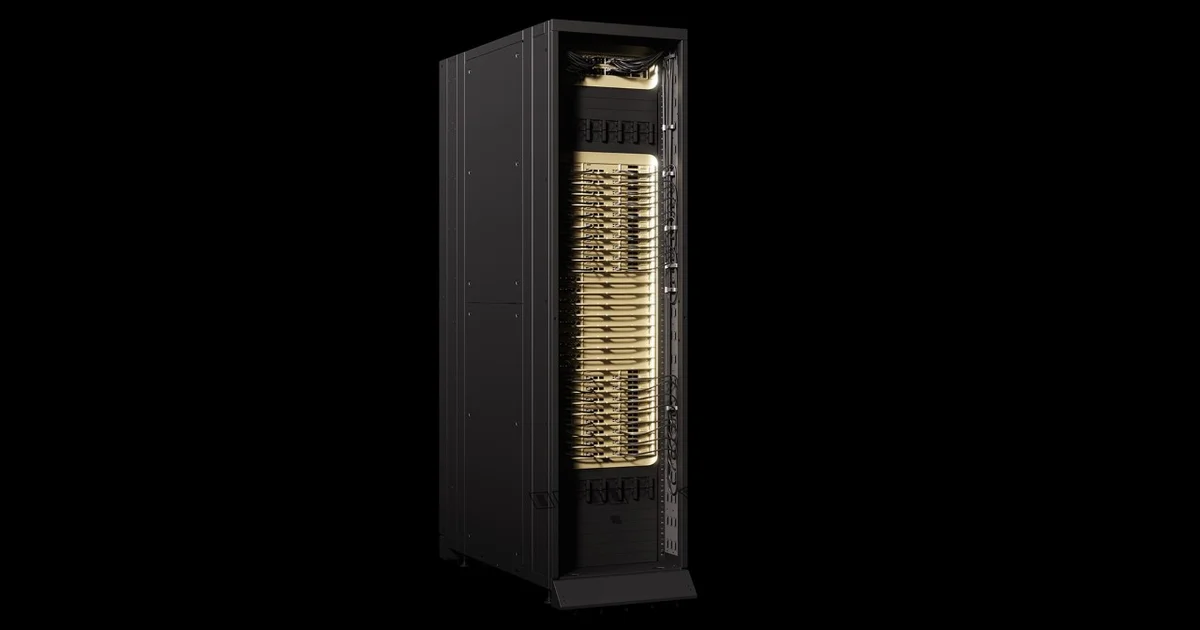
NVIDIA Vera Rubin NVL72 combines 72 Rubin GPUs connected through sixth-generation NVLink networking. The rack-scale architecture is designed for workloads in which large amounts of model data need to move efficiently between accelerators.
Training frontier models and serving complex inference requests frequently involve computations spread across multiple GPUs. Moving intermediate data between those devices can become an important constraint even when individual accelerators provide substantial processing throughput.
The NVL72 architecture addresses communication within the rack. Beyond that boundary, OCI's networking infrastructure is responsible for connecting large numbers of rack-scale systems.
Oracle claims that Vera Rubin can deliver up to 30 times the inference throughput per watt and four times the training performance of the previous NVIDIA Blackwell generation under the comparisons used in its announcement.
These are vendor performance claims, not a guarantee that every model or deployment will experience the same improvement. Model architecture, batch sizes, memory requirements, software optimization and system configuration all influence practical results.
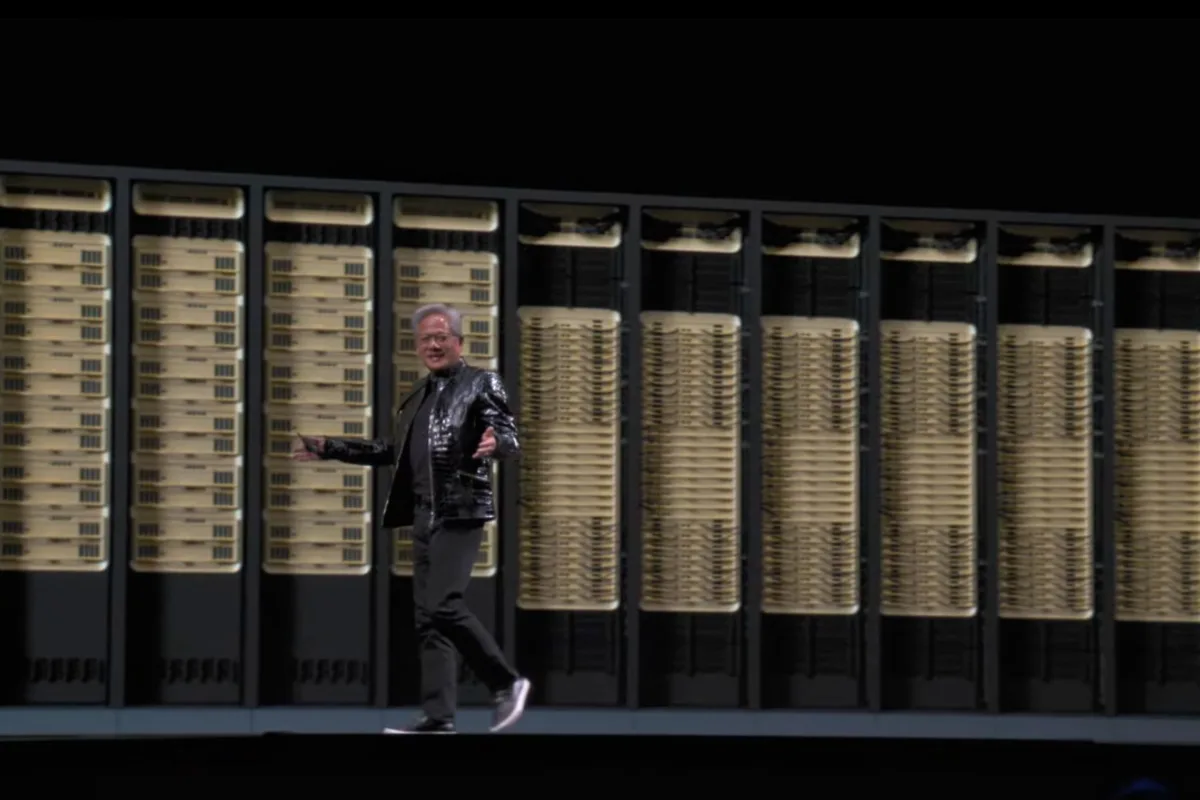
HBM4 memory and NVLink 6 are central elements of the new platform. Both are intended to reduce data movement limitations and keep the computing resources active rather than waiting on transfers.
The broader question is how these improvements translate into sustained application performance and cost. That will require measurements across real customer workloads rather than relying exclusively on peak platform comparisons.
Vera CPUs target the work between model calls
Oracle has announced an initial deployment of 150,000 NVIDIA Vera CPUs. The processors are designed to support the orchestration, code execution, data retrieval and other operations involved in running agentic AI systems.
Each Vera processor includes 88 custom Olympus CPU cores and 176 threads through NVIDIA Spatial Multithreading. The architecture provides up to 1.2TB/s of LPDDR5X memory bandwidth and 3.4TB/s of bisectional bandwidth across its internal coherency fabric.
OCI configurations combine two Vera processors, providing 176 CPU cores and 352 threads. Oracle specifies 1TB of LPDDR5X system memory, 7.68TB of local NVMe storage and 200Gbps Acceleron networking for the announced instances.
The design reflects a shift in the types of workloads that AI infrastructure needs to support. An agent may issue several model requests while also spending substantial time running scripts, handling information and coordinating external systems.
NVIDIA claims Vera provides an 80 percent improvement in selected agentic CPU workloads. As with its GPU comparisons, the result should not be treated as a universal increase in the speed of complete AI agent tasks.
Oracle says Vera CPUs are generally available through OCI, including Bare Metal and flexible virtual machine options. It also specifies that regional availability will expand during the current quarter, so customers should not assume immediate access in every OCI region.
Independent CPU and GPU scaling changes resource allocation
Oracle Kubernetes Engine is being positioned to allow CPU and GPU resources to scale independently. This matters because an agent's processing requirements can vary considerably over the course of a single request.
GPU utilization may fall while the application executes code or waits for data. Conversely, CPU resources may remain lightly loaded during intensive model inference.
Allocating both resources as a fixed combination can therefore leave expensive computing capacity underused. Independent scaling offers a way to match different infrastructure components more closely to actual workload demand.
The economic benefit will depend on scheduling efficiency, application behavior and the pricing of the corresponding cloud resources. Faster hardware alone does not automatically produce a lower cost per successful task.
Oracle also highlights hardware-based isolation through Acceleron for workloads involving untrusted AI-generated code. Such workloads require careful separation between execution environments, permissions and sensitive infrastructure resources.
Acceleron connects the racks into larger Superclusters
Oracle combines NVIDIA rack-scale systems with its Acceleron networking architecture, NVIDIA Spectrum-X Ethernet, Spectrum-6 switches and BlueField-4 DPUs.
The networking system uses multiple independent planes to distribute traffic and improve resilience. Oracle describes Multipath Reliable Connection as a way to send data over different paths instead of restricting communication to a single network route.
The approach is designed to reduce congestion, preserve bandwidth and help large distributed workloads continue functioning when individual network paths encounter problems.
In AI training, communication interruptions can affect enormous numbers of accelerators. Depending on the failure and the software involved, restarting work from a checkpoint can be costly in both time and computing resources.
Oracle says its networking architecture can support systems with more than 131,000 GPUs using two Ethernet switching tiers in specified configurations. This is an architectural capability claim, not confirmation that a Vera Rubin deployment of that precise size is already operating.
The partners also intend to expand the physical infrastructure to multi-gigawatt scale. Such facilities require substantial power delivery, cooling and network capacity, in addition to the computing systems themselves.
No complete deployment timetable for the planned multi-gigawatt expansion was disclosed in the joint announcement.
HGX Rubin NVL8 offers a smaller future configuration
Oracle plans to add NVIDIA HGX Rubin NVL8, a server configuration connecting eight Rubin GPUs through NVLink.
The proposed platform includes two 64-core Intel Xeon 6 processors, 4TB of DDR5 memory and 6.4Tbps of high-speed RDMA networking.
Unlike the larger NVL72 rack-scale architecture, NVL8 is designed to provide Rubin acceleration in a smaller x86-based server configuration. This may appeal to organizations with existing x86 software environments or workloads that do not require an entire NVL72 system.
Potential applications include model training, fine-tuning and inference. However, Oracle has announced the platform as a future addition rather than an already available OCI product.
The partners have not published a specific availability date or commercial price for HGX Rubin NVL8.
OpenAI demonstrates the scale of Oracle's existing infrastructure
Oracle and NVIDIA identify OpenAI among the organizations using their large-scale AI infrastructure. According to the companies, GPT-6 Astra was trained and served on an OCI Supercluster in Abilene, Texas, involving more than 100,000 NVIDIA Blackwell GPUs.
That distinction matters because the cited training infrastructure belongs to the Blackwell generation. It is not evidence that the same training process ran on Vera Rubin.
OpenAI is also among the early users of Vera CPUs on OCI, particularly for workloads involving sandboxed code execution and tools associated with AI agents.
Oracle is extending NVIDIA integration into higher-level services as well. Its announcements include NVIDIA Dynamo for inference workloads, cuVS technology for accelerated vector indexing and further optimization work involving enterprise applications and database services.
These initiatives have different implementation and availability schedules. Existing services, newly available infrastructure and future features should not be treated as a single completed deployment.
Availability is established; the full economic benefit is not
Oracle's announcement marks a commercial milestone for NVIDIA's latest rack-scale infrastructure. Vera Rubin NVL72 and Vera CPUs are now described as generally available on OCI, with new options for organizations building large-scale training, inference and agentic systems.
The advertised improvements in compute efficiency are substantial, but they do not provide a complete picture of operating expenses.
The cost of running an AI workload depends on cloud instance prices, memory capacity, networking, software overhead and how effectively the resources are utilized over time.
For agentic systems, measurements of completed tasks, execution latency and CPU-GPU utilization will often be more meaningful than isolated model throughput.
Oracle did not disclose detailed public pricing for the new configurations in its joint announcement, nor did it specify the exact number of Vera Rubin NVL72 racks that would become operational in the near term.
The established facts are the announced general availability of NVL72 and Vera CPUs, the initial 150,000-CPU deployment commitment and Oracle's plans for larger clusters and smaller Rubin server configurations. The actual customer economics and the timetable for those future deployments remain open.