
 By Tsuky
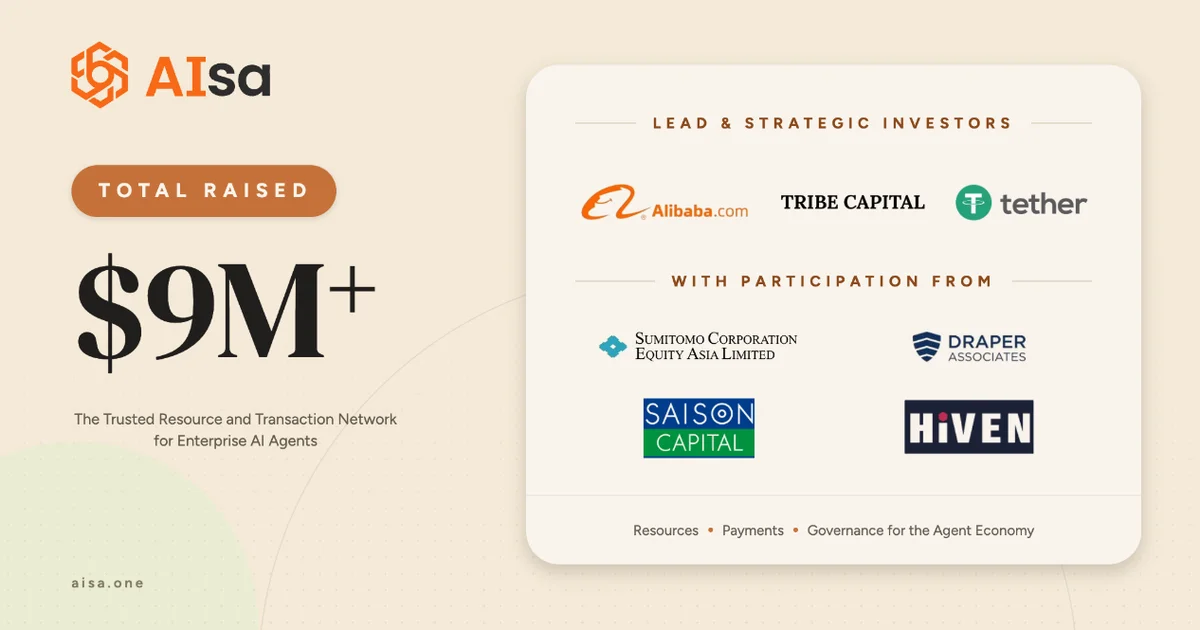
Imagine an AI agent preparing a detailed market research report. It gathers public information, compares companies and begins drafting its findings. Then it discovers a specialized database that could significantly improve the analysis. The database charges for each query. Normally, accessing it requires an account, payment details and perhaps a subscription. The agent may understand exactly why the information is useful, but it cannot necessarily complete the purchase. A human must intervene. That interruption is the problem AIsa wants to solve. The San Francisco company is developing infrastructure that lets AI agents discover digital services, access them and pay for usage within rules established by businesses or users. The idea has attracted fresh investment. On October 15, AIsa announced the completion of a seed extension round involving Tether Capital and HIVEN. The financing brings its cumulative funding above $9 million. The story received renewed coverage from specialist publications on October 18. It is an investment in the emerging infrastructure of autonomous software rather than simply another cryptocurrency transaction.
More than $9 million in cumulative funding
AIsa already had several notable investors. In July, the company announced that it had raised $6.5 million in total, including a seed round co-led by Alibaba and Tribe Capital. Other previously named investors include Sumitomo Corporation, Draper Associates and Saison Capital. Tether Capital and HIVEN now join that group as strategic investors. The new announcement puts cumulative funding above $9 million. There is an important financial distinction. Tether has not announced a standalone $9 million investment. The companies have not disclosed how much Tether contributed, how much HIVEN invested or the equity stakes they acquired. AIsa's valuation was not published either. Comparing the July and October figures shows that reported cumulative funding has increased by more than $2.5 million. It does not establish the exact amount supplied by either new investor. Even without those details, the involvement of Tether is strategically interesting. The company is best known for USDt, its dollar-linked stablecoin. Its investment points toward potential uses for programmable payments beyond transfers between ordinary cryptocurrency users.
Why AI agents need payment infrastructure
Most digital purchasing systems were designed for humans. A person registers an account, accepts commercial terms, enters payment information and chooses a subscription or service. That process works reasonably well for someone using software directly. It becomes less practical when an AI agent needs to interact with many specialized providers during one assignment. An agent may need a language model for one task, a data provider for another and a computing service for a third. Managing separate accounts and subscriptions for every resource creates considerable administrative friction. AIsa proposes a unified interface that connects agents to models, APIs, data, software and computing resources. Instead of negotiating every service relationship independently, developers can use a shared gateway. Usage can be measured and billed as resources are consumed. For some tasks, paying per call may be more efficient than maintaining subscriptions that are rarely used. The approach could be particularly appealing to smaller teams that need occasional access to specialized capabilities. But the exact commercial benefit will depend on provider pricing, platform fees and the services actually available through the network. The concept is straightforward. Its practical value still needs to be demonstrated across different workloads.
Giving an agent payment access requires spending controls
Allowing software to initiate purchases introduces an obvious risk. Agents can make mistakes. They can repeat actions unnecessarily, choose expensive services or consume more resources than expected. If an agent has unrestricted access to a payment method, an operational error can quickly become a financial problem. AIsa therefore emphasizes enterprise governance. Its platform advertises spending limits, permissions, approval workflows and transaction audit trails. The intended approach is to delegate restricted authority rather than unlimited financial freedom. A business could assign a budget to a research task, authorize specific resource categories and require human approval before larger purchases. The agent would then be able to act within those boundaries. That is different from creating an independent financial entity that controls its own wealth. In most enterprise scenarios, the agent is using authority granted by a person or organization. The crucial question becomes whether the system reliably enforces the limits. AIsa has described the controls it offers. That does not establish that every possible error, fraud attempt or security incident has already been prevented through independent testing.
Stablecoins are an option, not the only payment method
Tether's involvement naturally draws attention to stablecoins. These digital assets are designed to track the value of a reference currency, commonly the US dollar. They can be used for programmable transfers between digital services. In some scenarios, they may be useful for frequent low-value payments. However, AIsa does not describe its platform as exclusively based on cryptocurrency. The company says its infrastructure supports billing and settlement in conventional currencies as well as stablecoins. The key feature is the ability to associate resource usage with an authorized financial transaction. An agent making a series of data requests could have its usage recorded and charged according to the provider's terms. The settlement mechanism would depend on the service and the payment arrangement. It would therefore be incorrect to suggest that all AIsa transactions use USDt. The companies have not disclosed such a breakdown. Nor have they said Tether's investment was made using USDt. Stablecoins are part of the opportunity Tether sees, but they are not evidence that every transaction in the network currently takes place on a blockchain.
AIsa claims 250,000 agents and more than 100 million transactions
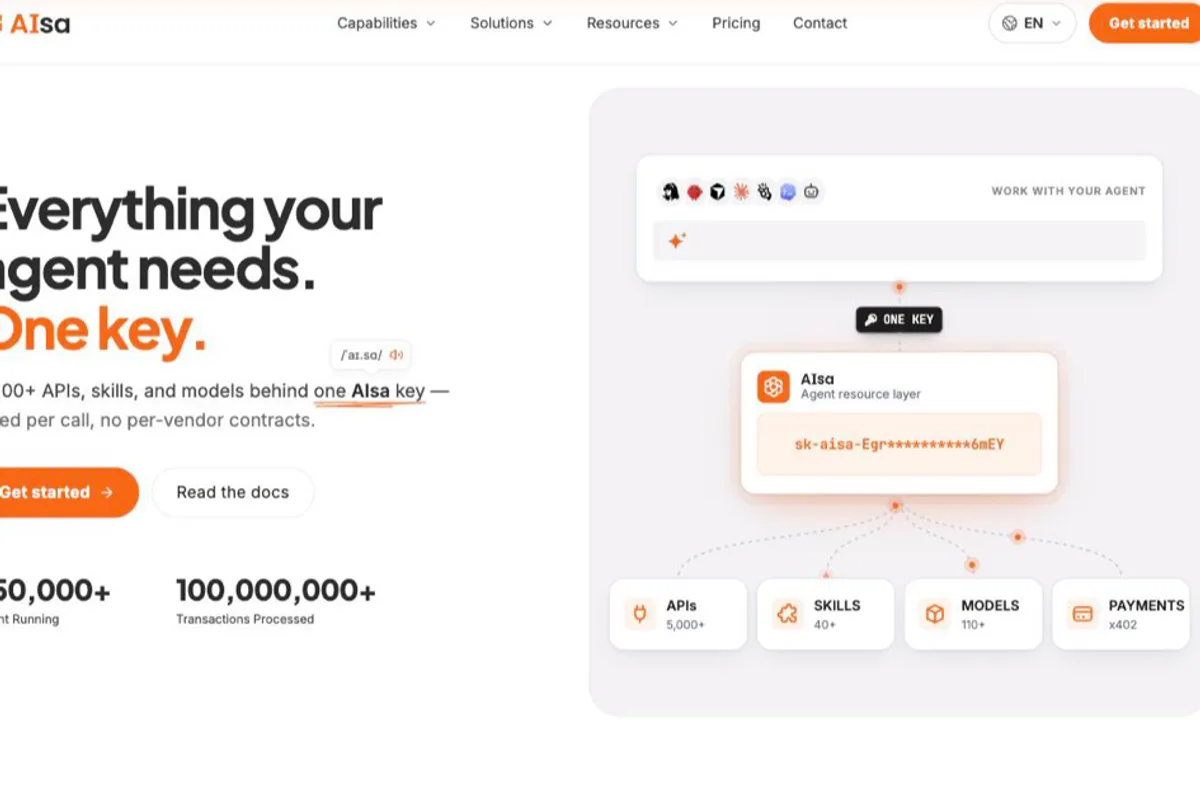
Tether's announcement includes substantial usage figures. AIsa reports more than 250,000 agents operating on its platform. It also claims to have processed more than 100 million transactions. The network reportedly offers access to over 5,000 APIs, skills and models through a single interface. These numbers suggest meaningful activity for a company founded in 2025. They also require careful interpretation. A registered or operating agent is not necessarily a daily active user. The word transaction may encompass different types of events depending on the platform's accounting. The announcement does not provide a detailed breakdown showing how many of the 100 million operations were actual financial settlements on blockchain networks. The figures have not been presented as independently audited measurements. They should therefore be attributed to AIsa and Tether rather than treated as independently established industry statistics. They indicate the scale the companies claim to have reached. They do not prove that autonomous agent commerce has already become a mature global payment market.
Enterprise pilots are exploring real business applications
AIsa says it has started strategic pilot programs with several enterprises. The announced areas include financial intelligence, market research, supply-chain management and commerce. Each involves recurring access to outside information or specialized digital tools. A supply-chain analyst may need data about vendors and logistics. A financial research agent may combine market information with analytical services. A market research workflow might use several models and data sources before completing a report. AIsa wants to connect those operations to resource access and billing. That could make it easier to deploy agents beyond experimental demonstrations. However, the company has not provided comprehensive public results from these pilots. The names of all participating businesses, their implementation costs and their measured efficiency gains are not fully disclosed. The pilot announcements therefore establish exploration rather than a proven general improvement in productivity. More detailed case studies will be needed to assess whether the infrastructure reduces costs and complexity in production environments.
Tether's AI ambitions extend beyond stablecoins
The AIsa investment fits into a broader strategy. Tether has been supporting projects involving artificial intelligence, digital infrastructure and robotics. Its QVAC initiative focuses on AI capabilities that can run directly on user devices. The Wallet Development Kit, or WDK, provides tools for building digital wallets. Tether has also invested in NEURA Robotics, with plans involving local AI and machines that can transact within predefined financial limits. AIsa adds another component to that general direction. Its focus is the network through which agents can obtain digital resources and settle authorized usage. In principle, local intelligence, wallet infrastructure and service payments could complement one another. But the investments and technology initiatives are separate. Their existence does not prove that every product has already been integrated into a complete commercial system. The significance lies in the direction Tether is pursuing: extending programmable financial tools to software systems that increasingly perform work on behalf of humans.
Agent payments introduce a new security challenge
A payment-enabled AI agent presents security problems beyond those of a conventional software subscription. The system must verify that the agent is authorized to act. It must enforce the approved budget and determine which services can be used. It must also consider whether the information returned by those services is trustworthy. External content can contain inaccurate data or malicious instructions. That becomes especially concerning when an agent can respond to information by spending money. A manipulated workflow could produce unnecessary purchases, expose data or consume financial resources without delivering the intended result. Permissions, spending limits and approval systems are useful safeguards. But they are not a substitute for careful security design. Enterprises will also need to consider identity management, access revocation, auditability and financial compliance. Ultimately, an automated payment still needs a clear chain of responsibility. The difficult challenge is not simply enabling software to transfer funds. It is making those actions predictable, accountable and reversible where appropriate.
Digital services may increasingly be sold directly to software
If platforms like AIsa succeed, they could influence how digital services are packaged and sold. Today, many providers primarily market subscriptions to people and organizations. In the future, software agents may become direct customers of narrowly defined services. An API could sell individual requests. A data provider could charge for one specialized lookup. A computing platform could offer a limited operation rather than a monthly contract. Parts of this model already exist. The proposed change is to integrate discovery, authorization and purchasing into the agent's workflow. Software could identify a need, choose an approved provider, consume a resource and record the cost without interrupting the broader task. That might create new opportunities for specialist suppliers. It could also give substantial influence to the platforms that control resource discovery and billing. Pricing transparency, competition and the ability to change providers will become important questions. A single convenient interface reduces friction. It can also become a powerful intermediary if many businesses begin depending on it.
The investment highlights a market that is still taking shape
With more than $9 million in cumulative funding, AIsa remains a relatively young company. Backing from Tether Capital and HIVEN does not guarantee it will become the dominant payment infrastructure for AI agents. It does show that the category is attracting investors from technology and digital finance. The next milestones will be more important than the funding announcement itself. AIsa needs to demonstrate that its spending controls work reliably in professional environments. It needs to attract service providers and show that usage-based purchasing offers practical advantages over existing integrations and subscriptions. Greater transparency about transaction types, financial volumes and enterprise pilot results would also make its progress easier to evaluate. The October 15 announcement is therefore not proof that autonomous software has already transformed online commerce. It identifies a problem that will become more important as agents gain the ability to perform complex tasks. Software that works autonomously may sometimes need to purchase resources autonomously. But giving it payment access without effective boundaries would turn a productivity opportunity into a financial risk. The future of agent commerce will depend on balancing those two requirements. AIsa and its new investors are betting that the infrastructure managing that balance could become a valuable part of the AI economy.