
 By Kilam
The Achievement Begins With Consistency
Star Wars: Galactic Racer's most important technical achievement is not a spectacular reflection or an exceptionally detailed environment. It is the ability to remain very close to 60 frames per second during races that require constant decisions.
The game uses Unreal Engine 5, a sophisticated rendering platform whose modern features can also be computationally expensive.
Digital Foundry's launch-period analysis describes strong performance across the consoles tested, with isolated irregularities mainly associated with camera transitions.
PS5 Reconstructs Its Image Toward 4K
On standard PlayStation 5, technical measurements report an internal resolution around 1296p, reconstructed toward a 4K output through temporal upscaling.
Internal rendering resolution should not be confused with the resolution transmitted to the display.
Reconstruction helps preserve performance while providing a relatively sharp presentation. Observed races remain consistently close to the intended frame rate.
PS5 Pro Focuses on Image Clarity
PlayStation 5 Pro increases the observed internal resolution to approximately 1728p.
That improves fine detail and clarity during motion, but both PlayStation models target 60fps. The main advantage is sharper image quality rather than a higher frame-rate mode.
Published observations describe temporal reconstruction without definitively establishing PSSR use, so it would be inappropriate to attribute every visual improvement to that specific technology.
Xbox Series X Offers Similar Results
Xbox Series X is broadly comparable to standard PS5 in rendering quality and consistency.
Available measurements do not establish a large, systematic advantage for either platform during the tested sequences.
For many players, ecosystem preferences may matter more than the small graphical differences.
Series S Makes Sensible Compromises
Xbox Series S operates at a lower reported internal resolution of approximately 864p.
Lumen global illumination is replaced by baked lighting, and selected environmental details are reduced.
These sacrifices are visible, but they help preserve performance near the 60fps target.
For such a fast racer, maintaining responsiveness is arguably more valuable than pursuing greater visual complexity at the cost of regular slowdown.
Ambitious Lighting and Geometry
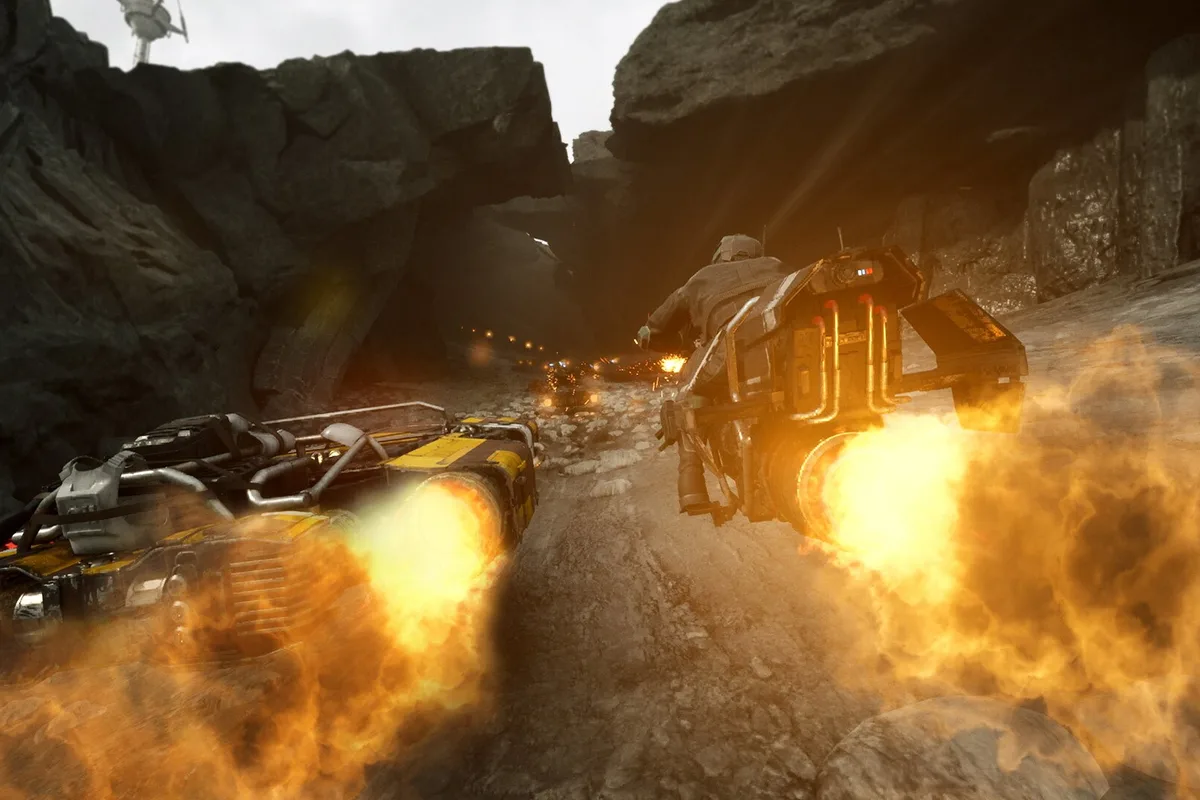
On more powerful hardware, Galactic Racer uses Lumen and other Unreal Engine 5 rendering technologies to create detailed environments.
Lighting reacts convincingly to varied surfaces, while dense geometry gives trackside structures and landscapes depth.
Some temporal instability remains in lighting effects and fine details. These issues are often difficult to notice while racing but more apparent during slower scenes.
Smooth Images Can Still Be Difficult to Read
Several reviews identify hazards that blend too closely with snowy or desert surroundings.
This is not necessarily a resolution or performance issue. An image can be technically sharp while failing to communicate important information quickly enough.
That limitation matters especially in a game where one collision may erase progress across multiple events.
Sound Completes the Experience
Engine audio, tunnel acoustics, acceleration effects and collisions all reinforce the feeling of speed.
The sound mix contributes to motion perception rather than simply providing atmosphere.
That matters in a racing game where immediate feedback is central to player control.
Technology Serving the Driving
Galactic Racer is impressive because its technical choices suit the genre. Fuse Games prioritizes a high frame rate, scales visuals according to hardware and still uses Unreal Engine 5 to deliver a remarkable spectacle.
The 4/5 rating accounts for reconstruction artifacts, Series S compromises and imperfect track readability.
Nevertheless, the overall result is exceptional: beneath the ambitious graphics lies a racing game that consistently protects the most important sensation of all, controlling a machine traveling at almost unreasonable speed.