 By Camille
Downloading a 3D model is often the easiest part of a printing project.
Preparing that file for a particular printer can require considerably more work, especially when several colors or materials are involved.
Users may need to inspect the geometry, configure supports, assign materials and decide how colors should be distributed across the object.
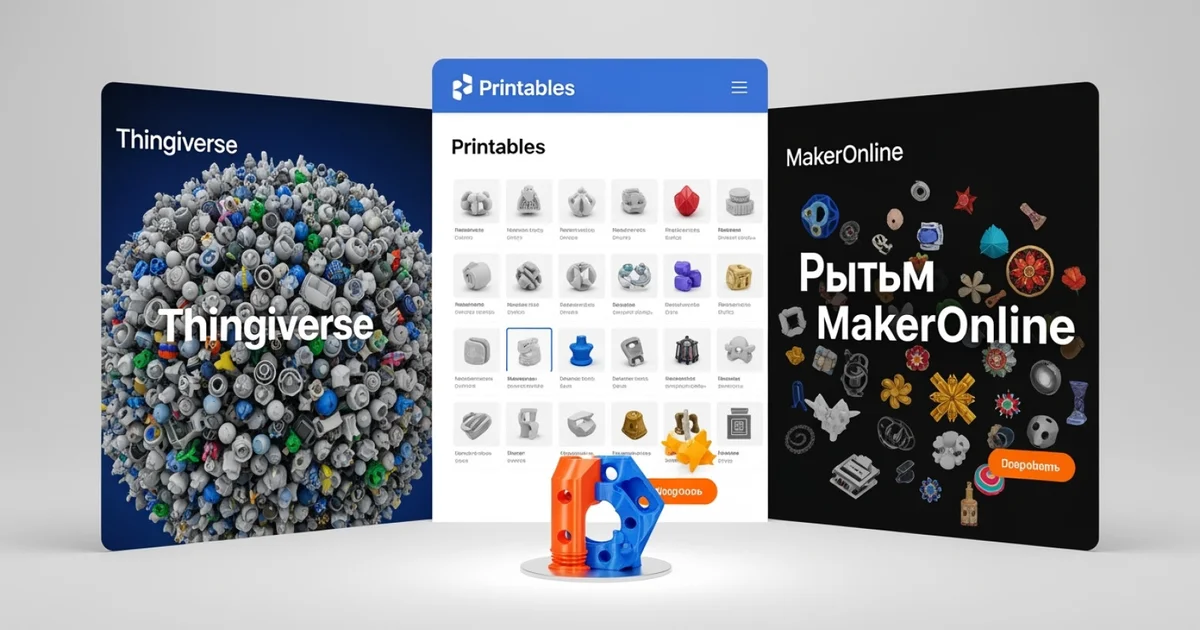
Anycubic wants to simplify that process through a new partnership with Thingiverse, one of the longest-established repositories of printable 3D models.
The agreement was officially announced on October 23. Reporting published on November 1 provided further detail about creator permissions and the commercial significance of the integration.
The dedicated service is scheduled to launch on November 17, meaning its full public functionality has not yet been demonstrated.
Thingiverse brings a library of more than two million models
The main attraction for Anycubic is the size of Thingiverse's catalog.
The platform hosts more than two million designs shared by its community.
They cover a broad range of applications, including practical household objects, replacement parts, decorative products, figurines and prototypes.
For Anycubic, integrating this library could make Makeronline substantially more useful without requiring designers to manually republish every creation on another platform.
However, access to the Thingiverse catalog should not be confused with the immediate availability of two million optimized print profiles.
The companies say selected models will receive additional preparation for multicolor printing.
They have not promised that every Thingiverse upload will be converted or fully optimized at launch.
STL-to-3MF conversion is the key technical change
The partnership goes beyond linking to an existing model repository.
Anycubic intends to convert selected STL files into multicolor 3MF projects suitable for compatible printers.
The two formats serve related but different purposes.
STL is widely used to distribute printable geometry.
It primarily describes the surface of an object through a collection of triangles.
That representation is useful but does not inherently contain every parameter needed for a sophisticated printing project.
3MF can contain additional information about objects, materials, colors and manufacturing configurations.
A properly prepared 3MF project may therefore reduce the amount of manual setup required before printing.
However, changing a file extension does not automatically create a meaningful multicolor design.
Colors still need to be assigned, machine constraints considered and print profiles validated.
Anycubic's proposed contribution is to perform some of that additional preparation for selected Thingiverse creations.
The goal is a near one-click printing experience
Thingiverse CEO Romain Kidd told Tom's Hardware that the partnership aims to provide Anycubic customers with an experience approaching one-click printing.
The idea is to reduce the distance between discovering a model and starting the printing process.
That could be particularly valuable for beginners who are unfamiliar with slicing software.
However, one-click printing remains an ease-of-use objective rather than a universal guarantee.
Printers have different build volumes, material capabilities and multicolor systems.
A project configured for one machine may still need adjustments before it works on another.
Support requirements, filament selection and printing temperature can also affect the process.
The practical value will depend on the accuracy and reliability of the available profiles.
The dedicated Makeronline section launches November 17
Anycubic has scheduled the opening of the Thingiverse collaboration section for November 17, 2026.
That date coincides with the opening of Formnext, a major international exhibition for additive manufacturing.
The timing gives Anycubic an opportunity to demonstrate its broader software-and-hardware ecosystem.
As of November 2, the promised section has not officially launched.
It is therefore too early to judge the number of usable multicolor projects available to customers on the first day.
The quality of the interface and the ease of preparing models will also need to be assessed after release.
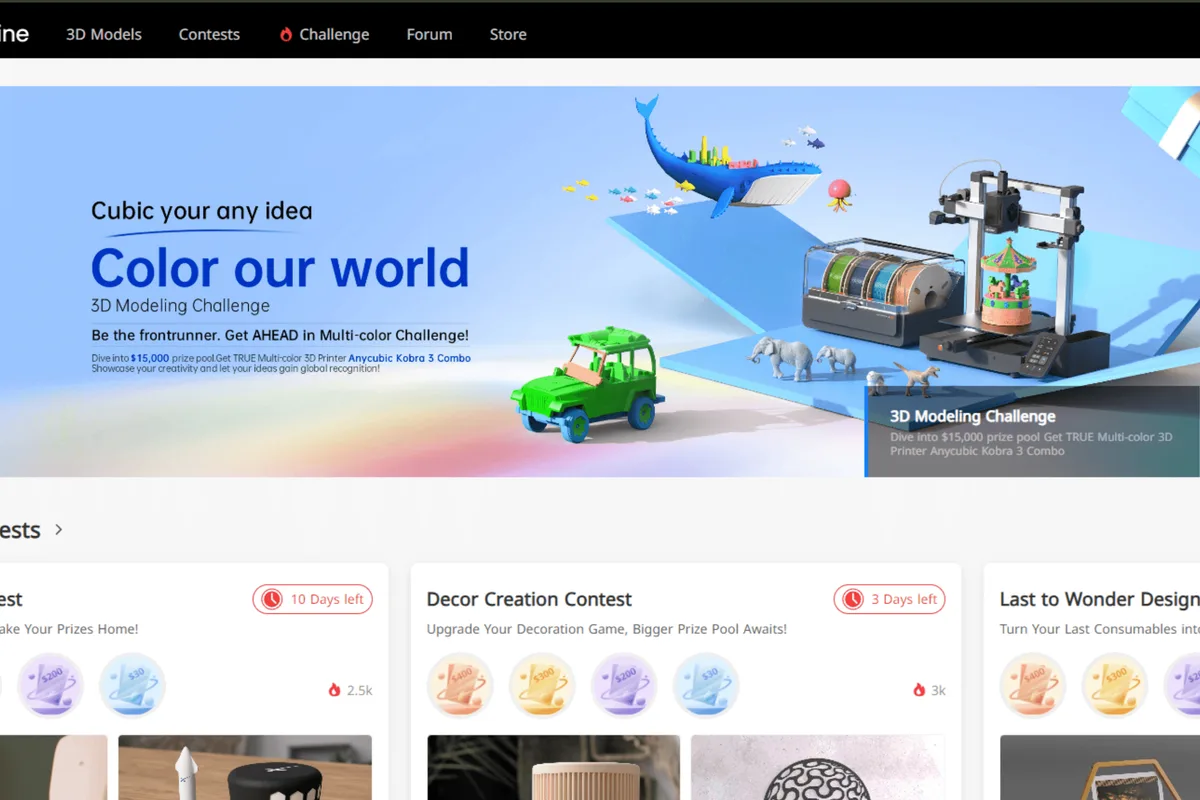
Which Anycubic printers will be supported?
The official announcement refers to compatible printers without publishing an exhaustive model list.
Specialist reporting has mentioned the Kobra X as an example of a machine that could benefit from the integration.
However, this should not be interpreted as confirmation that every Anycubic printer will support every feature.
Multicolor capability depends on the machine and its filament-handling accessories.
A printer designed for single-color output may still print suitable models without supporting their multicolor configurations.
A multicolor machine may need profiles tailored to its specific setup.
Software compatibility and hardware capability are therefore distinct considerations.
Existing Anycubic owners should treat the announcement as a prospective feature until their exact configurations are officially supported.
Anycubic has not acquired Thingiverse
The word exclusive may create confusion about ownership.
Anycubic has not purchased Thingiverse.
The platform became part of the MyMiniFactory group after being acquired from UltiMaker in February 2026.
The new agreement concerns content integration and the preparation of selected printable designs.
The precise contractual scope of the exclusivity has not been disclosed.
It would be incorrect to claim that Thingiverse is becoming unavailable to owners of other printer brands.
The original repository remains a separate community platform.
The exclusive arrangement may concern particular integration rights, but the public announcement does not explain every restriction.
Creators will need to opt into the program
The rights of designers are a significant part of the agreement.
Romain Kidd told Tom's Hardware that Thingiverse creators would need to opt into the integration.
This matters because community models can be distributed under different licenses.
Some permit broad reuse, while others require attribution or restrict commercial activity.
The companies say they will preserve existing Creative Commons and NonCommercial licensing conditions.
Converting a model into a more convenient 3MF file does not remove the restrictions attached to the original design.
A user who downloads a model for personal printing should not automatically assume that selling printed copies is permitted.
Commercial use depends on the applicable license and any additional permissions.
Multicolor conversion can raise derivative-work questions
Converting STL geometry into a 3MF project may appear to be a purely technical operation.
However, adding color regions or modifying the underlying model can create a file that differs from the original creation.
Some licenses permit such modifications, while others restrict derivative works.
The treatment of designs distributed under NoDerivatives conditions may therefore require particular attention.
Anycubic and Thingiverse say they intend to respect original creator rights.
They have not published a complete explanation of their selection, conversion and permission-enforcement procedures.
The availability of a downloadable file does not, by itself, grant permission for every possible redistribution or adaptation.
Creator confidence will depend on how transparently those rules are implemented.
The partnership strengthens Anycubic's content ecosystem
Competition in consumer 3D printing increasingly extends beyond the specifications of individual machines.
Software, ready-to-print projects and community resources have become important purchasing considerations.
An integrated experience can reduce the number of external services a customer must use.
Bambu Lab's MakerWorld provides an example of a model platform closely connected to a printer ecosystem.
Anycubic is pursuing a related strategy by developing Makeronline.
The Thingiverse partnership could give it access to a much larger content library without building every community relationship from scratch.
That may help attract new users and retain existing customers.
However, it also raises questions about whether increasingly integrated platforms will encourage long-term dependence on particular hardware brands.
The practical benefits will need to outweigh any limitations created by the ecosystem.
Convenient files do not eliminate printing constraints
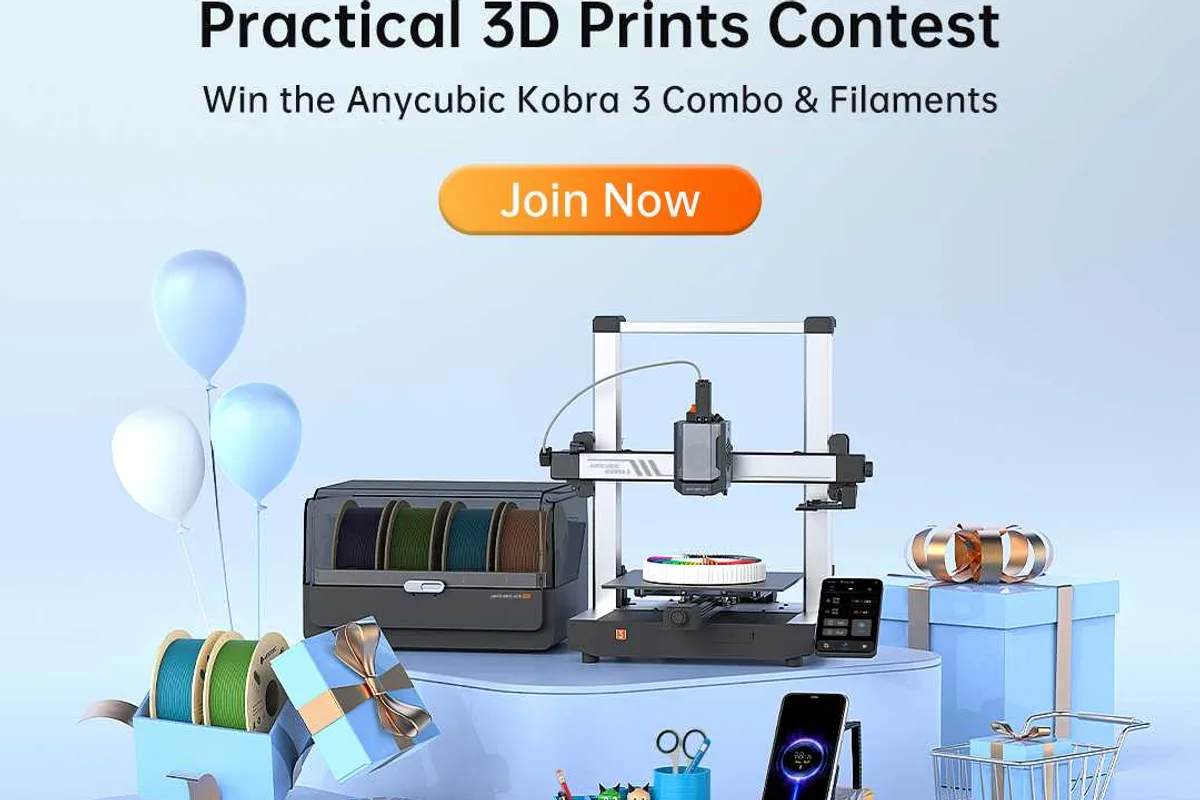
Even a carefully prepared 3MF file cannot guarantee a successful physical print.
Filament quality, bed adhesion, machine calibration and thermal settings still affect the result.
Multicolor printing may also require additional filament changes and produce more material waste.
Total printing time can increase depending on the object and equipment.
A project that is easy to load can therefore still be relatively expensive or time-consuming to manufacture.
The user experience should be judged by printing reliability and results, not simply by the number of clicks required.
Important questions remain unanswered
Several practical details have not been publicly confirmed.
The companies have not stated how many multicolor 3MF models will be available on launch day.
A complete printer compatibility list is also missing.
The criteria for selecting models and the detailed scope of the exclusive arrangement remain unclear.
Neither company has publicly explained whether creators will receive specific payments through the partnership.
That lack of information does not prove that no commercial arrangements exist.
It simply means their terms have not been established publicly.
The final opt-in experience and the reliability of converted files remain to be tested.
November 17 will be the real test
Anycubic and Thingiverse bring complementary resources to this agreement.
One supplies consumer printing hardware and software, while the other offers a vast community library.
The integration could be particularly valuable for newcomers to multicolor printing.
However, the figure of more than two million models is not enough to measure the quality of the service.
The key questions concern how many files are genuinely ready to print, which machines can use them and whether designers retain meaningful control over their work.
The partnership was announced October 23 and attracted renewed attention through November 1 reporting.
Its dedicated Makeronline section remains scheduled for November 17.
The companies have outlined a more integrated route from discovering an object to printing it.
Whether that experience is genuinely simpler and respectful of creators' rights will become clearer only after the service launches.