
 By Tsuky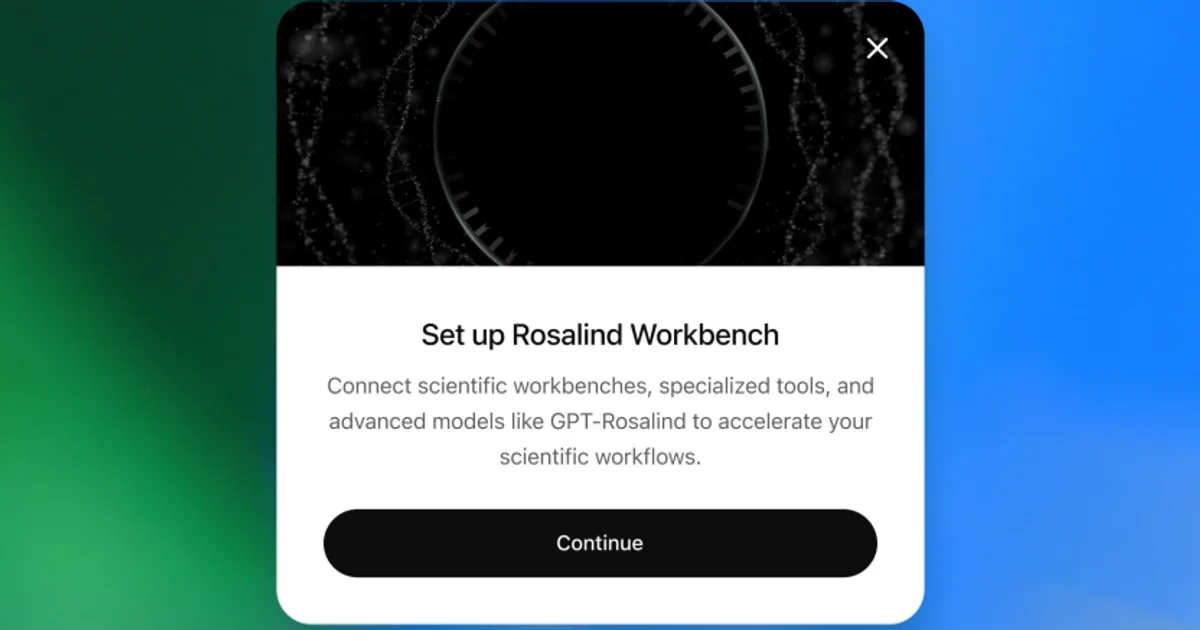
Scientific research rarely happens in a single application. A team investigating a biological mechanism may move between papers, molecular databases, statistical software, visualization tools and experimental records. Much of the work involves reconstructing how findings from one source relate to information held somewhere else.
OpenAI believes a specialized AI model can make that process less fragmented. Its Rosalind Workbench is designed to bring scientific tools and model reasoning into shared workflows, allowing researchers to move from questions to evidence without constantly rebuilding context.
The company now wants to put those capabilities into more university laboratories.
On October 15, OpenAI introduced the Rosalind Academic Plan. Eligible academic labs can apply for up to 30 complimentary ChatGPT Business Standard seats for as long as 12 months, along with an opportunity to activate GPT-Rosalind after passing a trusted-access review.
This is not a general free release of the model. The offer is limited to laboratories at US universities, and its specialized research capabilities are not automatically unlocked by receiving the seats.
What the academic offer actually pays for
The subscription element is straightforward. An approved laboratory can receive up to 30 Business Standard seats at no monthly charge for a maximum of one year.
These accounts provide a managed ChatGPT workspace, access to eligible commercially available OpenAI models and Codex capabilities within the limits of the relevant plan.
GPT-Rosalind access is handled separately. The laboratory must complete OpenAI's trusted-access process, and its principal investigator or designated lead must enable access for eligible members.
The model is therefore not simply another option that every participant can select from an unrestricted model menu.
There are financial and technical boundaries too. The program does not include API credits or GPT-Rosalind API access. A laboratory that relies on custom software to automate scientific analysis cannot assume the promotion will fund direct model integration.
OpenAI's support documentation also says a payment card is required during setup. Beneficiaries must review the applicable terms and any charges once the promotional period ends.
The practical saving could make experimentation easier, but it does not establish the long-term operating cost of a research workflow that becomes dependent on the model.
Rosalind already existed before the academic announcement
The October launch is best understood as a new access program rather than a new AI model.
OpenAI first introduced GPT-Rosalind in April 2026 for work involving biology, drug discovery and translational medicine.
The company expanded the model's scientific capabilities in June and announced broader trusted availability for eligible organizations in September. Published commercial pricing began applying in October.
The Rosalind Academic Plan builds on that existing product by creating a sponsored route for qualifying university labs.
Keeping those developments separate is important when assessing availability. A model can be generally offered to approved organizations while remaining unavailable to individual consumers and to laboratories that have not completed the necessary review.
The academic promotion does not change the underlying requirement for permission to use the specialized system.
A workbench for research, not merely a biology chatbot
GPT-Rosalind is designed to reason about problems in the life sciences. But its potential usefulness also depends on whether it can work with the tools researchers already use.
Rosalind Workbench aims to connect literature, databases, analysis environments and scientific viewers within a more coherent process.
Consider a researcher examining a protein. A typical investigation may involve consulting prior studies, reviewing sequence information, inspecting a three-dimensional structure and comparing potential biological interpretations.
Those steps use different forms of evidence. A conversational summary alone cannot replace the underlying data or the ability to inspect it.
OpenAI has demonstrated Workbench capabilities involving molecular visualization, sequence alignment and sequencing-data analysis. The goal is to keep the research question and relevant outputs connected as the scientist works through successive decisions.
That approach may help reduce repetitive data handling and make complex workflows easier to follow.
It does not eliminate the need to inspect methods, verify statistical assumptions or determine whether a generated interpretation is biologically defensible.
A tool that links several scientific resources can create real efficiencies while still making errors in how it interprets their contents.
The range of proposed applications is unusually broad
Drug discovery is the most obvious application, but OpenAI presents GPT-Rosalind as a platform for a much wider range of scientific questions.
Its stated research areas include therapeutic proteins, peptides, enzymes and the evaluation of molecular properties relevant to drug development.
The company also describes possible applications in disease detection, diagnostic research, genomic analysis, genetic therapies and RNA-based treatments.
Work involving immune responses and vaccine research is another category, as are studies of antimicrobial resistance.
Outside human medicine, the list extends to agriculture, animal health, ecology and conservation. Researchers could use related analytical tools to investigate crop resilience, biodiversity or biological responses to environmental change.
These are areas in which OpenAI intends the model to assist legitimate research. They are not a list of experimentally verified discoveries produced by the academic program.
The distinction is essential. A model might identify a plausible molecular interaction without proving it occurs under real biological conditions. It can help prioritize questions without demonstrating that a treatment is safe or effective.
The value of such assistance depends on subsequent validation, the quality of available evidence and the expertise of the research team.
Early university examples reveal both the appeal and the limitations
OpenAI's announcement includes accounts from academic researchers already exploring GPT-Rosalind.
The Zhao Lab at the University of California, San Francisco, describes using the system to gather drug-related physicochemical properties more quickly. Tools connecting to PubChem and NCBI helped the team compare information across multiple drugs.
One particularly relevant point in that account is the need to distinguish predicted properties from values measured in experiments.
That distinction captures a larger challenge for scientific AI. Information retrieved or generated by a model may appear in a consistent format even when its underlying reliability varies considerably.
Mathieu Bourdenx describes using GPT models throughout research activities, including literature exploration and refinement of experimental approaches.
Brian Hie, associated with Stanford University and Arc Institute, highlights the possibility of applying Rosalind to discovery and design work at larger scales.
These accounts are useful illustrations of how researchers approach the technology. They are not controlled studies establishing a particular improvement in experimental success rates or drug development timelines.
The academic announcement does not present independently validated clinical outcomes attributable to GPT-Rosalind.
For now, the strongest directly supported claims concern the kinds of workflows researchers are exploring and the access conditions OpenAI is offering.
The US-only restriction limits the immediate impact
Eligibility is one of the most important details in the announcement.
The sponsored academic offer is currently available only to laboratories affiliated with US universities.
Researchers in Europe, Asia or other regions cannot assume their institutions qualify for the same complimentary seats.
That does not mean GPT-Rosalind is entirely unavailable outside the United States. OpenAI separately offers trusted access to eligible organizations through its broader commercial and research arrangements.
The restriction applies specifically to this academic promotion.
OpenAI has not announced when or whether the sponsored program will expand internationally.
For European universities, the distinction matters because the economics of specialized AI tools may influence which laboratories can experiment with them and how quickly those tools become embedded in research practices.
A university that does not qualify for the promotion must evaluate other access arrangements and any associated costs.
Approval involves institutional and biological safety checks
GPT-Rosalind is not deployed through the same unrestricted access model as a general-purpose consumer chatbot.
Some life-sciences research involves sensitive biological questions and capabilities that require appropriate oversight. OpenAI uses its trusted-access process to evaluate who may use the specialized system and for what purposes.
A principal investigator or designated laboratory lead must submit the application. The review examines the institution, the applicant's identity and authority, the laboratory's research activities and the intended uses of the model.
The process also requires a designated institutional biosafety contact.
The company says monitoring and enforcement continue after approval, with access remaining subject to responsible-use requirements.
For universities that already have an OpenAI Enterprise agreement, requests must proceed through the existing institutional route rather than through an independent laboratory application.
These conditions make adoption more involved than purchasing an ordinary software subscription.
They also reflect the challenge of making powerful scientific capabilities useful to legitimate researchers while managing the risks associated with sensitive biological applications.
The announcement describes the safeguards, but it does not independently demonstrate how effective they will be in every research setting.
Data handling requires more than a training opt-out
OpenAI says research data shared under the Rosalind Academic Plan is not used to train its models by default.
For teams working with unpublished findings or commercially sensitive information, that is a relevant assurance.
It should not be confused with a promise that submitted material is never retained.
The offer uses a managed ChatGPT Business workspace subject to its usual data-handling conditions. According to OpenAI's support documentation, Zero Data Retention is not available under this promotion.
Laboratories must therefore review their institutional policies and any obligations governing the information they intend to upload.
This can include restrictions arising from research collaborations, contractual confidentiality and applicable rules governing sensitive data.
Administrators also need to manage account permissions and access when researchers join or leave a team.
A shared workspace can simplify collaboration, but a laboratory should not treat its inclusion in an academic research offer as a substitute for internal data governance.
The longer-term question is who controls the research workflow
Providing free access is an effective way to encourage researchers to test a new tool. It may also shape how they organize their work after the promotion ends.
Once an AI environment is connected to a laboratory's preferred databases, analysis tools and internal processes, replacing it may require retraining staff and rebuilding integrations.
That does not make the arrangement inherently undesirable. A reliable platform can save time and reduce administrative friction.
But the economics of academic research often differ from those of commercial software development. University teams may depend on fixed grants and struggle with recurring costs that increase after an introductory period.
For OpenAI, the program creates an opportunity to establish GPT-Rosalind inside real scientific workflows and learn how researchers use specialized AI assistance.
For universities, the decision is more complicated. They need to consider immediate productivity, scientific reproducibility, costs after the first year and the possibility of vendor dependence.
The presence of a specialized model does not guarantee that an institution should standardize all its research activity around it.
Access is expanding faster than evidence of scientific impact
The Rosalind Academic Plan lowers a practical barrier for a defined group of university researchers.
It makes sponsored access available to qualifying US laboratories and provides a path to a model intended for complex scientific work, with explicit controls on eligibility and use.
What remains uncertain is how much scientific value the system will deliver across different laboratories and disciplines.
Meaningful assessment will require more than testimonials. Researchers will need to compare workloads, verify outputs, examine errors and determine whether the model improves the quality of decisions as well as the speed of producing them.
Scientific discovery depends on evidence that can withstand scrutiny. A generated hypothesis is a starting point, not an experimental finding.
OpenAI's new program may help more teams explore that distinction in practice. Its success will be measured less by the number of complimentary seats awarded than by whether researchers can obtain reliable, reproducible results without surrendering control of their methods and data.