
 By Adri
Installing Linux on a recent laptop does not always guarantee that every component will work immediately.
The processor, graphics hardware and storage may be recognized correctly while smaller peripheral devices still require specialized software.
Integrated webcams are among the components that can present compatibility problems.
On modern laptops, a camera is no longer necessarily a simple sensor delivering images directly to the operating system.
It may depend on multiple hardware and software components that manage capture and image processing.
Intel uses dedicated image processing units, or IPUs, for these tasks on selected mobile platforms.
With Linux 7.4, developers have reached another milestone: initial support for IPU8 is now integrated into the mainline kernel development process, ahead of future Nova Lake laptops.
IPU8 is Intel's next-generation image processing hardware
Intel IPU8 represents a new generation of the image processing architecture used on selected mobile platforms.
Its purpose is to handle operations involved in capturing images from compatible laptop camera sensors.
The new hardware is intended for upcoming high-end systems powered by Nova Lake processors.
According to Phoronix, those laptops are expected in 2027.
Work on their Linux compatibility is therefore progressing before commercial availability.
That preparation matters to PC manufacturers, kernel developers and Linux distribution maintainers.
A driver integrated early can be tested and improved for months before the first customers receive the hardware.
When support arrives only after a laptop launches, early buyers may experience compatibility issues for an extended period.
Why modern webcams need image processing units
A laptop camera consists of multiple elements.
The sensor converts incoming light into digital information.
Those data must then be organized, processed and delivered to applications capable of displaying or recording images.
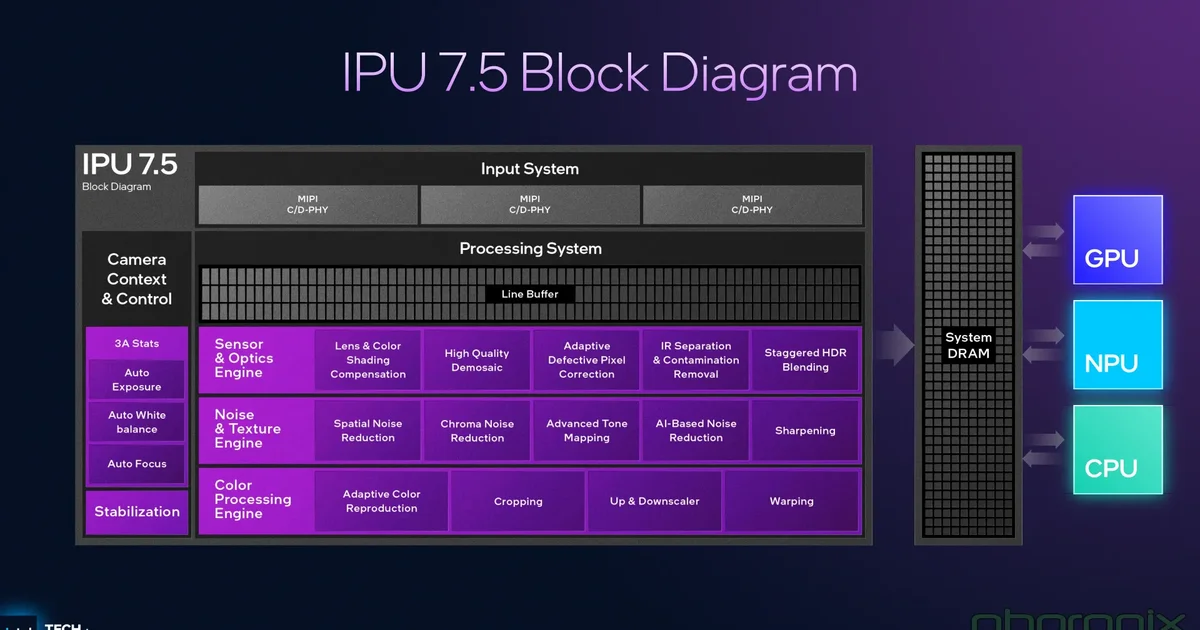
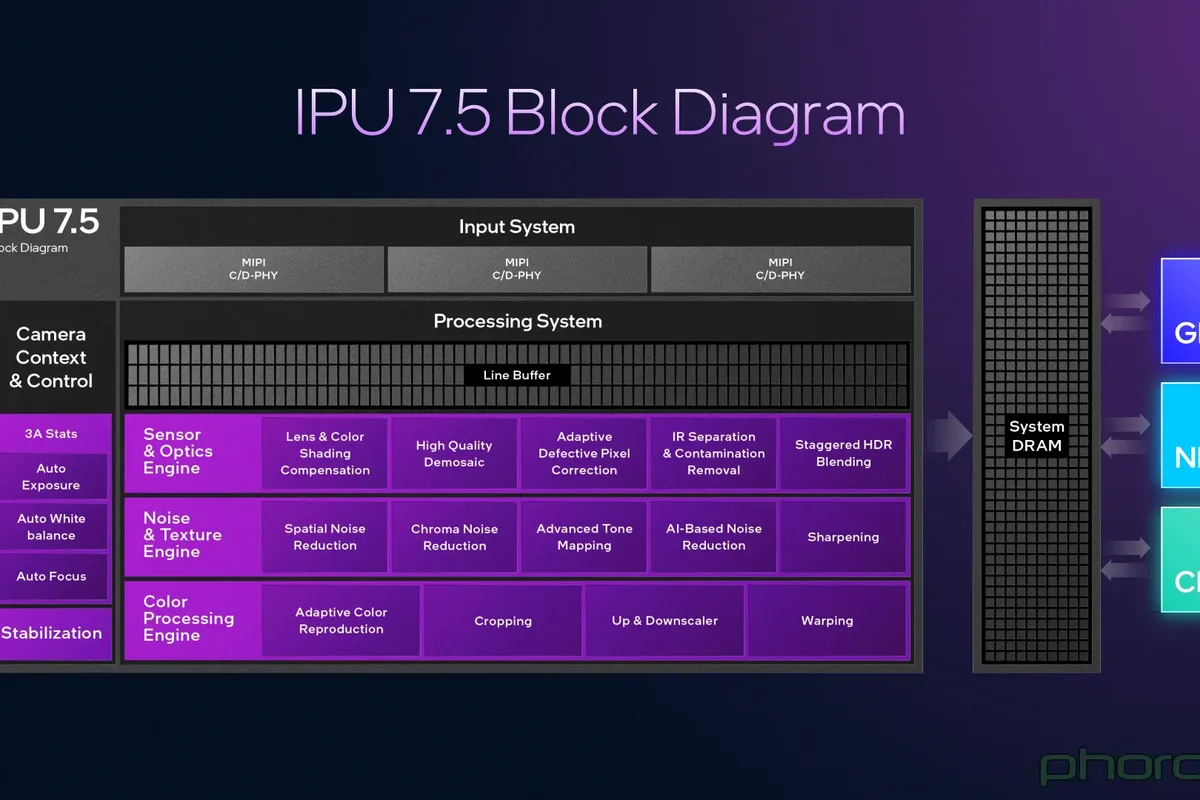
An image processing unit can handle operations involving color correction, noise reduction, exposure, white balance and processing sensor data.
The complete system also needs to operate within a laptop's power constraints.
Some designs use specialized interfaces such as MIPI CSI-2 to connect image sensors to their processing hardware.
A dedicated IPU provides a hardware architecture for organizing these tasks.
However, the operating system must understand how to communicate with it.
Without suitable drivers, a video conferencing application may receive no usable image even when the physical camera sensor is functioning correctly.
The required hardware support is entering the mainline kernel
The October 26 development concerns the integration of changes into the mainline Linux kernel.
Intel engineers had already submitted a series of IPU8 patches on September 30.
The series, prepared by Divyamani Tripathi, introduces several components needed to operate the new hardware.
It adds the PCI identifier used to recognize IPU8.
It also modifies internal interfaces used to communicate with firmware.
Other changes concern hardware initialization, synchronization features and memory translation management.
These details may seem distant from the everyday experience of using a webcam.
However, they are fundamental.
Before displaying an image, the operating system must detect the device, initialize its resources and communicate with its firmware.
Integrating those functions is an essential step toward working camera capture.
Why the driver still carries the IPU6 name
An interesting aspect of this development is that the main driver retains the IPU6 name.
That does not mean Linux treats different hardware generations as identical.
Developers are extending an existing software infrastructure to support multiple image processing units.
The objective is to share common functionality rather than maintain completely separate implementations unnecessarily.
Operations involving resource allocation, device organization and interaction with kernel interfaces may be reused.
Hardware-specific behavior remains controlled through dedicated checks.
The IPU8 patches, for example, preserve distinct checks for IPU7 and IPU8.
That prevents code written for one hardware generation from being applied automatically to another.
The historical name of a driver therefore does not define the number of generations it can support.
IPU7 and IPU7.5 are joining the same infrastructure
Linux 7.4 is not introducing IPU8 support in isolation.
The IPU6 driver is also gaining support for the IPU7 and IPU7.5 generations.
These technologies are associated with recent Intel platforms, including Panther Lake.
Their development had already progressed through other parts of the Linux ecosystem.
Bringing their support into a shared infrastructure consolidates that work.
This approach may simplify long-term maintenance.
When a fix concerns a shared function, it can potentially benefit multiple hardware generations.
It may also reduce the need to maintain parallel implementations of similar operations.
However, this consolidation does not eliminate the functional differences between IPU7, IPU7.5 and IPU8.
Each generation retains its own capabilities and requirements.
The patches have already been tested on IPU8 hardware
Intel's submitted patch series includes an important detail: the changes have been tested on IPU8 hardware.
The developers were therefore not simply preparing theoretical hardware identifiers for an upcoming product.
They were able to verify selected operations using equipment based on the new architecture.
That strengthens the technical relevance of the contribution.
However, the scope of this validation must remain clear.
Testing a driver on development hardware does not establish that every camera in every future Nova Lake laptop will work immediately.
Laptop manufacturers may use different sensors, hardware arrangements and device-specific firmware.
Each complete camera pipeline must therefore be validated.
Image processing unit support is an important prerequisite, not a universal compatibility guarantee.
A working webcam depends on more than one driver
The complexity comes from the organization of modern video capture.
Several components must communicate correctly before an application can display an image.
The operating system must recognize the sensor.
The image processing unit must be initialized.
The required firmware must be available and compatible.
Video data must then be exposed through suitable interfaces for applications.
On Linux, Video4Linux2, commonly known as V4L2, plays an important role in that process.
Applications also rely on multimedia libraries and additional software layers to access the camera.
A hardware driver can therefore be present in the kernel without every capture function being immediately available to applications.
Firmware availability and sensor configuration remain essential.
Linux 7.4 does not guarantee every future Nova Lake webcam will work
It would be tempting to summarize this development by saying that future Nova Lake laptops will now have fully working Linux webcams.
That would go beyond the available evidence.
The kernel is gaining mechanisms required to recognize and initialize IPU8.
Complete integration still needs to be verified on the computers that eventually use it.
Additional software components may be required depending on each laptop's design.
Manufacturers must also provide appropriate configurations and firmware.
Finally, Linux distributions need to include compatible kernel versions and supporting components.
The code integration is therefore a real milestone, not a blanket certification of future webcams.
Why mainline support matters for Linux distributions
Nevertheless, adding the driver to the mainline kernel provides a substantial advantage.
Linux distributions generally build on the official kernel, sometimes including their own fixes and configuration adjustments.
When a driver is maintained separately, distribution and maintenance can become more complicated.
It may require adaptation whenever the kernel changes.
Mainline integration generally makes it easier to review updates and maintain compatibility with the evolving operating system.
The relevant subsystem maintainers can examine future fixes.
Distributions also gain a common foundation for preparing support.
However, that does not mean Ubuntu, Fedora, Debian and every other distribution will receive the feature simultaneously.
Their release and kernel update schedules differ.
Some adopt new kernel versions rapidly, while others prioritize long-term maintained branches.
Availability on a specific computer will therefore depend on the software actually installed.
New Sony, Samsung and OmniVision sensor drivers
Linux 7.4's media subsystem update includes additional hardware support.
Developers are adding drivers for several image sensors.
The list includes the Sony IMX576.
It also includes OmniVision's OS02G10, OV05C10 and OG0VA1B.
Samsung's S5KJN5 and Himax's HM1246 are among the other supported sensors.
These additions extend the kernel's ability to recognize different imaging hardware.
They do not mean that every listed sensor will appear in Nova Lake laptops.
The devices cover different hardware families and potential capture applications.
Linux's media subsystem supports far more than laptop webcams.
It also serves embedded platforms and specialized imaging systems.
Rockchip, NXP and Qualcomm also receive new media support
The Linux 7.4 development cycle includes extensions for several other hardware platforms.
Rockchip RK3576 gains a driver for selected MIPI capture functionality.
NXP i.MX95 receives additions related to camera pixel formatting.
Other changes address Qualcomm and STM32 devices.
Selected Maxim components used in video links also appear in the update.
In addition, ITE IT6625 and IT6626 HDMI bridge chips gain specific support.
These changes illustrate the breadth of Linux's media infrastructure.
It covers more than playing video files or running conferencing applications.
It also includes the hardware interfaces needed by cameras, capture controllers and industrial systems.
Video4Linux2 continues to evolve
The changes also include improvements to Video4Linux2.
This framework provides important interfaces used by drivers and software to manage video devices.
Linux 7.4 corrects information associated with the P010 pixel format and adds details for Y12.
Development also includes internal interface improvements related to subdevices and pixel format descriptions.
These changes can simplify the integration of capture hardware.
They do not directly represent a new feature immediately visible to every desktop user.
Their purpose is to improve the tools developers use to connect the different stages of a video pipeline.
That shared infrastructure becomes especially important as hardware platforms grow more complex.
Why Intel is preparing drivers before laptop launches
Driver development often begins long before a new processor reaches the market.
Engineers use validation platforms to test hardware and software components.
Patches are then submitted to the Linux community for review.
Subsystem maintainers can request changes before accepting the code.
That process takes time, particularly when a driver interacts with multiple kernel interfaces.
Submitting early IPU8 patches months before Nova Lake laptops arrive gives the community time to perform this work.
It improves the chances that the software foundation will be sufficiently mature by the time consumers receive the hardware.
Early integration cannot guarantee the absence of problems.
It does, however, reduce the need to begin development only after products are released.
Should users install Linux 7.4 immediately?
Owners of current laptops do not need to rush into an experimental kernel installation because of this development.
Linux 7.4 remains under development.
Its changes will continue to be tested before a stable release.
Distributions will then decide when to incorporate the updates.
On existing computers, webcam functionality depends on the specific hardware and available software support.
A laptop using IPU6, IPU7 or IPU7.5 may benefit from different changes than a future IPU8 system.
Users should therefore consult compatibility information for their exact laptop model.
Those experiencing webcam problems can also check the kernel versions and firmware packages recommended by their distributions.
IPU8 support is not a universal fix for every currently malfunctioning camera.
A quiet but important step for future Linux laptops
Intel IPU8 support will not immediately transform the experience of most Linux users.
The Nova Lake laptops intended to use the new hardware are not yet commercially available.
There is no basis for claiming measurable webcam image-quality improvements from this driver integration alone.
Nevertheless, merging the code into Linux 7.4 represents meaningful progress.
The kernel now contains the initial mechanisms required to recognize and initialize the new generation of image processing units.
Consolidating IPU7 and IPU7.5 support within the existing driver should also simplify maintenance across several platforms.
The remaining task is to validate sensors, firmware and complete capture pipelines on shipping laptops.
That is precisely why the announcement matters: the work is progressing before the computers arrive.
For future Intel laptop owners running Linux, having the necessary drivers developed early could make the difference between a webcam that works during initial setup and months of frustrating compatibility issues.