
 By Adri
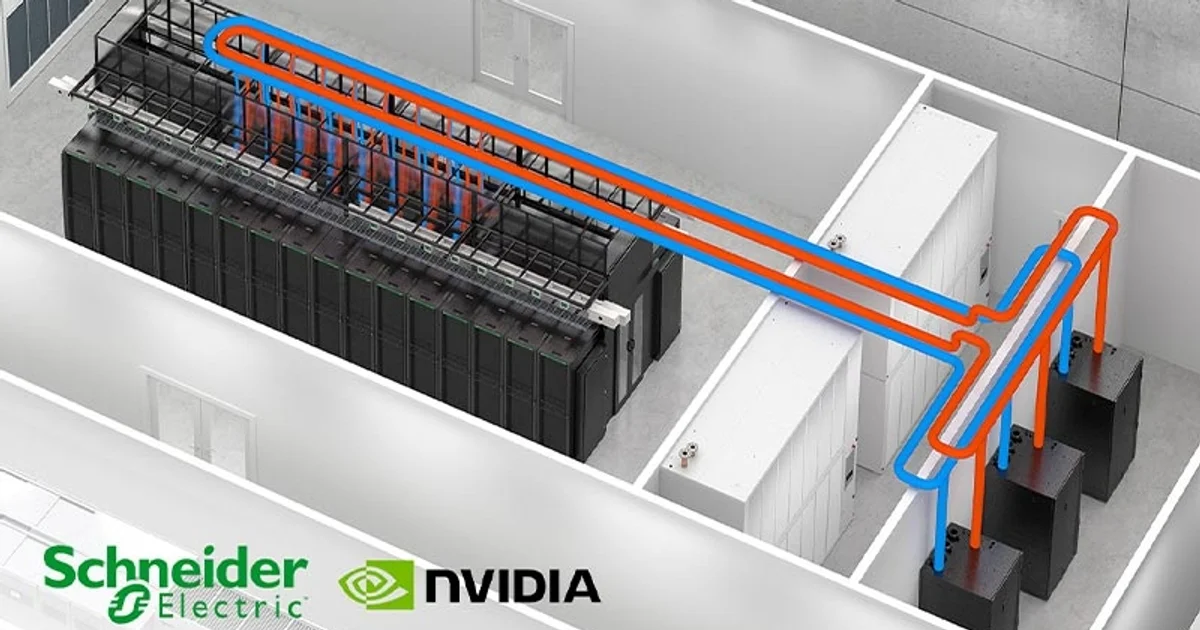
A data center can have space for additional servers without having the electrical and cooling capacity required to operate them.
As AI accelerator density increases, those infrastructure constraints become more closely connected.
A higher-powered GPU cluster can change the demands placed on electrical distribution, cooling circuits and facility operations.
Schneider Electric and NVIDIA are testing an approach intended to make those relationships easier to understand before equipment is installed or infrastructure is modified.
The system is called Immersive Twin.
Announced on October 21, the pilot involves Schneider Electric, NVIDIA, AVEVA, ETAP, Nscale and Start Campus.
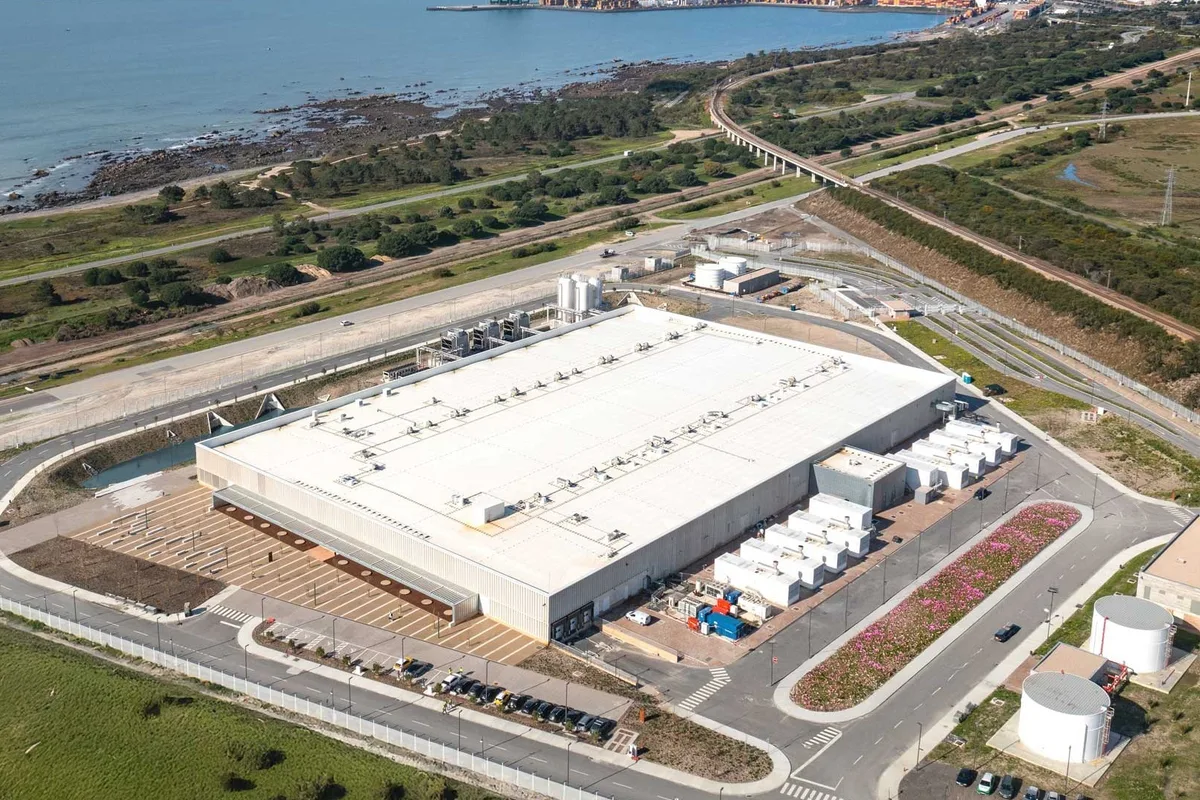
It focuses on Nscale's operations within the SIN01 facility at the SINES Data Campus in Portugal.
The objective is to bring engineering models, operational information and AI workload requirements into a shared digital environment.
Operators could then evaluate potential infrastructure modifications before implementing them in a live facility.
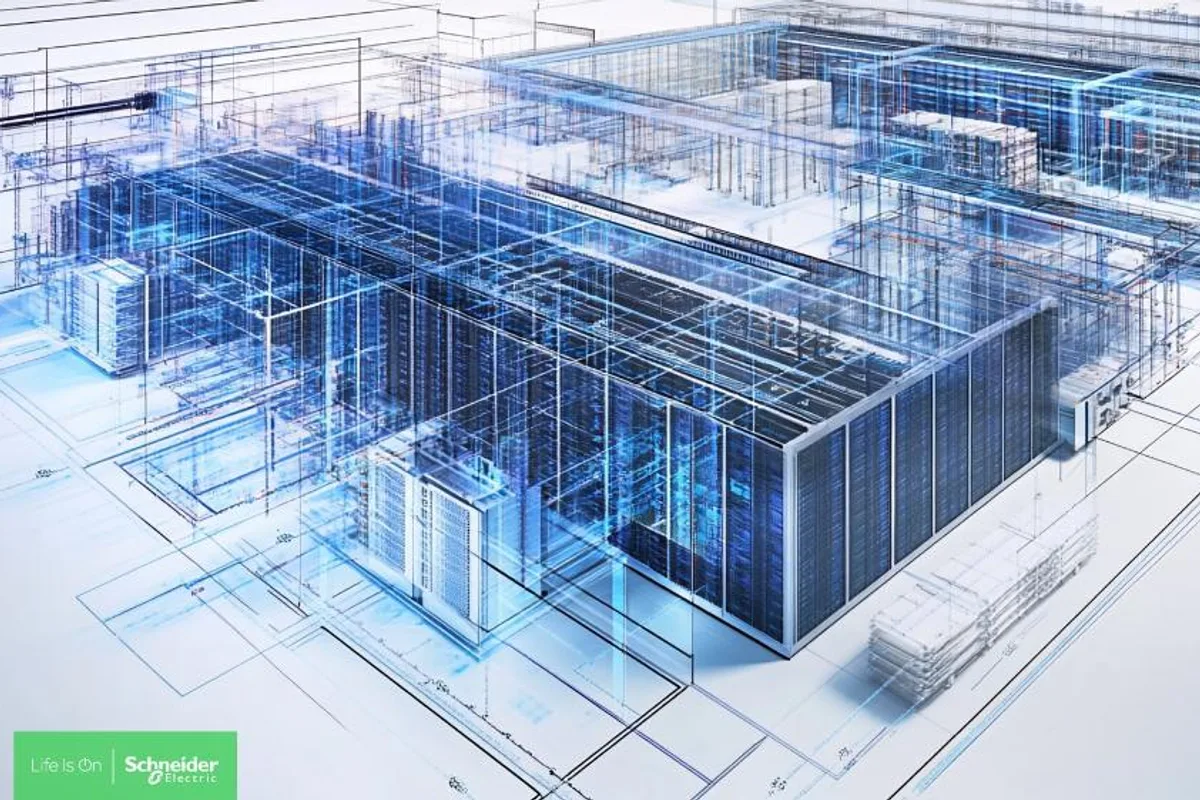
The digital twin is more than a 3D model
Digital twins are often associated with three-dimensional representations of buildings and industrial equipment.
Visualization is only one part of their potential value.
A useful data center model must also represent electrical capacity, thermal behavior, equipment dependencies and the operating characteristics of computing workloads.
Immersive Twin aims to combine these different forms of information.
For example, a new generation of GPU racks may increase power demand within one part of a building.
The total electrical capacity of the campus might appear sufficient, while a particular distribution component could still become a bottleneck.
Higher computing density may also change cooling requirements.
A simulation could help operators evaluate these interactions before making physical changes.
Such modeling is potentially useful when deciding whether existing systems can accommodate additional equipment or whether infrastructure upgrades are required.
Its accuracy still depends on the quality of the underlying engineering assumptions and measurements.
NVIDIA Omniverse provides the simulation framework
The project is built around NVIDIA's Omniverse DSX Blueprint.
NVIDIA is extending its role beyond providing GPUs by developing software tools for designing and evaluating the facilities that operate AI computing infrastructure.
The DSX Blueprint provides a framework for representing and simulating AI factory environments.
Schneider Electric contributes expertise in energy systems, facility infrastructure and data center operations.
AVEVA provides industrial engineering and operational software.
ETAP contributes electrical modeling and simulation technology.
Nscale operates the AI computing infrastructure involved in the pilot, while Start Campus develops the SINES facility.
These roles are complementary.
A GPU performance model does not independently describe how an electrical network behaves under changing demand.
Similarly, an electrical engineering model may not fully capture the operating patterns of complex AI workloads without relevant computing data.
Connecting those different domains is the central challenge.
OpenUSD helps link different engineering systems
Interoperability is an important part of the pilot.
Software used for architectural design, electrical simulation and facility operations does not necessarily share the same data structures.
The project uses OpenUSD to help connect three-dimensional representations and associated information.
OpenUSD originated as a framework for describing complex digital scenes and the relationships between objects.
Its adoption can make it easier to exchange models between tools that would otherwise operate separately.
However, using a common scene description format does not automatically solve every integration problem.
Accurate simulation still requires relevant physical properties, operational data and models describing how equipment behaves.
A three-dimensional representation of a server rack is not enough to determine its electrical consumption or cooling requirements.
Those values must be supplied and validated through appropriate engineering systems.
Liquid cooling makes infrastructure modeling more important
AI accelerator density is increasing pressure on data center cooling infrastructure.
Air cooling remains common, but high-density computing installations are increasingly adopting liquid-cooling technologies.
These systems use pumps, piping, heat exchangers and control equipment to manage thermal loads.
Their performance depends on factors including liquid temperature, flow rate and the thermal requirements of the servers.
Adding more powerful hardware can alter those conditions.
A digital twin could allow engineers to model changes in rack density or cooling configuration before physically modifying the installation.
That may help identify potential limitations and avoid costly redesigns.
However, simulated behavior must still be compared with measurements from the actual facility.
Without that validation, even a sophisticated model remains an estimate rather than proof of real-world performance.
Electrical distribution is becoming a critical AI constraint
An AI data center needs sufficient power to operate its hardware, but total site capacity is only part of the equation.
Electricity must be distributed through transformers, switchgear, backup systems and other components before reaching individual racks.
These elements have specific capacities and operating limits.
Different AI workloads can also have different power consumption patterns.
Intensive training operations may keep accelerators highly utilized for extended periods, while inference demand can vary with traffic and application behavior.
ETAP's electrical modeling capabilities are intended to help represent these relationships within Immersive Twin.
Operators could evaluate potential changes in computing capacity alongside the corresponding electrical requirements.
This may help identify infrastructure constraints that would not be obvious from headline power capacity figures.
The practical benefit will depend on the model's accuracy and its integration with operational measurements.
Portugal provides a large-scale development environment
The pilot operates at SIN01, part of the SINES Data Campus developed by Start Campus.
The site is located in Sines, on Portugal's Atlantic coast.
The broader campus is designed for eventual capacity of up to 1.2 gigawatts.
That is the project's planned development capacity, not the amount of power currently consumed by installed AI equipment.
The companies have also discussed the prospect of hosting more than 66,000 NVIDIA Rubin GPUs.
This figure should be understood as a projected capacity or deployment ambition.
The announcements do not establish that all those processors are already installed and operational at SIN01.
No detailed schedule has been disclosed showing when the entire planned GPU capacity would be available.
The campus is an appropriate test environment because its infrastructure is intended to evolve.
Operators planning future expansion need to compare the electrical, cooling and computing requirements of equipment that may not yet be physically installed.
A shared digital model could help evaluate those alternatives before major capital decisions are made.
More AI tokens per watt remains an unproven outcome
The companies describe the pilot as a way to improve computing output and efficiency.
The concept is that better infrastructure coordination could reduce operational constraints affecting GPU performance.
In some environments, electrical or thermal limitations may prevent installed computing hardware from achieving its intended throughput.
Addressing those bottlenecks could improve practical performance.
But token generation depends on many factors beyond facility infrastructure.
Model architecture, prompt length, batching, inference software and accelerator configuration all influence output.
Better cooling does not automatically increase token throughput if the hardware was already operating without thermal restrictions.
Likewise, reducing facility energy overhead does not necessarily produce a proportional reduction in energy consumption per generated token.
As of October 22, the partners have not published detailed results demonstrating a specific improvement in token throughput, electricity consumption or cooling efficiency from the SINES pilot.
Independent validation comparing the twin's predictions with measured operating conditions has not been publicly presented.
These outcomes remain goals to be evaluated rather than established performance gains.
Deployment planning may deliver benefits before daily operations
One of the most immediate potential benefits concerns infrastructure commissioning.
Industry experts consulted by TechTarget highlighted the possibility of identifying design issues before hardware arrives.
Incorrect sizing of electrical or cooling systems can delay the deployment of expensive AI equipment.
Such problems may require design changes, additional construction work or replacement components.
Testing configurations digitally could reduce the likelihood of those disruptions.
Engineers might use the model to evaluate different electrical architectures or verify that planned cooling capacity matches the hardware requirements.
The approach could also help coordinate teams responsible for computing infrastructure and physical facilities.
It does not remove the need for real-world electrical safety tests, equipment inspections or commissioning procedures.
A digital twin is better understood as an additional planning and validation tool than as a replacement for physical engineering checks.
Simulation and autonomous control are not the same thing
Digital twins can operate at different levels of integration.
A basic implementation represents an installation and allows engineers to run hypothetical scenarios.
A more advanced system connects the model to current operating measurements.
Eventually, some systems may recommend or automatically apply changes to physical infrastructure.
That last stage introduces additional safety, security and reliability requirements.
For the SINES pilot, public information establishes the integration of engineering models and operational data with power and cooling simulations.
It does not demonstrate comprehensive autonomous closed-loop control of the facility's electrical or cooling systems.
Describing Immersive Twin as an AI system already running the entire data center without human supervision would therefore overstate the announcement.
The confirmed development is the pilot's simulation and integration capability.
The partnership extends beyond a single Portuguese project
The SINES pilot is part of a broader collaboration between Schneider Electric and NVIDIA on AI infrastructure.
At GTC Berlin 2026, Schneider Electric is also highlighting modular prefabricated data centers, liquid-cooling systems and high-density electrical architectures.
Its work includes 800-volt direct-current power distribution concepts for future AI facilities.
These technologies address different aspects of the same challenge: deploying increasingly demanding computing hardware reliably and efficiently.
Schneider Electric provides energy infrastructure and industrial software.
NVIDIA is developing reference architectures and tools intended to make AI computing facilities easier to design and deploy.
The collaboration should not be interpreted as an exclusive requirement for every NVIDIA-powered data center to use Schneider Electric equipment.
It represents technical cooperation across complementary areas of the infrastructure stack.
Measured results will determine the pilot's value
The next meaningful evidence will come from comparing model predictions with real operating measurements.
Useful indicators could include temperature prediction errors, thermal incidents, commissioning delays and the frequency of design changes.
Energy efficiency can be assessed through facility power consumption and metrics such as power usage effectiveness, where suitable data is available.
For AI workloads, comparisons should also consider actual computing output under equivalent model and hardware conditions.
A performance improvement measured on one configuration would not automatically apply to every data center.
As of October 22, 2026, the SINES initiative is a confirmed digital-twin pilot backed by major industrial and computing technology companies.
Its quantified operational benefits remain to be demonstrated.
The broader engineering question is already important: AI performance depends not just on the accelerators inside a server but also on the infrastructure supplying power and removing heat.
For the next generation of AI facilities, better coordination between those systems may prove as valuable as some improvements in computing hardware itself.