
 By Tsuky
Palantir spent much of its history being associated with government contracts, intelligence agencies and defense organizations. That reputation reflected an important part of its business, but it often overshadowed its efforts to sell complex data and operational software to private companies.
The third quarter of 2026 marks a significant change.
For the first time, revenue from US commercial customers exceeded revenue from US government clients.
The difference was only $31 million, yet the direction matters. It shows that Palantir's commercial business is no longer simply a secondary activity alongside its public-sector contracts.
The company's November 2 earnings announcement also provides some of the clearest financial evidence yet of how rapidly demand for enterprise AI software is expanding.
Quarterly revenue reaches $2.31 billion
Palantir reported revenue of $2.313 billion for the three months ended September 30, 2026.
That compares with $1.181 billion in the same period a year earlier.
The increase represents 96% annual growth and 20% sequential growth.
It was also the first quarter in which Palantir exceeded $2 billion in revenue.
The result surpassed the roughly $2.18 billion analysts had expected, according to Reuters.
Growth of this magnitude is unusual for a software business already operating at a multibillion-dollar annual scale.
The company has almost doubled its quarterly revenue in twelve months.
However, this historical performance does not establish that the same growth rate will continue indefinitely.
Commercial customers overtake US government revenue
US commercial revenue reached $984 million, increasing 148% year over year.
It also grew 29% compared with the previous quarter.
US government revenue was $953 million, up 96% from a year earlier.
The milestone does not reflect a collapse in government demand.
Both businesses are expanding rapidly, but private-sector customers are growing faster.
That distinction is important for understanding Palantir's changing business model.
The company remains a major government software supplier while increasingly generating substantial revenue from commercial organizations.
Overall US revenue reached $1.937 billion, accounting for approximately 84% of the global total.
The strongest part of the company's expansion is therefore heavily concentrated in the United States rather than distributed evenly across all international markets.
What businesses are actually buying
Palantir is not primarily a developer of general-purpose language models.
Its main proposition is to connect software, information and artificial intelligence to the operations of organizations.
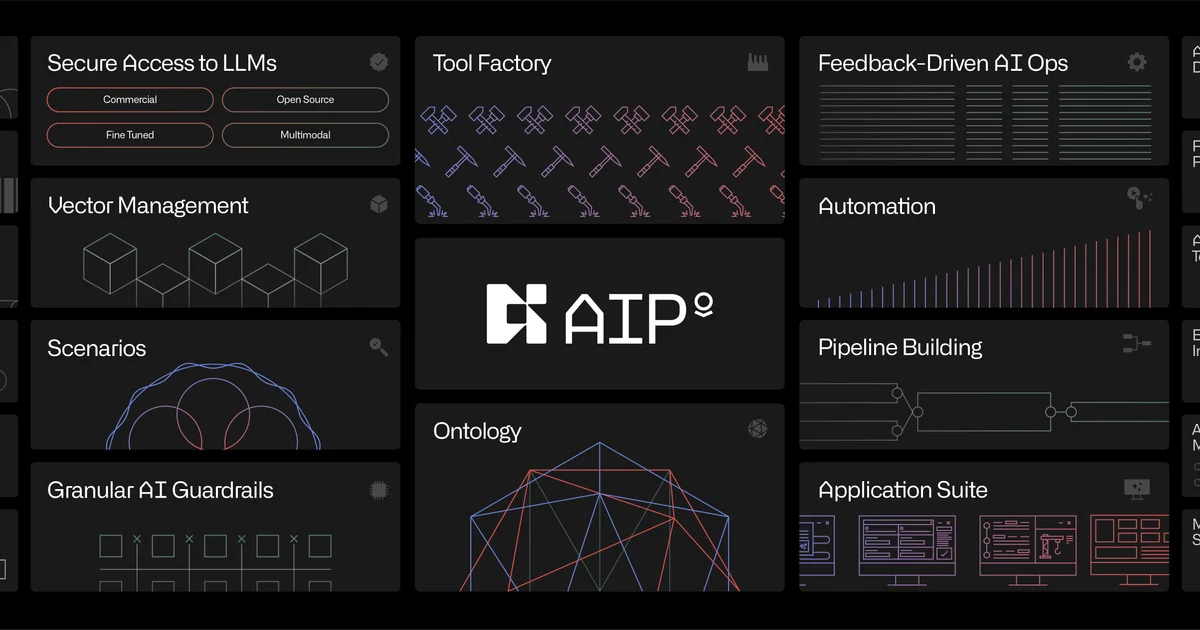
The company sells several complementary technologies, including Foundry, Ontology, Artificial Intelligence Platform and Apollo.
Foundry supports data integration and operational analysis.
Ontology represents the objects, relationships and business processes within an organization.
AIP enables applications, agents and automations that use AI models alongside those systems.
Apollo handles software deployment and management across different computing environments.
Together, these products are designed to connect AI-generated decisions with real operational data and controlled actions.
That differs from a standalone chatbot that produces answers without access to the systems needed to act on them.
Enterprise agents need more than a language model
Consider a manufacturer trying to prevent shortages of components.
An AI system may need to examine inventory levels, orders, supplier schedules and production constraints before recommending a decision.
But making a recommendation is only one stage of the process.
The organization must also determine whether that recommendation is authorized, which software systems can be changed and whether human approval is required.
Palantir positions its platform as a way to connect those stages.
Its software emphasizes operational context, permissions and controlled execution.
This example illustrates the kind of workflow AIP is designed to support. It does not prove that every Palantir customer has already achieved such automation.
Actual capabilities depend on the implementation, connected systems and policies established by the customer.

Strong revenue offers evidence beyond AI demonstrations
The AI software market is full of demonstrations and pilot projects.
Revenue growth provides a more concrete indicator of commercial activity.
Palantir's US commercial revenue rose 148%, meaning the company recognized substantially more sales from that segment during the quarter.
Management attributes the expansion to adoption of its AI software and operational platforms.
However, corporate financial statements do not disclose the profitability of every AI project undertaken by customers.
They also do not establish that every initial experiment has become a permanent production deployment.
What the figures demonstrate is that organizations are paying increasingly large amounts for Palantir's services.
Determining the value those organizations receive would require additional evidence about implementation expenses, productivity improvements and operational results.
Contract signings tell a more complicated story
Palantir closed 212 deals worth at least $1 million during the quarter.
That included 107 deals of at least $5 million and 64 worth at least $10 million.
The total contract value signed during the period reached $2.918 billion.
That figure increased 6% from a year earlier, considerably less than the 96% growth in recognized revenue.
US commercial total contract value was $1.463 billion, growing 11% year over year.
The contrast with 148% US commercial revenue growth is noteworthy.
However, contract value and recognized revenue are not directly interchangeable.
Contracts can cover multiple periods, include future obligations or contain terms that affect the timing of revenue recognition.
The company has also discussed some large agreements having shorter durations than usual.
These factors complicate comparisons between quarterly contract activity and revenue.
The slower increase in new contract value is therefore a monitoring point rather than proof that sales growth is about to collapse.
Net dollar retention reaches 165%
Another significant metric is Palantir's net dollar retention rate of 165%.
This measures changes in revenue from a comparable customer population over a trailing twelve-month period.
A result above 100% indicates that expansion within the retained customer base more than offsets reductions or losses.
At 165%, Palantir reports substantial growth from existing relationships.
That could involve larger contracts, additional applications or expanding use within customer organizations.
However, the metric does not mean every individual customer increased spending by 65%.
Nor does it establish the satisfaction or long-term purchasing plans of every customer.
It remains a valuable indicator for assessing a software business selling complex systems to large organizations.
Profitability is also exceptionally strong
Palantir's revenue growth is accompanied by substantial accounting profits.
GAAP operating income reached $1.085 billion, representing a 47% operating margin.
GAAP net income attributable to common stockholders was $1.128 billion, around 49% of revenue.
Diluted earnings per share were $0.44.
The company also reported $1.427 billion in adjusted operating income and $1.216 billion in adjusted free cash flow.
These adjusted figures are non-GAAP measures, meaning they exclude or modify certain items according to Palantir's definitions.
They should not be confused with the results reported under standard US accounting rules.
Nevertheless, the business reported substantial margins under both approaches.
Strong profitability helps explain investor interest, although it does not automatically justify any particular market valuation.
Privacy and governance remain central concerns
Enterprise AI often involves sensitive information.
An organization may need to connect AI models to customer records, supplier data, employee information or operational decisions.
Those connections create demanding requirements for access controls and auditing.
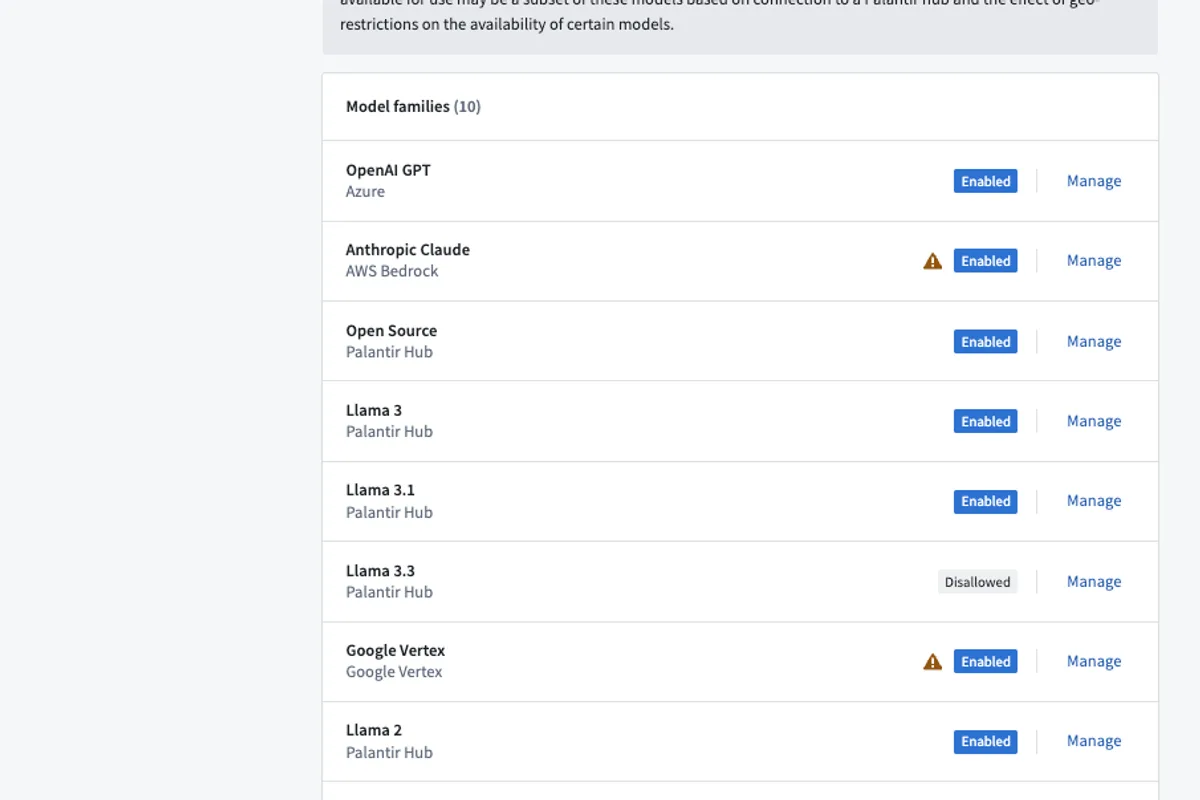
Palantir emphasizes governance, permissions and human oversight within its platform.
Its tools allow administrators to control which AI models are available and how applications interact with organizational systems.
These capabilities address a genuine problem.
Organizations cannot safely grant unrestricted access to every internal database simply because an AI agent might benefit from additional context.
However, the presence of security controls in product documentation is not proof that every customer has configured them correctly.
The quarterly earnings figures do not independently measure the effectiveness of those controls across all deployments.
Government work remains a major business
The commercial milestone should not obscure Palantir's continuing government operations.
Worldwide government revenue reached approximately $1.146 billion during the quarter.
That includes US government clients and international public-sector customers.
The segment therefore remains a major part of Palantir's business.
Some government deployments operate in environments where data security, public accountability and the consequences of automated decisions are particularly important.
Palantir's commercial success does not resolve the ethical and legal debates surrounding every application of its software.
Questions about surveillance, transparency and individual rights remain relevant in particular use cases.
Financial performance and the appropriateness of individual deployments must be assessed separately.
Full-year guidance rises to approximately $8.53 billion
Palantir has also raised its financial outlook.
The company expects fourth-quarter 2026 revenue between $2.649 billion and $2.653 billion.
Its full-year revenue guidance is now $8.530 billion to $8.534 billion.
That implies approximately 91% annual revenue growth.
The company also expects more than $3.559 billion in US commercial revenue for the year.
These are management forecasts, not revenue already earned.
The fourth quarter will need to demonstrate that deployments and customer spending continue to support the projected expansion.
Why investors did not automatically celebrate
Despite results exceeding expectations, Palantir shares initially declined in after-hours trading.
Reuters reported a fall of nearly 3% following the announcement.
The company's valuation already reflects substantial expectations for future growth.
When investors anticipate exceptional performance, even strong results may not be enough to push the share price higher.
Contract duration, new bookings, competition and the sustainability of profit margins all influence the financial outlook.
The 11% increase in US commercial contract value attracted attention for that reason.
However, one trading session should not be treated as a final judgment on the company's operating performance.
Market valuation and business execution remain separate questions.
The next test is whether commercial AI growth can endure
Palantir has demonstrated remarkable momentum in US enterprise software.
Its commercial business has now overtaken US government revenue for the first time, marking an important change in the composition of its sales.
The company is benefiting from demand for AI systems that connect to actual business operations rather than remain isolated demonstrations.
However, maintaining extremely high growth becomes more difficult as the revenue base expands.
Future quarters will need to show whether new contract signings, customer expansion and software deployment continue to support the current pace.
The most important development is therefore not simply the headline figure of 96%.
It is the emergence of a commercial business large enough to exceed Palantir's historically dominant US government segment.
The company has reached that point with strong financial results. Whether the expansion represents a durable transformation of enterprise software or an unusually intense phase of AI investment remains the question its next results will have to answer.