
 By Adri
Humanoid robots have become a familiar presence in Chinese technology demonstrations.
Some can run, dance, navigate obstacles and perform movements that would have appeared remarkable only a few years ago.
Those achievements demonstrate genuine progress in robotics engineering.
However, they do not answer the most important commercial question: can the same machines perform useful work in unfamiliar environments?
That distinction is changing where China's robotics industry directs its investment.
A Reuters investigation published on November 2 describes an accelerating shift toward embodied AI, the technology needed to connect machine perception, reasoning and physical action.
The industry's ambition is to build robots that can learn and adapt rather than depend on detailed programming for every task.
Embodied AI companies raised $13 billion in six months
According to data from research firm ITjuzi cited by Reuters, Chinese embodied AI businesses raised 93.5 billion yuan during the first half of 2026.
That is approximately $13 billion across 322 financing deals.
The amount was five times higher than during the corresponding period of 2025.
The growth illustrates investor interest in software and robotics systems that could eventually support a wide range of commercial applications.
Funding is reaching not only traditional robot manufacturers but also specialized developers of machine intelligence.
However, investment is not equivalent to revenue.
A company can attract substantial capital before demonstrating that its robots can operate profitably at scale.
The financial boom therefore indicates strong expectations rather than proven sector-wide commercial maturity.
Hardware performance is becoming less distinctive
For years, the most visible competition between humanoid robot manufacturers concerned physical performance.
Walking on two legs, maintaining balance and recovering from falls require sophisticated engineering.
Several companies have now demonstrated increasingly capable machines.
As competition expands, the cost of some hardware platforms is also coming under pressure.
That changes how manufacturers can differentiate their products.
A robot that follows a predetermined route to carry a box is not necessarily capable of identifying the correct package in an unfamiliar warehouse.
The second task requires perception, planning and the ability to adapt to unexpected conditions.
As mechanical capabilities become more widely available, software intelligence could account for a larger share of the industry's competitive advantage.
Embodied intelligence connects perception and action
Embodied AI focuses on systems that learn to operate in physical environments.
A conventional language assistant generally processes information and produces an answer.
A robot must also decide how to move and interact with objects.
It has to interpret camera images, sensor readings and the positions of surrounding objects.
It then needs to select movements that satisfy the requested objective.
Physical environments introduce uncertainty.
An object may slip, an obstacle may move or the weight of a package may differ from expectations.
A useful autonomous robot must be able to react to such changes.
That continuous relationship between observation and action is one of the central challenges in embodied intelligence.
Why impressive demonstrations are not enough
A robot can perform a difficult movement under carefully prepared conditions while struggling with an ordinary manipulation task.
Athletic demonstrations can be optimized through repeated training and controlled environments.
Industrial work introduces different requirements.
Machines must handle objects consistently, coordinate with existing equipment and avoid unsafe behavior.
A warehouse robot, for example, might need to recognize different packages, manipulate unfamiliar materials and work near people.
Commercial usefulness depends on sustained performance rather than one successful demonstration.
Reliability, maintenance and operating costs therefore matter as much as technical sophistication.
Chinese developers compete over robotic intelligence
The Reuters investigation identifies companies including X Square, Galaxea and Spirit AI as participants in the embodied AI race.
These developers operate alongside hardware manufacturers such as AgiBot and Unitree.
The industry increasingly contains distinct areas of specialization.
Some companies focus on complete robots, including mechanical structures, sensors and actuators.
Others develop AI models or tools used to collect training data.
Still others attempt to combine those capabilities in integrated platforms.
It remains uncertain which business model will eventually prove most successful.
However, the competitive landscape is clearly expanding beyond the sale of humanoid machines as mechanical products.
Physical training data is becoming strategically important
Training a model to recognize an object can involve large collections of images.
Teaching a robot to manipulate that object requires more information.
Developers need observations, motion trajectories and data describing the consequences of physical actions.
Robots must learn not only what objects look like, but also how those objects behave when touched or moved.
Chinese companies are collecting demonstrations performed by human operators.
Some use teleoperation systems that allow people to control robotic movements remotely.
Others record human movements with wearable sensors.
The resulting data can help train models to reproduce and adapt physical behaviors.
However, collecting large quantities of demonstrations is not sufficient by itself.
The quality, diversity and relevance of those examples determine how useful they are for learning.
Simulation helps training but cannot replace reality
Virtual environments provide another important source of training experience.
Simulations allow researchers to repeat experiments without risking expensive physical damage each time a robot fails.
They also make it possible to vary lighting, object positions, surfaces and environmental conditions.
However, virtual environments cannot reproduce every detail of the physical world.
Friction, material deformation and sensor imperfections can behave differently outside simulation.
A robot that grasps an object reliably in a virtual environment may struggle when handling the real version.
This challenge is often described as the simulation-to-reality gap.
Reducing that gap is essential if training results are to transfer successfully into commercial applications.
China benefits from its manufacturing ecosystem
China has extensive industrial capabilities in electronics, automotive manufacturing and mechanical engineering.
Those resources can support the production of sensors, motors, batteries and other robotic components.
The country also offers factories and commercial environments where developers can conduct trials.
A manufacturing facility can become both a potential customer and a testing environment.
Developers can observe failures, collect new examples and revise their systems.
That connection between production and software development may accelerate iteration.
However, China does not hold an uncontested advantage in every area.
American companies remain influential in AI research, model development and computing infrastructure.
Restrictions involving advanced semiconductor exports may also affect access to the computing resources required by some research programs.
Robot production is already expanding
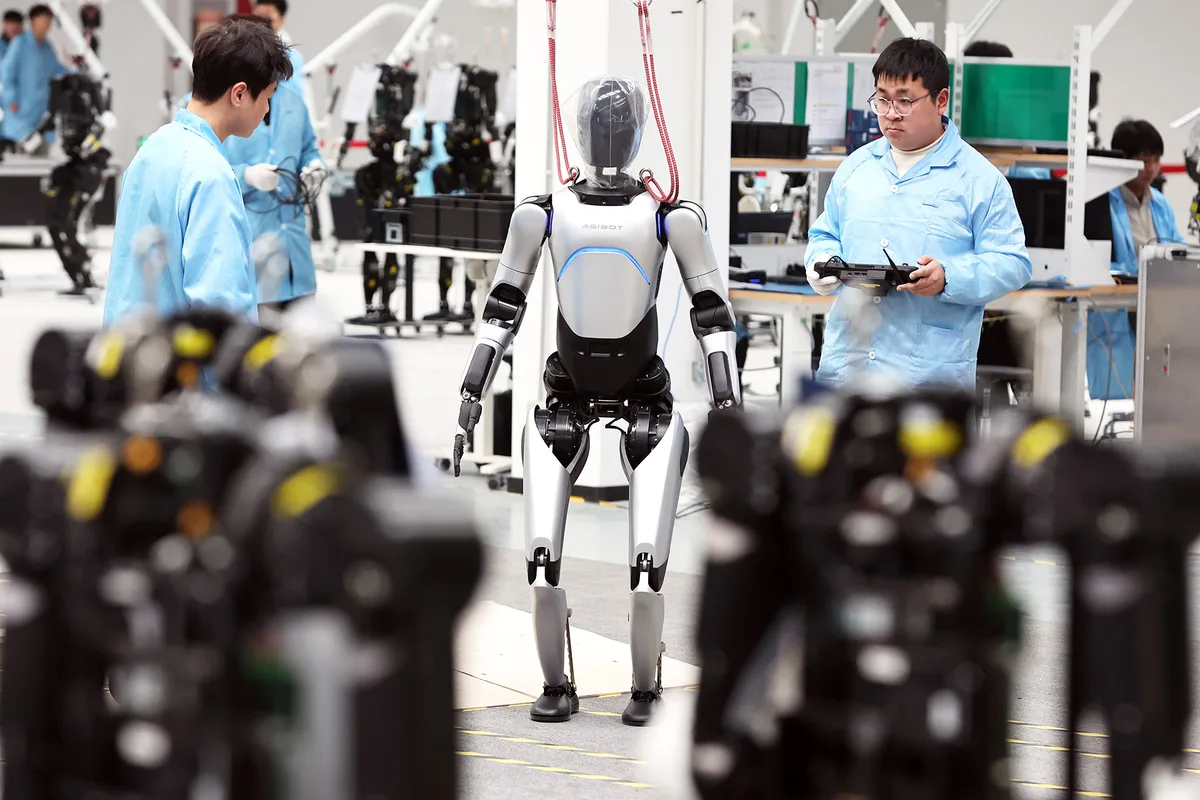
Several Chinese manufacturers have announced growing industrial capacity.
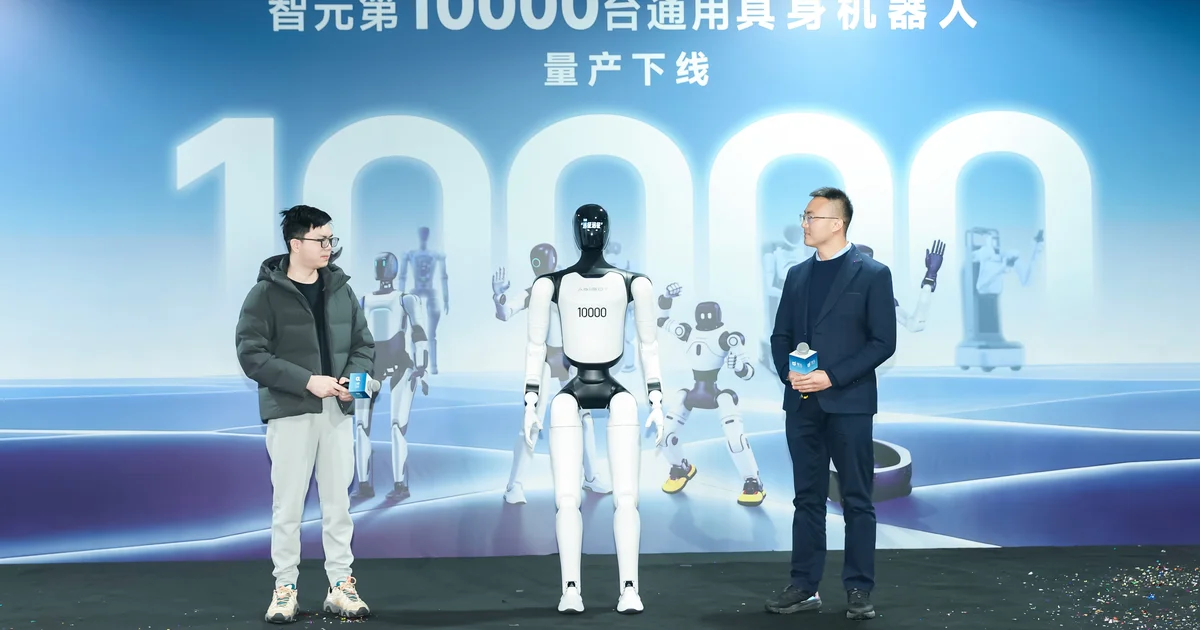
AgiBot said on March 30, 2026, that it had produced its 10,000th humanoid robot.
The announcement came directly from the manufacturer.
The company says its products are being used in logistics, hospitality, retail and selected industrial environments.
However, production figures should not be confused with verified long-term commercial utilization.
The number of machines manufactured does not establish their average operating hours, profitability or autonomy.
Pilot deployments and initial production milestones are meaningful progress.
They do not prove that humanoid robots have already become general-purpose workers.
Early deployments remain focused on limited tasks
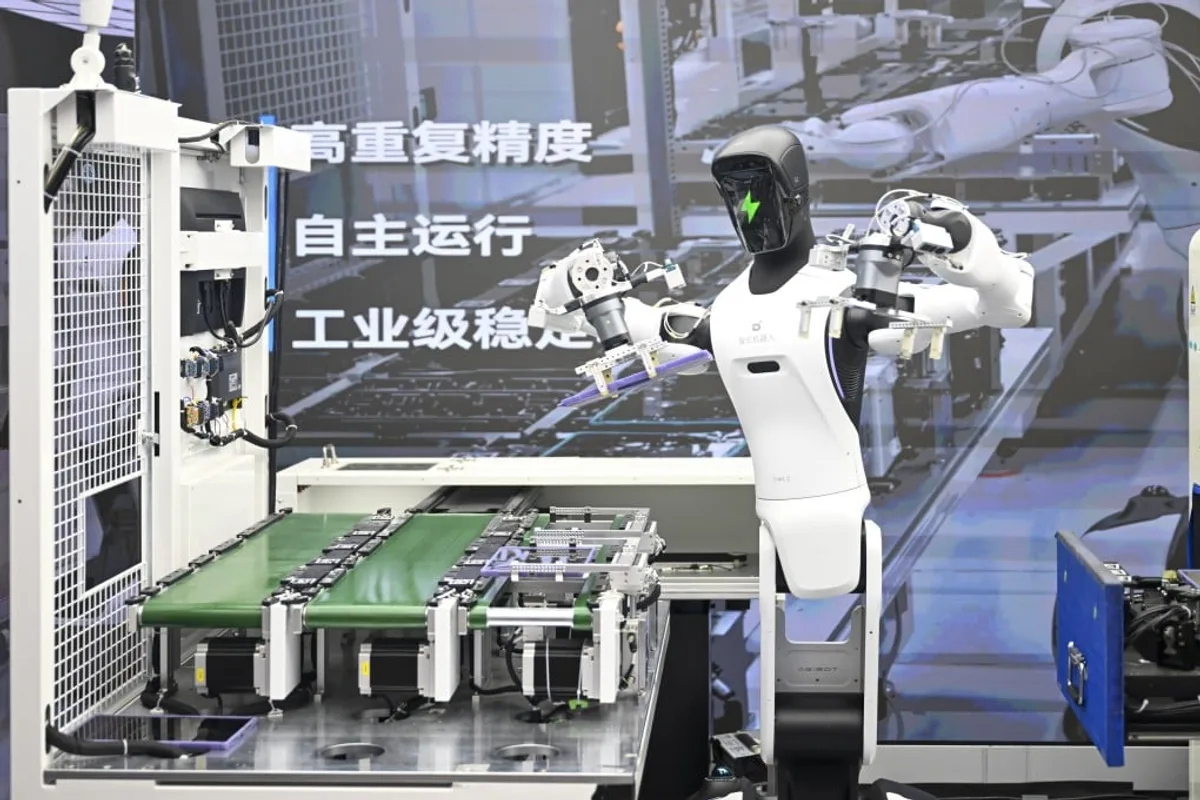
Robots are being tested in factories and other professional settings.
The easiest commercial tasks are often those that can be precisely defined.
A robot may move objects between known locations or perform repeated operations in an organized workspace.
The difficulty increases when objects change, people interfere or instructions become ambiguous.
Reliable autonomy also requires a machine to recognize when it should stop or request assistance.
That limitation is particularly important in environments shared with human workers.
Physical safety raises the stakes
A software error in a chatbot may produce an incorrect answer.
An error in a humanoid robot can produce an unexpected physical movement.
The potential consequences are therefore different.
Manufacturers need safeguards that restrict dangerous actions and allow systems to stop safely.
They must also evaluate how robots behave in situations outside their training examples.
A successful stage demonstration does not provide the same evidence as prolonged industrial testing.
Safety, maintenance and reliability are major components of the actual deployment cost.
They help explain why impressive technical demonstrations do not immediately lead to widespread adoption.
An investment boom also creates financial risks
Rapidly increasing investment can accelerate research and recruitment.
It can also create high valuations before companies develop substantial recurring revenue.
Some robotics startups will need to show that their prototypes can become commercially viable products.
Others may struggle with the cost of hardware development, manufacturing and customer support.
Funding conditions can change before those challenges have been solved.
The current wave of investment therefore provides opportunities but does not guarantee that every participant will succeed.
Competition with the United States extends to AI models
American companies are also developing systems that combine vision, reasoning and physical control.
The shared objective is to make robots more adaptable across different tasks.
A truly versatile machine would need to transfer knowledge from previous experiences to unfamiliar situations.
That capability remains difficult to establish reliably in real-world environments.
The international competition therefore concerns algorithms, training data and computing resources as much as hardware.
The availability of advanced processors may influence how quickly different companies can train and improve their models.
The decisive milestone will be less spectacular than a backflip
The next major advance in humanoid robotics may not be the most impressive movement captured on video.
Commercial customers need evidence that machines can perform useful work for extended periods.
Relevant measures include task success rates, human intervention frequency, reliability and total operating costs.
Customers will also want to know whether robots can be adapted to new tasks without extensive reprogramming.
These are the areas where embodied AI must demonstrate its practical value.
The $13 billion invested in China's sector during the first half of 2026 shows the scale of the ambition.
However, the eventual winner may not be the company producing the most spectacular demonstration.
It may be the one that consistently converts artificial intelligence into useful, safe and dependable physical work.