
 By Adri
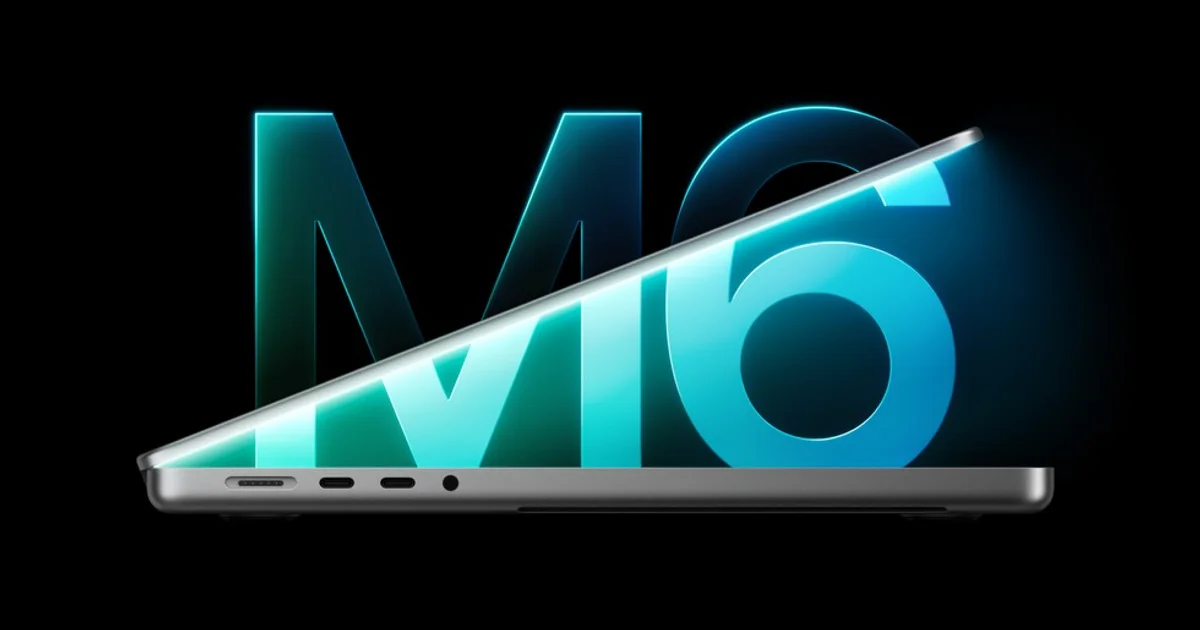
Apple has given its entry-level 14-inch MacBook Pro two more CPU cores, two more GPU cores and a substantially stronger argument for running AI workloads locally. What it has not changed is the starting memory capacity. The M6 model still ships with 16GB of unified RAM, an important consideration for a machine now being marketed as a serious platform for local language models.
The announcement is primarily about silicon rather than industrial design. The MacBook Pro retains its Liquid Retina XDR display, established port selection and familiar physical construction. The main advances sit inside the M6 chip, where traditional CPU and graphics performance increasingly share the spotlight with dedicated AI acceleration.
A 12-core CPU and GPU push beyond M5
The new M6 features a 12-core CPU and 12-core GPU, up from the 10-core configurations used in Apple's M5 comparison. Apple claims up to 30 percent better graphics performance and highlights its third-generation ray-tracing engine alongside Dynamic Caching.
That 30 percent figure is not a universal performance increase. Graphics workloads respond differently to additional cores, changes in memory bandwidth and improvements to the rendering architecture. CPU-bound applications or tasks constrained by memory capacity may see considerably smaller benefits.
Apple's application-specific figures provide more useful context. Blender ray-tracing rendering and Xcode project compilation are each claimed to run up to 1.3 times faster than on the M5 MacBook Pro, while Affinity image processing reaches up to 1.2 times the previous performance.
These numbers come from Apple-controlled tests. Independent benchmarking will be needed to establish sustained performance across different projects, particularly when CPU and GPU resources are heavily utilized over extended periods.
Local AI acceleration meets a memory ceiling
The M6 introduces a Dual 16-core Neural Engine and Neural Accelerators within its GPU cores. Apple reports Neural Engine performance up to 1.9 times that of M5, alongside improvements of up to 25 percent in selected on-device AI workloads.
For language-model inference, Apple specifically claims up to 1.3 times faster time to first token than the M5 MacBook Pro. This measures how quickly a model begins responding, not necessarily its sustained token generation rate or its ability to handle larger models.
The distinction matters because unified memory remains central to local AI performance. A processor can execute inference operations faster without changing how much model data fits into memory. With 16GB in the base configuration and a 32GB maximum, the M6 MacBook Pro offers more compute performance but no expansion of its upper memory capacity.
Memory bandwidth reaches up to 170GB/s, compared with 153GB/s for M5. That should help workloads sensitive to data transfer rates, although the actual improvement depends on the model, software implementation and available memory.
Apple is also pairing the hardware with macOS 27 and its expanded Siri AI and Apple Intelligence functionality. Some of these services are tied to cloud processing, beta availability or feature-specific restrictions. Their presence does not imply that every AI feature runs entirely on the device.
Battery life stays central to the MacBook Pro formula
Apple quotes up to 24 hours of battery life for the new machine. It also claims up to four additional hours compared with the original M1 MacBook Pro, although that comparison reflects Apple's specified testing conditions.
The company says the laptop retains strong performance while unplugged. That is an attractive proposition for developers and content creators, but battery endurance under sustained rendering, software builds or continuous AI inference will require more demanding tests than a general battery-life figure can provide.
Fast charging is supported, with Apple claiming up to 50 percent capacity in 30 minutes when using a suitable USB-C power adapter such as its 96W model.
The display continues to offer up to 1,600 nits of peak HDR brightness, with optional nano-texture glass. A 12MP Center Stage camera and six-speaker audio system also return.
Wireless connectivity improves while wired ports remain familiar
Wi-Fi 7 and Bluetooth 6 are welcome updates, especially for users moving large files over compatible wireless networks. Actual throughput will depend on networking equipment, signal conditions and the capabilities of connected devices.
The physical interfaces remain largely unchanged: three Thunderbolt 4 ports, HDMI, an SDXC card reader, MagSafe 3 and a headphone jack. The laptop supports up to two external displays.
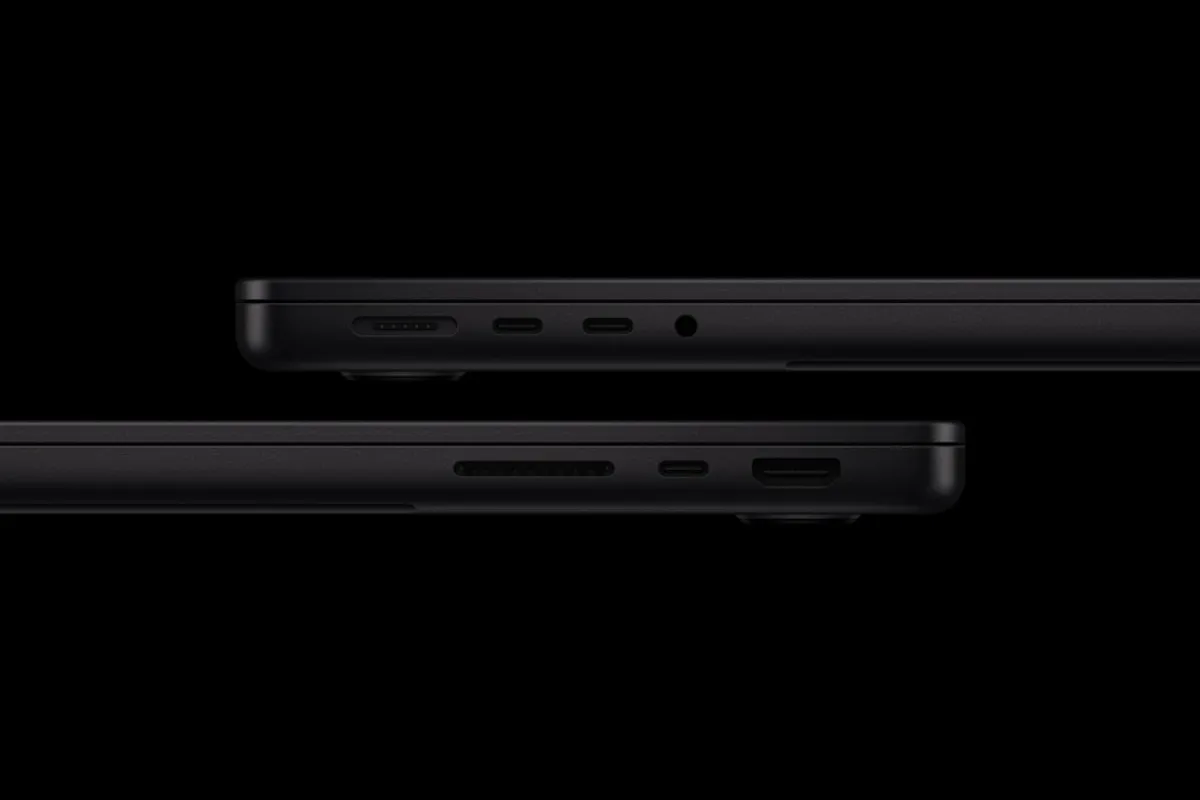
Thunderbolt 4 remains capable for conventional external storage, displays and docking stations. Nevertheless, keeping it rather than moving to Thunderbolt 5 leaves an identifiable limitation for users seeking higher bandwidth for demanding peripheral configurations.
The standard configuration includes 1TB of SSD storage, with options extending to 4TB. Apple also advertises faster storage performance, although specific sustained throughput figures will need external validation.
The upgrade question depends on what Mac you already own
The M6 MacBook Pro starts at $1,999 in the United States, with preorders opening October 28 and availability scheduled for November 6. Apple offers configurations with up to 32GB of unified memory, making the purchase decision especially relevant for buyers planning substantial development or local AI workloads.
For owners of Intel-based MacBooks or early Apple silicon machines, the combined CPU, GPU and efficiency improvements may represent a significant platform upgrade. Apple cites particularly large gains when comparing the M6 with its M1-era hardware.
The justification is less obvious for someone already using an M5 MacBook Pro. Apple's own application comparisons suggest tangible but workload-dependent improvements, while the display, port selection and overall design remain familiar.
The release will also provide an opportunity to examine how the M6 performs during prolonged workloads rather than isolated benchmark runs. CPU scaling, GPU performance, thermal behavior and local AI inference efficiency remain the most relevant measurements to establish independently.