
 By Adri
The expansion of artificial intelligence is increasingly constrained by the physical components required to run large computing systems.
Advanced processors are essential, but their performance also depends on memory, networking and the broader infrastructure connecting individual computing devices.
That industrial reality provides context for Sam Altman's latest visit to South Korea.
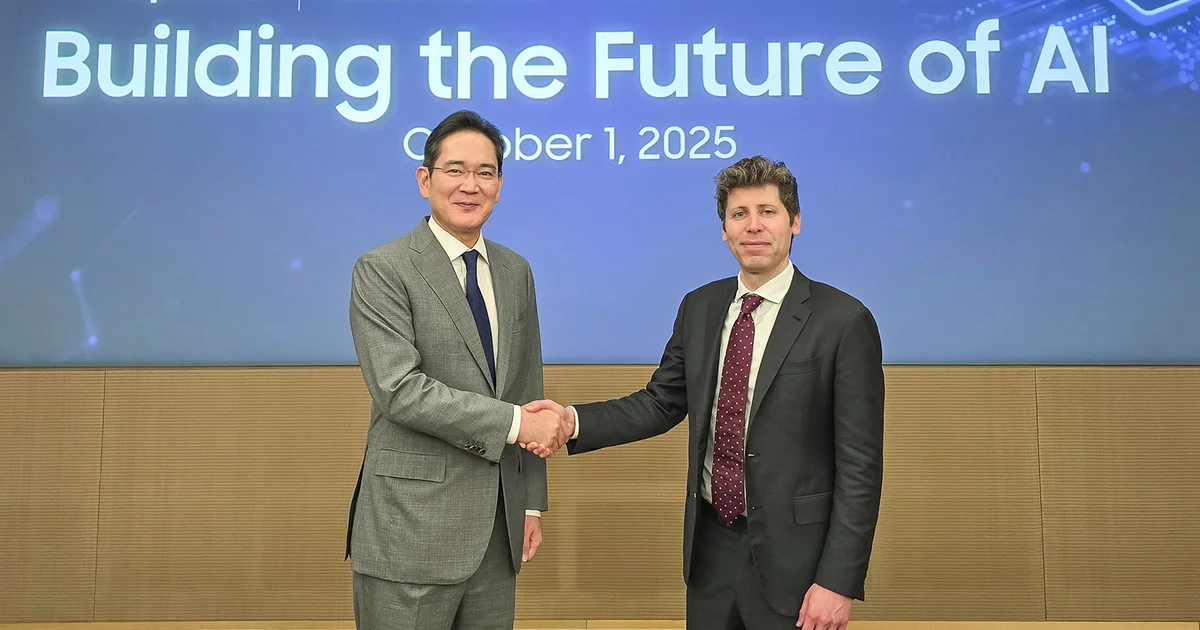
On October 31, the OpenAI chief executive met approximately 50 Samsung leaders at the company's training center in Yongin, south of Seoul.
He also held discussions with representatives of SK Group, which includes major memory manufacturer SK hynix.
The meetings reinforce relationships that already exist. They do not establish that a new memory supply contract was signed.
Samsung gathered executives from several major divisions
The meeting brought together leaders from Samsung's electronics, financial and biotechnology businesses.
According to Samsung's account reported by Yonhap, the session focused on how artificial intelligence could reshape corporate management, operations and future business opportunities.
Altman emphasized that adopting AI technology is not enough to create a sustainable competitive advantage.
Companies must also use it to work faster, improve products and respond more effectively to changing markets.
The breadth of the audience matters.
Samsung is not simply a manufacturer of memory chips.
It operates businesses across numerous industries, many of which could use AI software in their own operations.
The discussions therefore extended beyond hardware supply to the broader transformation of the company's activities.
OpenAI's hardware leadership was also represented
The OpenAI delegation included Richard Ho, a senior executive involved in the company's hardware development.
His participation prompted speculation about whether Samsung and OpenAI could expand cooperation in chip manufacturing.
Such a possibility should not be confused with an announced agreement.
The companies did not disclose a new jointly developed AI accelerator during the visit.
Nor did they announce a new confirmed foundry contract or identify a semiconductor manufacturing process for a future OpenAI chip.
In an industry where designing and qualifying a new processor can take years, the presence of hardware specialists is meaningful but insufficient evidence of a completed program.
Memory supply is a fundamental AI infrastructure concern
Large AI computing systems rely on extensive memory capacity and bandwidth.
High-bandwidth memory, or HBM, is especially important in many advanced accelerators.
HBM uses stacked memory structures to enable rapid data transfers.
This architecture supports computing workloads that require processors to move substantial amounts of information.
An accelerator cannot operate at its theoretical maximum performance if access to required data becomes a persistent bottleneck.
Memory bandwidth therefore influences the performance and economics of complete AI systems.
Manufacturers capable of producing advanced memory have become strategically important partners for developers and operators of AI infrastructure.
This helps explain the emphasis on Samsung and SK hynix in OpenAI's industrial partnerships.
The companies already signed agreements in October 2025
The current talks follow a strategic partnership announced on October 1, 2025.
At the time, OpenAI disclosed agreements with Samsung and SK under its Stargate infrastructure initiative.
The partnerships aimed to expand advanced memory supply and examine new AI data center opportunities in South Korea.
Samsung Electronics and SK hynix outlined plans to increase production capacity.
OpenAI's announcement referred to a target of up to 900,000 DRAM wafer starts per month as part of the broader capacity expansion.
That target belongs to the 2025 agreements.
It should not be presented as a newly signed November 2026 purchase order.
It also does not mean 900,000 finished memory chips would be delivered monthly.
A semiconductor wafer contains multiple circuits, and the number of usable chips depends on manufacturing conditions and yields.
Production capacity, purchase commitments and actual deliveries are separate commercial measures.

SK hynix remains another important supplier
Altman also met SK Group Chairman Chey Tae-won during the South Korea visit.
Senior representatives of SK hynix and SK Telecom attended the discussions, according to South Korean reporting.
Their existing cooperation includes advanced memory and potential AI data center development.
However, the precise content of the private meeting was not fully disclosed.
Reports discussing HBM expansion and infrastructure cooperation should therefore be attributed as reported discussion topics rather than confirmed new orders.
Maintaining relationships with multiple major memory manufacturers may give OpenAI more options when planning future systems.
That does not guarantee immediate access to every requested component.
Manufacturing schedules, qualification processes and existing customer commitments can all constrain supply.
Why advanced memory is difficult to scale
Building AI data centers requires coordination across multiple industrial supply chains.
Operators need accelerators, memory, networking components, power systems and cooling equipment.
HBM manufacturing involves specialized stacking and packaging processes.
Finished components must then meet the requirements of the computing platforms in which they will operate.
Increasing nominal production capacity does not instantly create an equivalent quantity of qualified memory available to every buyer.
Manufacturing yield, technical validation and contractual commitments influence what can actually be delivered.
This is why suppliers and AI developers increasingly coordinate long-term production plans.
It is also why a high-level meeting should not be confused with an immediate increase in market supply.
AI demand can influence the broader PC memory market
The growth of AI infrastructure creates competition for semiconductor manufacturing resources.
Memory manufacturers must decide how to allocate capacity and investment among different products.
HBM used by accelerators and conventional DRAM installed in personal computers are not interchangeable products.
They nevertheless share parts of the wider manufacturing ecosystem.
Investment decisions favoring high-demand products can affect the economics of other memory categories.
However, it would be misleading to attribute every increase in consumer memory prices directly to OpenAI.
Inventories, production decisions, demand from other customers and broader market conditions also influence pricing.
Altman's visit highlights the strategic importance of memory supply, but does not establish a direct numerical effect on PC component prices.
Stargate partnerships extend beyond semiconductors
The October 2025 agreements also addressed possible AI data center development in South Korea.
Samsung SDS, Samsung C&T and Samsung Heavy Industries were among the companies involved in assessing infrastructure opportunities.
SK Telecom also participated in discussions concerning data center development.
These arrangements reflect the range of capabilities needed to establish large computing facilities.
Projects require buildings, electrical capacity, cooling, networking and operational services in addition to chips.
However, an agreement to explore a project is not proof that the facility has already been completed.
Each development must be evaluated according to its actual construction and operational status.
Samsung is also pursuing internal AI transformation
The October 31 meeting was notable for including executives outside Samsung's semiconductor division.
Leaders from finance and biotechnology participated alongside electronics executives.
Samsung has been developing a company-wide approach to AI transformation, often described as AX.
Its efforts include training and operational adoption of generative AI tools.
South Korean reporting indicates that the company has already launched programs involving thousands of executives.
These initiatives make Samsung both an industrial supplier to AI infrastructure projects and a potential customer for enterprise AI services.
That dual role is an important part of the relationship with OpenAI.
The meeting should therefore not be understood solely as a memory procurement negotiation.
Industrial cooperation does not guarantee immediate revenue
Continued engagement between OpenAI and Samsung may be commercially encouraging for both companies.
However, no additional publicly confirmed contract value emerged from the October 31 meeting.
There was no new disclosed volume of memory purchases or detailed delivery schedule.
Manufacturing targets also remain distinct from completed shipments.
Before an industrial partnership translates into recognized revenue, companies must establish specifications, manufacturing readiness, qualification and commercial terms.
Those arrangements can change as customer requirements and available capacity evolve.
It would therefore be premature to translate the meeting directly into quantified financial forecasts.
The next meaningful milestone will be execution
Altman's visit confirms the continuing importance of South Korea's major semiconductor manufacturers to OpenAI's infrastructure plans.
It also illustrates how these relationships can extend across memory, data centers and enterprise software.
The next measurable developments will be specific supply agreements, qualified production capacity, actual deliveries and operational data center projects.
Any newly announced purchase commitment would represent a separate development from the October 31 meetings.
For now, the confirmed story is one of continuing industrial dialogue and existing strategic partnerships.
That is significant because advanced AI increasingly depends on long-term access to complete computing infrastructure.
But a meeting between technology leaders is not the same as a signed order, and planned manufacturing capacity is not the same as delivered hardware.