
 By Kilam

Language models can produce convincing conversational responses.
However, understanding a sentence is not enough to make a character function in a video game.
The system must also determine which character is being addressed, which objects exist in the scene and what actions can actually be performed.
That is the problem North Side is attempting to solve with Bot Colony Redux.
Available through Steam Early Access since October 30, 2026, the game integrates several AI technologies into a science-fiction adventure.
An architecture beyond a chatbot
North Side has not simply added a conversational interface to an existing game.
The developer uses its proprietary natural language understanding technology to interpret player intentions within the context of a virtual environment.
Its documentation identifies Perla as an internal system designed to connect language with objects and actions.
The system must distinguish a request for information from an instruction to move or manipulate something.
If a player asks a robot to pick up an item and carry it to another room, the game must identify the object, destination and required operations.
This involves structured knowledge of the environment.
Without that layer, a character might generate a plausible answer while remaining unable to perform the requested action.
North Side considers the connection between conversation and behavior a fundamental component of its technology.
From speech to robot behavior
When players use a microphone, spoken words must first be converted into text.
The developer's documentation cites Azure Speech-to-Text among its technologies.
The linguistic content can then be processed by North Side's internal systems and AI language models.
These components help interpret the request, context and personality of the character involved.
The response may appear as text or be converted back into speech.
North Side mentions ElevenLabs for expressive voice generation.
The company also references OpenAI GPT models used within its conversational system.
However, the technologies named by the developer should be distinguished from the complete implementation.
North Side has not published a comprehensive specification identifying every model and processing stage used in the commercial version.
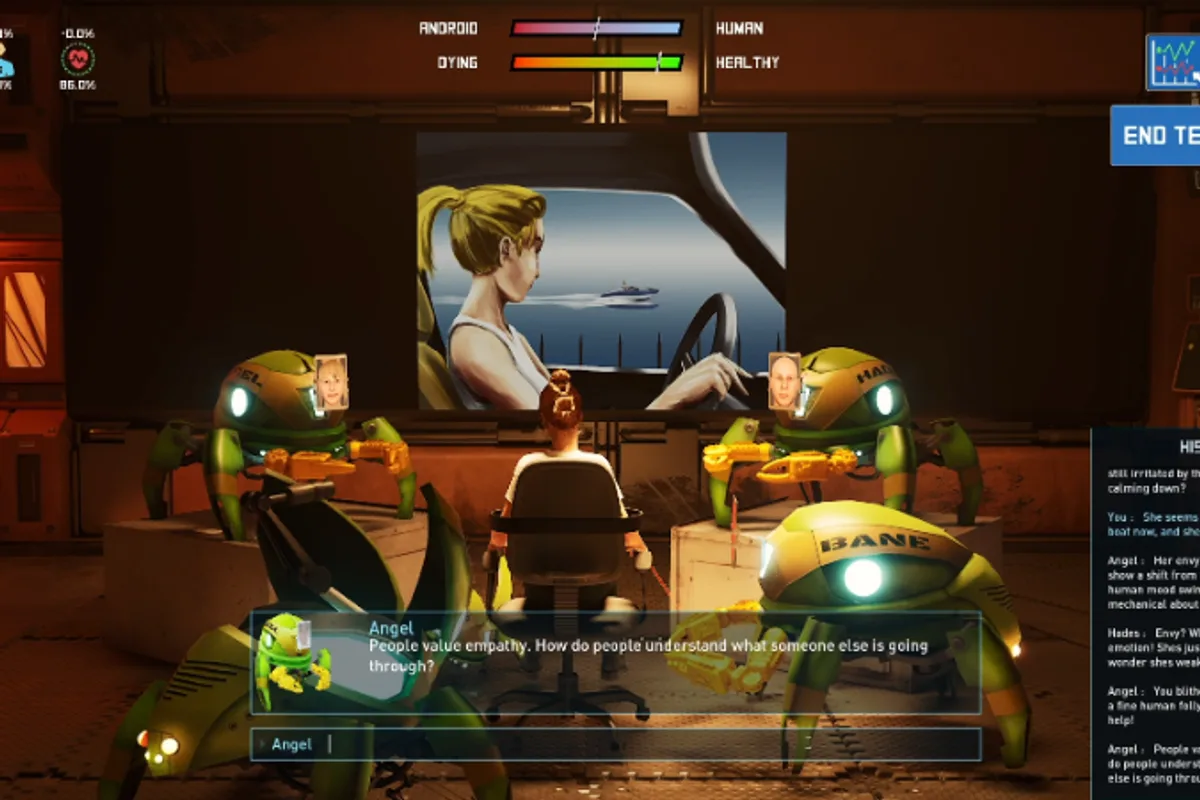
Why context matters
Maintaining conversational consistency is another important challenge.
A robot must do more than produce a grammatically correct answer.
It also needs to account for its role in the story, what it knows and what has already happened.
In Bot Colony Redux, robots have simulated personalities and emotional characteristics.
Some may respond suspiciously or use humor.
Others may refuse to cooperate or redirect conversations.
The technical challenge is producing those behaviors without losing the objectives of the investigation.
Open-ended dialogue allows players to introduce unexpected subjects.
The developer must balance conversational freedom with coherent mission progression.
Addressing that balance is one of the reasons for the Early Access release.
Latency becomes a gameplay concern
In a conventional AI assistant, a short processing delay may be acceptable.
In an adventure game, the same pause can interrupt the rhythm of a scene.
North Side says it has worked on streaming responses to reduce the perceived delay between questions and robotic reactions.
Latency can originate at several stages, including audio capture, speech recognition, language processing, response generation and voice synthesis.
Some of those operations use remote computing resources.
Response time can therefore depend on network conditions and service availability.
The developer has not published independent measurements guaranteeing a fixed response time for every conversation.
Actual responsiveness remains an important characteristic to evaluate in the playable version.
Sixteen languages and bilingual conversations
Multilingual support introduces further complexity.
North Side advertises sixteen conversational languages, including French.
Players can interact through speech or text.
The studio also presents the ability to mix two languages during certain conversations.
To work reliably, the system must recognize the words, understand the request and generate an appropriate response in the relevant language.
Language switching complicates that process.
Performance may also vary depending on pronunciation, microphone quality and the languages involved.
A supported-language list is therefore not a guarantee of identical accuracy in every situation.
Cloud costs explain the LEKS currency
Bot Colony Redux's business model is directly connected to its technical architecture.
The game can be downloaded free of charge.
However, conversations using its AI services consume LEKS credits.
Every new player receives a starting allocation.
Additional credits can be purchased after that allocation is exhausted.
North Side says this system helps cover the cost of cloud resources.
Speech recognition, language models and voice synthesis are commonly priced according to usage.
The cost of a conversation can therefore depend on factors such as duration and processing volume.
Public documentation does not establish a universal average cost per hour.
Specific spending estimates would require measurements across different gameplay scenarios.
Depending on external services
Cloud services provide additional capabilities but introduce operational limitations.
Interactions may depend on third-party providers.
Poor connectivity or a service outage could affect associated features.
That distinguishes Bot Colony Redux from an adventure game where all dialogue and behavior execute locally.
Steam explicitly identifies third-party services involved in generating AI content.
The listing also confirms online interactivity and in-app purchases.
North Side does not describe the game as a fully self-contained offline experience.
However, the precise consequences of connectivity loss during each episode have not been fully detailed.
A technological ambition dating back to 2009
Bot Colony was not conceived during the recent boom in generative AI.
North Side introduced the concept in 2009.
An initial version was subsequently released in 2014.
The original idea already involved free-form conversations with characters in an interactive environment.
The developer acknowledges that the technology available at the time limited what could be achieved.
Advances in speech recognition, language models and voice generation have enabled the project to be rebuilt.
Redux also introduces modernized environments and robotic characters.
It represents a renewed attempt to solve a game-design problem identified well before the current generation of AI tools.
Real-world gameplay is the decisive test
North Side estimates that Early Access will last approximately twelve months.
During that period, it plans to improve language understanding, performance and interactions.
The technical claims are ambitious, but promotional demonstrations alone cannot establish the system's reliability under every condition.
A meaningful evaluation would need to examine whether robots can follow multi-step instructions, maintain conversational context and avoid contradictory responses.
The cost of extended conversations and the responsiveness of characters will also matter.
Bot Colony Redux is therefore a concrete example of generative AI being used as a gameplay system.
The question is no longer simply whether a robot can produce a convincing reply, but whether that reply can support a coherent and engaging adventure.