
 By Adri
Performance-oriented smartphones often follow a familiar formula: use the newest processor, introduce a fast display and add features intended to appeal to mobile gamers.
Xiaomi appears to be taking a slightly different approach with the standard Redmi K100.
Rather than focusing exclusively on the newest silicon, the phone combines the established Snapdragon 8 Elite with a high-refresh-rate display and an unusually large 10,000mAh battery.
That positioning could appeal to users who value endurance and sustained gaming sessions more than having the latest processor generation.
On October 26, Notebookcheck reported that a device believed to be the Redmi K100 had appeared in the Geekbench 7 database.
Gizmochina had previously detailed the same reported listing on October 24.
The phone is scheduled for a Chinese presentation on October 27, according to promotional materials and reports of Redmi's announcement.
Several specifications are already confirmed by the manufacturer, while the benchmark figures still require separate qualification.
Geekbench 7 reportedly shows 2,705 single-core and 9,885 multi-core points
The reported device carries the model number M786BC.
Technology publications associate that identifier with the Chinese Redmi K100.
According to the listing, the device runs a Qualcomm Snapdragon 8 Elite processor with 16GB of RAM.
Its operating system is identified as Android 17.
The CPU configuration includes two cores running at 4.32GHz and six others at 3.53GHz.
The integrated graphics processor is listed as the Adreno 830.
The reported Geekbench 7 scores are 2,705 points in single-core testing and 9,885 in multi-core testing.
These numbers offer an early indication of the hardware configuration.
However, they do not provide a complete assessment of the final commercial product.
A benchmark can be run on development hardware or with software settings that differ from retail devices.
Thermal conditions, battery state and power-management configuration can also influence performance.
Geekbench 7 additionally uses a different scoring methodology from older releases.
Its figures should not be directly compared with Geekbench 6 results.
Why Xiaomi is reusing the Snapdragon 8 Elite
Qualcomm introduced the Snapdragon 8 Elite in 2024.
The chipset represented a major development in the company's mobile processor architecture.
It uses custom Oryon CPU cores alongside the Adreno 830 GPU.
The processor has already appeared in several premium Android smartphones, including the previous Redmi K90.
Its inclusion in a phone scheduled for late 2026 is therefore not a new technical breakthrough.
It is primarily a product-positioning decision.
An older flagship processor can remain sufficiently powerful for many current applications.
Web browsing, multitasking, photography and games do not necessarily require the newest chip generation.
Manufacturers can instead allocate resources toward other components.
For the Redmi K100, Xiaomi is placing particular emphasis on battery capacity and gaming display features.
That does not automatically guarantee excellent value.
Final pricing and independent performance testing will determine whether the combination is competitive.
A 10,000mAh battery is the headline feature
The Redmi K100's most striking specification is arguably not its processor.
It is the battery.
Xiaomi has announced a capacity of 10,000mAh for the standard model.
That is substantially larger than the batteries in many conventional smartphones, which frequently fall between 4,000mAh and 6,000mAh.
It also exceeds the previous Redmi K90's reported 7,100mAh capacity.
According to Gizmochina, the Redmi K100 Pro has an 8,580mAh battery, while the Pro Max uses a 9,070mAh cell.
The standard K100 would therefore offer greater nominal battery capacity than its more premium siblings.
However, greater battery capacity does not automatically translate into longer endurance under every condition.
Actual power consumption depends on the processor, display, cellular connectivity, brightness settings and running applications.
Gaming at high frame rates can place substantial demands on the graphics processor.
Even so, the large capacity offers meaningful potential for people who want to reduce how often they need to recharge.
Independent battery testing will establish whether that potential translates into superior real-world endurance.
A large battery also creates practical questions
A bigger battery must fit inside a limited physical volume.
Manufacturers therefore work to increase the energy density of their cells.
That can involve different materials and more efficient internal packaging.
For users, however, capacity is only one part of the equation.
Weight and thickness also matter.
Charging behavior and thermal management are equally important.
Reports based on certification information suggest wired charging may reach 100W.
That figure does not reveal how long a complete recharge will take.
Maximum charging power is not necessarily sustained throughout the process.
Battery controllers typically adjust charging behavior according to temperature and charge level.
The meaningful result will be the time required for a full charge under reproducible conditions.
A 6.83-inch AMOLED display with 165Hz refresh rate
The Redmi K100 uses a 6.83-inch display.
Xiaomi confirms an AMOLED panel with a maximum 165Hz refresh rate.
Such a high frequency can improve the smoothness of motion on screen, particularly in compatible games.
The manufacturer also advertises peak brightness of 3,500 nits.
That number refers to a maximum under specified conditions.
It does not establish that the entire panel can sustain the same brightness indefinitely.
Independent testing will need to examine sustained brightness and outdoor visibility.
The promotional material also describes a 480Hz multi-finger touch reporting rate.
Xiaomi additionally advertises an instantaneous touch sampling rate of up to 3,500Hz.
These specifications describe different processes from the screen's 165Hz refresh rate.
The refresh rate concerns how frequently the image is updated.
Touch reporting concerns how input events are detected and communicated.
Higher touch frequencies can potentially reduce certain parts of input latency, but do not independently guarantee perfect responsiveness.

More than 40 games reportedly support a 165fps mode
Redmi says more than 40 games can take advantage of a 165fps mode.
That announcement requires careful interpretation.
A 165Hz display can show up to 165 distinct images every second when the software and hardware provide them.
Not every game has the same engine capabilities or performance limits.
Some titles impose frame-rate caps.
Others reduce frame rates to manage power consumption or temperature.
Xiaomi's compatibility claim therefore applies to selected games and settings.
It does not mean that every demanding title can run at 165fps on the Redmi K100.
Testing will need to examine actual rendered frame rates and their stability over longer sessions.
A short benchmark result is not equivalent to maintaining performance for an hour.
The D2 chip supplements the Snapdragon's graphics capabilities
Xiaomi pairs the Snapdragon 8 Elite with a second chip called the D2.
The company describes it as a specialized component supporting selected display-processing and gaming functions.
Such auxiliary processors can contribute to frame processing and perceived smoothness.
However, the D2 does not replace the Adreno GPU responsible for much of the device's graphics rendering.
It would therefore be misleading to describe the phone as having two equivalent general-purpose graphics processors.
The architecture combines a primary application processor with a specialized companion component.
Its value will depend on game compatibility and integration with HyperOS.
Some techniques can improve the perception of fluidity without increasing the number of frames natively rendered by the game engine.
The distinction between native rendering, interpolation and display processing will be important in future reviews.
Meaningful comparisons will require identical workloads and settings.
HyperOS 4 supports the gaming-focused design
The Redmi K100 is scheduled to ship with HyperOS 4.
Xiaomi's software platform is built on Android.
The manufacturer promotes improved resource management and application-level optimizations.
These features are intended to distribute available computing resources more efficiently.
In a gaming-oriented smartphone, system tuning can have a substantial influence on sustained performance.
Memory management, thermal limits and process priorities all contribute.
However, the operating system's name alone does not determine the result.
Actual behavior depends on the power-management policies implemented by the manufacturer.
A setting prioritizing frame-rate stability may have different energy consequences from one designed for maximum short-term performance.
Independent testing will be needed to assess the effectiveness of these options.
Bose branding appears on the Redmi K100's audio system
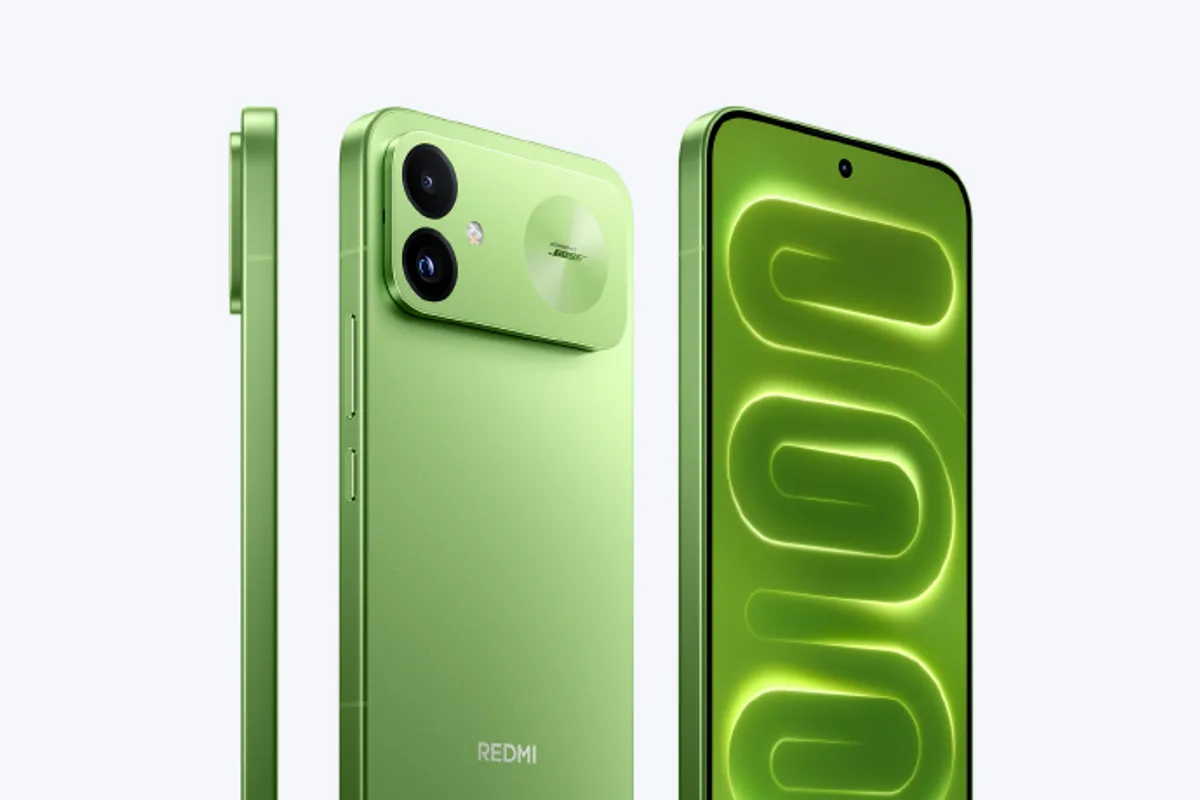
Official promotional images show a Sound by Bose label on the phone.
Redmi's communications describe stereo speakers tuned in association with the audio company.
That is relevant for a gaming-focused device.
Games often use positional audio cues to communicate movement, distance and events.
Well-designed stereo reproduction can make those cues easier to interpret.
However, an audio brand partnership does not independently establish excellent speaker performance.
Sound quality depends on driver dimensions, acoustic enclosure volume and signal processing.
Maximum volume, distortion, tonal balance and stereo separation will need independent assessment.
Thin smartphones face major physical constraints, particularly at low frequencies.
Even with careful tuning, their speakers cannot be evaluated as though they had the acoustic volume of larger standalone systems.
A design that avoids exaggerated gaming styling
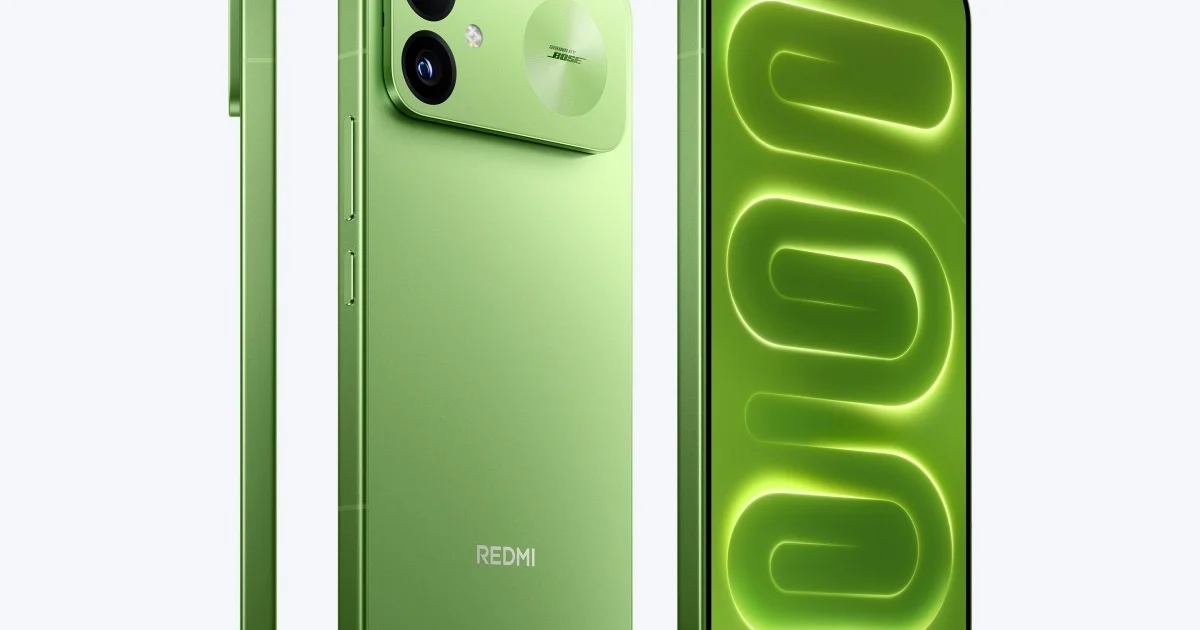
Redmi has shown the phone in a Firefly Green finish.
The handset features flat sides and a broad rectangular rear camera module.
Two rear camera lenses are visible in the promotional images.
Despite its gaming-related features, the overall design remains relatively restrained.
It does not rely on an elaborate collection of physical controls, external fans or conspicuous lighting elements.
That suggests a broader audience than highly specialized gaming phones.
The Redmi K100 may appeal to people who want strong gaming performance without a device that looks unusual during everyday use.
However, the practical balance will depend on dimensions, weight and ergonomics.
Those characteristics should be evaluated using a physical production unit.
A 50-megapixel main camera
Redmi has confirmed a 50-megapixel primary camera.
That specification indicates the company is not focusing exclusively on gaming.
However, pixel count provides only a partial picture of photographic capabilities.
Image quality also depends on sensor size, optics, stabilization and computational processing.
A high-resolution sensor does not automatically deliver superior low-light results.
Motion handling and HDR processing also contribute significantly.
The manufacturer has not yet provided enough information for a complete camera assessment.
Video capabilities and the performance of other cameras will need to be examined after the official presentation.
Geekbench cannot determine gaming performance by itself
The reported Geekbench 7 results primarily describe CPU performance.
They do not directly measure all of the phone's graphics capabilities.
Two devices using the same processor can behave differently because of their cooling designs and power limits.
In demanding games, GPU performance can become the principal constraint.
Resolution, graphical effects and the target frame rate strongly influence the workload.
Sustained behavior also matters.
Some smartphones gradually reduce clock speeds to maintain acceptable temperatures.
A CPU benchmark run under unknown conditions does not reveal how a phone handles that situation.
The reported 2,705 and 9,885 points are therefore useful indicators of a likely configuration.
They are not a verdict on cooling efficiency or the ability to sustain 165fps.
Can the Redmi K100 compete with newer smartphones?
The answer will depend heavily on pricing.
The Snapdragon 8 Elite remains a capable platform, but it belongs to an earlier chipset generation.
More expensive smartphones may offer newer processors with greater performance or improved efficiency.
The Redmi K100 combines its components differently.
Its 165Hz screen, 10,000mAh battery and auxiliary graphics processing could make sense for certain users.
Mobile gamers and people seeking long battery life are obvious potential audiences.
However, the economic value of this combination is not yet established.
Final Chinese pricing and any subsequent international variants will matter.
A phone with exceptional battery capacity may offer strong value at one price and be much less attractive if it approaches the cost of more fully equipped competitors.
International availability is uncertain
The announced presentation concerns China.
Xiaomi has not confirmed a French launch schedule for the standard Redmi K100.
The company has previously marketed related Redmi and Poco devices in different regions.
Some technology publications therefore speculate that the K100 could eventually appear internationally under Poco branding.
That remains unconfirmed.
Regional rebranding can also involve differences in configuration and pricing.
Specifications announced for China should not automatically be attributed to a hypothetical European model.
French buyers will need an official announcement before knowing availability, pricing and applicable warranty terms.
What to watch during the official presentation
The Redmi K100 launch should clarify several remaining questions.
Weight and dimensions will be especially important given the large battery capacity.
Charging details and compatible accessories will also deserve attention.
On the gaming side, Xiaomi may demonstrate features enabled by the D2 companion chip.
However, manufacturer demonstrations should be distinguished from results obtained through independent testing.
Cooling performance will be another major consideration.
A 165Hz display is most useful when compatible games can provide a consistently smooth experience.
Finally, official pricing will make it possible to assess the device against competing smartphones.
A promising hardware combination that still needs real-world testing
The Redmi K100 illustrates an interesting direction in performance-focused smartphones.
Rather than relying exclusively on the newest processor generation, it combines an established flagship chipset, an unusually large battery and a fast display supported by specialized graphics hardware.
The Geekbench 7 entry reported on October 26 provides preliminary evidence of a configuration matching that positioning.
It does not establish final performance or real-world battery life.
The Chinese presentation should reveal pricing, complete specifications and commercial arrangements.
The most important question will then be whether this combination delivers long, comfortable gaming sessions without excessive compromises in weight, heat or everyday usability.
A 10,000mAh battery is an impressive headline specification. Independent tests will show how much it actually changes the experience.