
 By Tsuky
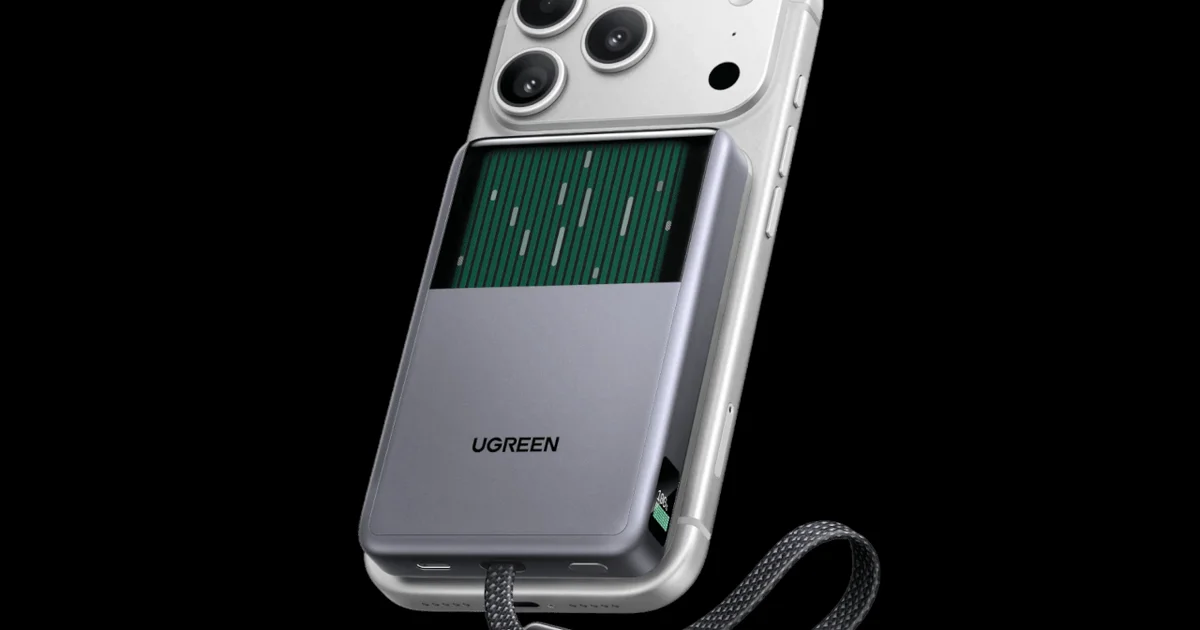
Most magnetic phone batteries are not especially interesting to look at. They attach to the back of a compatible smartphone, transfer power and gradually get warm. UGREEN decided to turn that last characteristic into an engineering project. Its MagFlow Pro power bank has a transparent panel showing coolant moving through narrow internal channels. A tiny pump circulates the liquid, while thermal components distribute heat away from areas involved in charging. It looks like a miniature liquid-cooled PC accessory attached to an iPhone. The design attracted attention when UGREEN introduced it at IFA 2026 in Berlin on September 4. The product has been available in several markets since then. On October 17, 9to5Mac's Michael Burkhardt published a new hands-on assessment, providing a useful opportunity to revisit the device as an everyday accessory rather than simply a trade-show curiosity. His observations reveal an appealing mixture of clever features and ordinary compromises. The coolant is visible. The integrated USB-C cable is useful. But the battery remains warm, feels relatively thick and lacks a built-in kickstand. At its $149.99 US list price, those trade-offs matter.
Wireless charging creates a genuine heat problem
The engineering justification for the MagFlow Pro begins with induction. Wireless charging transfers energy between coils without requiring a physical electrical connector between the phone and charger. The process is convenient, but some energy is lost rather than delivered to the receiving battery. Part of that loss becomes heat. The electronics, charging coil and battery cells can also warm up while the system operates. Magnetic charging adds another consideration: the power bank sits directly against the back of the smartphone. The two devices are therefore operating close together while both may generate heat. Excessive temperatures can trigger protective measures that reduce charging power. That can make a theoretically fast charger slower during prolonged use. The shift from 15W to 25W Qi2 charging increases the maximum advertised wireless power by roughly 67 percent. That does not translate into a 67 percent reduction in charging time. The receiving phone must support the higher power level, and its charging system will adjust output according to battery level, temperature and other conditions. But higher supported power does make thermal management more relevant. UGREEN's solution is to actively move coolant around the battery pack rather than relying solely on passive heat dissipation.
CryoPulse puts a micro-pump inside the case
UGREEN calls the cooling system CryoPulse. It combines a small liquid circuit with a micro-pump that moves coolant through internal channels. The design is supported by copper heat-spreading material and an arrangement that separates some charging components. UGREEN also uses a thermal-management system called ThermalGuard to adjust charging behavior. The intended result is better control of heat accumulation around components that can become warm during high-power wireless charging. The window on the back of the power bank makes the coolant visible. That is an unusual design decision. A user can see movement inside the accessory, giving it an appearance more commonly associated with custom desktop computers. Club386 observed the system directly at IFA, while the October 17 hands-on report from 9to5Mac highlighted the visible circulating fluid again. The presence of an operating pump is therefore more than an unsupported marketing illustration. However, the visible movement does not tell the user how much heat has been removed or how the system will perform after several years. Adding liquid channels and a mechanical pump also introduces components absent from simpler magnetic batteries. The design may offer better thermal performance, but its long-term reliability will need to be assessed through extended use.
The advertised temperature reduction needs careful interpretation
UGREEN claims the cooling system can reduce peak temperatures by approximately 10 degrees Celsius compared with a reference used in its testing. Its September announcement described peak temperatures up to 10 degrees below an industry reference of 48 degrees Celsius while charging an iPhone 17 Pro Max. International product material also advertises a reduction of up to 18 degrees Fahrenheit compared with conventional chargers. Those two differences are approximately equivalent. An 18-degree Fahrenheit temperature difference is about 10 degrees Celsius, not 18 degrees Celsius. More importantly, the figures do not establish that every iPhone attached to the MagFlow Pro will become 10 degrees cooler. The measured result depends on the location of the temperature sensor, the charging conditions, ambient temperature and the comparison device. The new hands-on report makes a useful practical observation. The MagFlow Pro still feels warm while operating. Its cooling system does not make it cold to the touch. The purpose is to manage heat rather than eliminate it. Independent controlled testing would be required to establish exactly how much better the system performs against conventional magnetic chargers using passive cooling. The presence of liquid cooling does not, by itself, prove a measurable improvement in phone battery longevity.
Qi2.2 delivers up to 25W wirelessly
The MagFlow Pro provides 10,000mAh of nominal battery capacity and supports Qi2.2 magnetic wireless charging at up to 25W. It is designed primarily for compatible iPhones and other supported devices. UGREEN claims an iPhone 17 Pro Max can reach 50 percent charge in approximately 40 minutes under its stated test conditions. Actual results will depend on the phone and environment. The maximum wireless output is not necessarily maintained throughout a complete charge. Phones generally reduce charging power as the battery fills or temperatures rise. That behavior is part of battery management rather than evidence that the accessory is defective. The liquid-cooling system is intended to help maintain favorable conditions during demanding charging sessions. However, without directly comparable tests, it is difficult to establish exactly how much additional charging speed comes from active cooling instead of the higher nominal power rating. Buyers should also verify the capabilities of their specific smartphones. Magnetic attachment alone does not guarantee support for the full 25W wireless output. Some phones may accept lower power or require particular compatibility conditions.
The integrated 45W USB-C cable may be the best feature
The most useful part of the accessory may be far less exciting than its cooling window. UGREEN has integrated a USB-C cable into the power bank. The cable supports wired charging at up to 45W and can double as a carrying loop. That eliminates the need to remember a separate charging cable for many everyday situations. It also makes the power bank useful with devices that do not support magnetic wireless charging. A second USB-C connection adds flexibility. The overall output is limited, however. The charging system cannot provide every individual port's maximum theoretical power simultaneously without regard to the total power budget. The Verge's product coverage describes a maximum combined output of 45W. That limit matters when charging several devices. Wired charging generally wastes less energy than comparable inductive charging, making it useful when maximizing the power bank's remaining capacity is more important than convenience. Burkhardt also highlighted the built-in cable as a genuinely useful feature in his October hands-on report. For many buyers, this may be the capability they appreciate most often. Liquid cooling looks sophisticated. Having the right cable attached when a phone is nearly empty solves a very familiar problem.
The 10,000mAh figure is not the energy delivered to a phone
UGREEN's advertised 10,000mAh capacity is typical of portable batteries designed to extend smartphone runtime. It is a useful amount of stored energy for travel or a long day away from a wall outlet. But it should not be interpreted as a guarantee of two complete charges for a phone with a 5,000mAh battery. The capacity refers to the cells inside the power bank. Energy must pass through conversion and control circuitry before reaching the receiving device. Those steps involve losses. Wireless charging introduces additional losses related to inductive transfer and alignment. The practical number of phone charges therefore depends on the specific handset and charging method. UGREEN supplies its own estimates for selected iPhones, but they reflect the manufacturer's stated testing conditions. The integrated USB-C cable offers a more efficient alternative when users want to maximize delivered energy. Liquid cooling may improve thermal behavior, but it does not eliminate the fundamental efficiency differences between wired and wireless power transfer.
The cooling system makes the battery bulkier
The MagFlow Pro has to accommodate more components than an ordinary power bank. Alongside the battery cells and charging circuitry, it contains the wireless charging assembly, liquid channels, pump and associated thermal-management hardware. That affects its physical design. The October 17 hands-on report describes it as relatively thick. UGREEN also lists a weight of approximately 230 grams in its international product material. Attaching that much additional weight to the back of a smartphone changes how the device feels in the hand. The battery may be convenient for charging, but the combined package is not particularly slim. Burkhardt also criticized the lack of a built-in kickstand. Some competing magnetic batteries can hold a phone upright while charging. That makes them useful for watching video, joining calls or following instructions on a screen. The MagFlow Pro does not provide the same convenience without an additional accessory. Physical fit is another consideration. The reviewer noted that the battery would extend below the body of an iPhone Duo based on the case dimensions he had examined. Magnetic compatibility therefore does not guarantee a tidy fit with every phone. For prospective buyers, dimensions and weight deserve as much attention as the headline wattage.
A liquid-cooling system is not essential for every user
UGREEN is addressing a real issue, but not every smartphone owner experiences that issue in the same way. Someone who uses a magnetic battery occasionally for a small top-up may see little benefit from a more complex cooling system. A simpler, lighter and less expensive pack could be sufficient. The argument for active thermal management becomes more compelling when users regularly rely on high-power wireless charging. Longer sessions and warmer environments can place greater demands on temperature control. A system that distributes heat effectively could help reduce some power throttling under those conditions. The important word is could. The MagFlow Pro's claimed benefits need standardized comparisons to determine their magnitude. The pump and liquid circuit also raise questions about durability that simpler passive solutions do not face in exactly the same way. UGREEN has produced an interesting technical design, but it has not made conventional magnetic power banks obsolete. The right choice depends on charging habits, environmental conditions and the value placed on size and simplicity.
At $149.99, the MagFlow Pro is a premium accessory
UGREEN lists the MagFlow Pro at $149.99 in the United States. The announced German recommended retail price is €119.99. Those figures are market-specific and should not be treated as universal prices. Discounts have also been available. In his October 17 report, Burkhardt noted an Amazon promotion bringing the US price down to approximately $95. That sale price may not remain available. The gap between the list price and promotional pricing makes a considerable difference to the product's value. At $150, buyers can choose among many established magnetic power banks, including models that are slimmer or offer built-in stands. The MagFlow Pro needs its cooling system and additional features to justify the premium. At a significantly discounted price, the combination becomes easier to recommend to people who regularly use Qi2 wireless charging. The integrated cable and informative side display add practical convenience. The cooling system provides a potential benefit that would be more persuasive with longer-term comparative measurements. Neither price nor technology alone determines whether the product is a good purchase.
A clever solution that still comes with ordinary trade-offs
The MagFlow Pro represents an interesting development in smartphone accessories. Portable batteries are increasingly adopting features that were previously associated with much larger devices: informative displays, advanced power management and now active liquid cooling. UGREEN has managed to package a visible coolant circuit into a magnetic battery that consumers can actually buy. That is a notable engineering achievement. The October hands-on assessment also demonstrates why technical novelty is not the same as everyday convenience. The unit still becomes warm. It remains relatively thick, adds noticeable weight and does not have a kickstand. Those compromises may matter more than a cooling specification during routine travel or commuting. Its strongest everyday qualities are straightforward: 10,000mAh of nominal capacity, Qi2.2 charging at up to 25W, an integrated USB-C cable and a display showing charging information. CryoPulse is the feature that makes the product distinctive. Whether it makes the MagFlow Pro a better purchase than a conventional battery depends on how much a user benefits from improved thermal control and whether independent testing confirms meaningful advantages. For now, UGREEN has produced a useful accessory with an unusually elaborate way of managing heat. The more important question is not whether the coolant looks impressive. It is whether the system helps users charge their phones more consistently, comfortably and efficiently when they actually need it.